Losing while winning

Israel just released its own version of a national intelligence estimate, it is a post-mortem of last year’s war with Hezbollah. First the good news:

It is clear that Hizbollah’s balance statement at the end of the fighting was mixed. Politically, despite its efforts to portray the campaign as a “divine victory,” the organization incurred severe criticism at home. Furthermore, much of its military infrastructure was damaged. Its system of underground tunnels in the border area was exposed and in part destroyed. The organization’s array of defensive outposts on the border and its grip on the area were almost completely eradicated. A large portion of its medium range rocket system (Fadjr rockets and 220 mm and 320 mm rockets) was also destroyed. Above all, the Dahiya quarter in Beirut, the organization’s organizational, military, and political nerve center, was razed. As if that were not enough, Hizbollah’s mass of supporters, most of whom are concentrated in southern Lebanon, suffered heavy losses in property and personnel. It is likely that elements in the Iranian leadership also criticized Hizbollah once it was dragged into a premature violent confrontation with Israel that exposed its strategic capabilities, particularly with regard to rocket launches deep into Israel.

This seems largely consistent with what Gen Yaacov Amidror wrote at the beginning of this year.

* Hizballah casualties were not less than 500 and may have reached 700 – a figure greater than all the casualties Hizballah has suffered during the last twenty years. It will take Hizballah at least two years to rebuild its capabilities and to recruit and train new people.* Israel also developed a system which made Hizballah’s long-range rocket launchers good for one use only. Within less than five minutes of launch they were destroyed by Israel’s air force, an unprecedented achievement in modern warfare.

* The determination of Israel’s government to respond and to retaliate is a very important factor in restoring deterrence. Now those around Israel understand that Israel has certain red lines, and that if these lines are crossed, Israel’s retaliation will be intentionally disproportionate. As a small country, we cannot allow ourselves the luxury of reacting proportionally.

* Middle East leaders understand that Israel is prepared to use military force, and that in the future we are not going to be as tolerant of attempts to act against us.

* Nasrallah said at the beginning of the war that there would be no international forces and no Lebanese army in south Lebanon. The entry of these forces is, from the Israeli point of view, the greatest success of the war.

* What is the real mood of the Israeli people after the war? It is that we are not suckers and we are not going to make the same mistake again. We are not going to put ourselves in danger if it is not necessary. We unilaterally retreated from Lebanon and didn’t retaliate for six years, and in the end we found Hizballah in a stronger position to fight against us. When Israel retreated from Gaza what was the result? More Kassam rockets on Sderot and Ashkelon.

(The last two items are clearly disputable at this point, though.)
Meryl Yourish emphasized the positive aspects of the report.

It’s good to read some hopeful news for a change. But the next year or two is fraught with potential existential threats for Israel. It would be much better to see some of the dictatorships in the region replaced with democracies. Too bad that won’t happen in my lifetime.

However, there is a “however” in the report.

On the other hand, the organization can claim success for its operational doctrine. Its forces inflicted many losses on the IDF in local combat, and above all, Hizbollah never ceased its bombardment of the Israeli home front, even in the face of massive air activity. The organization’s logistical forecasts also proved correct, given its success in preserving a large inventory of ammunition, thereby enabling Hizbollah soldiers to hit Israel with large numbers of rockets during every stage of the fighting (an average of 150-200 rockets per day were fired). From the organization’s perspective, these actions both brought about an end to the fighting and severely shook the “Zionist entity.” From this vantage, the operational balance was positive.

Noah Pollak emphasizes the negative and adds some points of his own.

First, the report misses one of the central, and most successful, pillars of Hizballah’s strategy, which was to use civilian casualties in Lebanon and the sensational media images resulting from them as a means of undermining the Israeli war effort. And second, Israeli strategists must think about a rather unconventional way to respond to Hizballah in the next outbreak of hostilities, which is to bypass fighting in Lebanon and go directly to Hizballah’s local source of weaponry, money, and support: Syria.

There is little doubt that Israel scored was successful in degrading Hezbollah’s offensive capabilities last summer. However it failed to strike a knockout blow against the organization. If Pollak is correct, then the next time a threat from Hezbollah appears imminent, Israel must strike, not at the puppet, but at its masters in Iran and Syria.

Crossposted at Soccer Dad.

Posted in Iran, Israel, Syria | 1 Comment

Fish tales at the PA aid conference

blair_small_fish.jpg

“It was a small fish, actually, rather like a guppy.”

fayyad_medium_fish.jpg

“No, no, Habibi Blair, it was more like a bluegill.”

kouchner_steinmeier_biggest_fishes.jpg

“Ha, Monsieur Fayyad, it must have been a bass.”
“Herr Kouchner, I must disagree it was more like a salmon.”

Well the world just met to decide what amount ought to be given to the PA in order to keep it functioning. (Funny, but there was never any question whether it was a good idea to keep the PA as permanent mendicants to the international community. As Elder of Ziyon trenchantly observes, past history shows that the aid is conditioning, not conditional.)

The New York Times includes these two precious paragraphs in its report.

In a move significant both practically and symbolically, the Saudis pledged $500 million over three years.Many countries do not fulfill pledges that they make at such conferences. Egypt and other Arab countries are known for pledging funds to the Palestinian Authority that they do not deliver.

Last I checked Saudi Arabia was an Arab country. So if it behaves the way “other Arab countries” do, we can assume that the Saudi pledge was significant only symbolically.

The Washngton Post manages to pin the blame on Israel.

Events that followed the Nov. 27 Annapolis conference contributed to Palestinian resentment here and in the territories leading up to the Paris meeting. A week after both sides pledged to adhere to the U.S.-backed “road map” for peace — a plan launched in 2003 that calls for Israel to stop settlement activities and for Palestinians to disarm militant groups and boost security — Israel announced the construction of more than 300 homes on occupied land on the outskirts of Jerusalem.”I’ll be eager to implement all our commitments under the road map, and I expect the Israeli side to do the same, comprehensively, and without excuses from our side or theirs,” Palestinian Authority President Mahmoud Abbas told the delegates. “I expect them to stop all settlement activities, without exceptions.”

In the meantime the article reports that American aid will go to Gaza from where the Qassams are being fired into “non-occupied” Israe. Apparently having its innocent victims targeted is not cause for as much “resentment” as is building apartments.

Infidel Bloggers Alliance finds
another reason to blame Israel.

I’m sorry, but how do roadblocks cause the Palestinians to lose their money? Is everything the Jews fault? I don’t get it.

According to the POMED Wire, the answer is “yes.”. (Professor Noah Feldman of NYU is on the advisory board of this group. Given that they don’t seem to hold the Palestinians accountable, they appear more interested in fostering dependency, corruption and terror than democracy.)

Boker Tov Boulder summarizes things nicely

I’m so stunned. How could this be, that Israel is out of luck, the “donors” are out $7.4 billion, and the Palestinians take all? They win everything? They don’t have to risk anything, contribute anything, or pay anything back? They just repeat the same old promises that they’ve already broken, pocket the $7.4 billion, make more demands, and continue to attack our children? Just like that?And how did they manage to get 32% more than they said they wanted?

YidWithLid again links to a chart showing a correlation between increased aid and increased terror.

blair_laughs.jpg

“I love fish jokes. I hope they tell another one just for the halibut.”

Crossposted at Soccer Dad.

Posted in Israel | Comments Off on Fish tales at the PA aid conference

Palestinians get a free pass to more billions

Once again, the world has shown that the Palestinians need not uphold a single portion of their end of the Road Map, or any other agreement, for the world to fawn at their feet. The sum total of Palestinian Pledge Week: $7.4 billion dollars for the next three years. And what do they have to do for it?

Promise to be better.

What is Israel supposed to do? Why put her people at risk for the sake of the Palestinian economy. No, really.

World leaders at the conference urged Israel to ease limits on Palestinian movement in the West Bank and Gaza Strip, following up on a warning from the World Bank that without an easing of the sweeping physical and administrative restrictions donors may be wasting their money.

Oh, and Israel is also supposed to stop building houses for Israelis if the Palestinians deem them to be on Palestinian property. Never mind that no agreement regarding the borders of the Palestinian state has been reached, let alone hammered out. It’s Israel’s fault that the Palestinians are suffering. Because Israel shouldn’t be building the fence and manning the checkpoints that stopped the wave of suicide bombings that were coming sometimes two and three per day in the bloody, bloody spring of 2002.

I have not forgotten that spring. Neither have the Israelis. The world, however, has. And certainly the AP has no sense of history.

Israel has been reluctant to lift scores of roadblocks in the West Bank, many of them put there by the Israeli military amid the street violence and suicide bombings by Palestinian militants that followed collapse of the last peace talks seven years ago.

The restrictions have left the Palestinian economy, always dependent on international help, in much worse shape since then.

You see? It isn’t the suicide bombings that caused the problem. It’s the checkpoints that were put into place to stop the bombings.

Say, let’s take a look at the donors. Because you know, those Arab and Muslim nations—the ones who talk incessantly about their Palestinian “brothers” and who are the first to offer weapons and money for weapons, what are they pledging?

United States: $555 million for 2008, though about $400 million has not been approved by Congress.

Arab League members: $1.3 billion over three years, including $500 million from Saudi Arabia and $300 million each from United Arab Emirates and Kuwait.

European countries: more than $3 billion, including $650 million from the European Union alone in 2008, probably similar levels for 2009 and 2010.

Key European donors include Britain, $500 million for three years, pledged with conditions; Norway, $420 million over three years; Spain, $360 million over three years; France and Sweden, $300 million each over three years; and Germany, $290 million over three years.

Wow. Saudi Arabia pledged $500 million dollars over the next three years. That’s really generous from the state that produces 10 million barrels of oil per day, especially when oil is going for more than $90 a barrel. Wow, that’s more than half a day’s oil production pledged over the next three years! Holy cow, those Saudis couldn’t be more generous! And Kuwait too, gee!

The Saudi largesse towards their Palestinian brothers speaks volumes about how much they really care about helping the Palestinian economy. Probably about as much as they care about women’s rights in Saudi Arabia.

Posted in palestinian politics, World | 2 Comments

Beilin the oxymoron

Four years ago Thomas Friedman described outgoing Meretz chairman Yossi Beilin as a fanatical moderate:

What I have always admired about Mr. Beilin is that he is a fanatical moderate — as committed to his moderation as the extremists are to their extremism. In a Middle East where extremists tend to go all the way and moderates tend just to go away, the example that he and his Palestinian partners are setting is critical. It shows that civil society in Israel and the West Bank is still alive and refuses to give in to pessimism. But they need, and deserve, courage and help from America now too.

The subject at hand was the Geneva Accord. It was about Beilin, then out of government, freelancing in diplomacy in order to undermine the political standing of the elected government of Israel.

Now Dr. Beilin is moving on a again. He’s leaving the Meretz party and Ha’aretz has pulled out a new oxymoron.

There is probably no one else in Israeli politics like Yossi Beilin – a brave weakling, a leader who never swayed the enthusiastic masses, and yet who still managed to carry away the center of the political map and get it to adopt his political path.

Although Ha’aretz meant that last part in a complimentary fashion, I see it as his condemnation. Who remembers 14 years ago? In 1993 Beilin was way ahead of the curve. He was pushing for a two state solution when even PM Rabin wasn’t. Who would have believed then that what was extreme leftism would become mainstream centrism of 2007?

Beilin has accomplished a lot. But instead of going to the people he’s worked behind the scenes to bring his ideas to fruition. He was almost certainly in contact with the then outlawed PLO in 1992 in a successful attempt to bring down the Shamir government and bring Labor to power. That assured that the Oslo Accords would come to be.

He was in Baltimore in 1996 speaking at Baltimore Hebrew University. Despite his controversial nature, the hosts made sure that he would only take pre-screened questions. (Given that the man is known as an intellectual, it was astonishing that he was too intellectually timid to take unscreened questions from the crowd.) When someone spoke out of turn and asked about Palestinian violations of Oslo he minimized them and emphasized Israeli “violations.” The Palestinian violations, though, went to the heart of the agreement. The Israeli ones were, at worst, procedural. (But even then he wasn’t as extreme as his hosts who were members of APN.)

The Geneva Accord was a somewhat less successful attempt to subvert the government of Israel. But it still put the Sharon government on the diplomatic defensive. Never mind that Beilin couldn’t scrounge up enough votes to stay in power.

Instead of making his case to Israelis. He made it to Europe, to the media, to the diplomatic corps and most damaging of all to the Palestinians.

Yossi Beilin is a very smart man. And he’s accomplished a lot. But he’s done it by evading the rules that govern individuals. He considers himself and his causes to be above the law. He has caused incalculable harm to Israel’s security and image in doing so. But that has never stopped him. Nor has he been stopped by his lack of popularity.

So if you need an oxymoron to describe Yossi Beilin how about an “anti-democratic democrat.” Democracy to Beilin is nicety that need not be observed by those who, like him, know better.

Crossposted on Soccer Dad.

Posted in Israel | 3 Comments

Haveil Havalim #145 is UP!

Well Haveil Havalim #145 is UP!

Given that it’s the 3rd anniversary edition you might be interested in some past milestones.

Here’s what the 1st edition looked like.
Here’s the 1st anniversary edition.
Here’s the second anniversary edition

The categories this time include

Channukah
Politics
Israel
Judaism
History
Torah
Humor
Misc
Media

And it features posts on:

The inquisition in the new world

Reporting from enemy territory

Returning to Shechem

Perspectives on Channukah

Criticizing Tutu

Another work accident

and much, much more.

Posted in Israel, Jews, Linkfests | Comments Off on Haveil Havalim #145 is UP!

Tel-Aviv Tech

Judy Siegel-Itzkovich reports:

Tel Aviv University has hit the jackpot, with three of its scientists included in the list of 50 of the world’s leading innovators in the coming issue of one of the world’s leading science magazines, Scientific American.Prof. Eshel Ben-Jacob of TAU’s faculty of exact sciences and his research assistant Dr. Itay Baruchi were chosen for their innovative work in brain research and their success in creating a memory- and information-processing neurochip made of living neurons. Ben-Jacob told The Jerusalem Post he was very happy his and Baruchi’s work was being recognized, especially since when he first sent an article on it for publication to the prestigious journal Nature along with recommendations from three Nobel Prize laureates, it was rejected on the grounds of “not being of general interest.” However, last spring, it was published in the American Physical Society’s journal Physical Review.

Prof. Beka Solomon was selected for the development of a novel therapeutic approach in the form of an experimental nasal spray for treatment of Alzheimer’s disease, based on friendly bacterial viruses that are able to overcome the drawbacks of other ongoing approaches.

Israelis have been making the list for the past few years.

This is the sixth year that the journal’s board of editors has selected the 50 top innovators. No other Israelis were included in the 2008 list, and only two Israelis were previously on the list; they were Dr. Shulamit Levenberg of the Technion (2006), Prof. Ehud Shapira of the Weizmann Institute of Science (2006) and Prof. Micha Asher of the Hebrew University (2004).

Science might still take a back seat to Israel hatred and politics.

The Israeli edition of Scientific American, produced by ORT-Israel, is due to publish the list in February, but it isn’t known whether the Arabic version published in Kuwait will choose to omit the Israeli achievement.

Crossposted on Soccer Dad.

Posted in Israel, Israel Derangement Syndrome | 2 Comments

The Israeli Intelligence Estimate: No war on the horizon, yet

The Israeli Intelligence Estimate is being previewed by Ynet. Some of the more interesting tidbits:

Israel’s strategic position has improved in the last year- but with it also the military capabilities of its enemies: the Qassam threat has worsened- and a potential hudna will only serve Hamas; Syria is waiting to “get even” but is not expected to start a war; Iran is likely to procure a nuclear bomb by 2009 and the American NIE leaves Israel almost completely alone in the campaign to stop the Persian menace. Ynet reveals the highlights of the Israeli Intelligence Estimate

That’s the overall view, but here’s some very interesting data on the Lebanon War:

The second reason for Israel’s improved capacity for deterrence: Iran, Syria, and Hizbullah have analyzed the results of the Lebanon war and agreed that launching a projectile offensive against the Israeli home front will harm them and their interests more than they will harm Israel.

Iran, for example was surprised by Israel’s ability to wipe out Hizbullah’s entire long-range rocket arsenal in less than an hour, long before the organization could launch even a single ‘Zilzal.’ Furthermore – in a development published here for the first time – the Israeli Air Force was able, with the support of ground forces, to destroy all of Hizbullah’s medium-range rocket launchers (220mm and 306mm) after they were used once or twice.

Tehran had, in the past, provided Hizbullah with an array of heavy rockets, to be used against Israel should Iran’s nuclear facilities be struck. The near-total destruction of this launching system in the wake of the “local provocation” which Nasrallah initiated in July 2006, stirred a great anger in Iran as well as a reevaluation of its relations with Hizbullah.

That’s very good news. And the deterrence capability was only strengthened by Israel’s raid on the Syrian Mystery Plant (a.k.a. North Korean nuke factory). Apparently, Hezballah is now allowed out only with Iranian Guard supervision:

In the end Iran, along with Syria, agreed to replenish and expand the rocket array in Lebanon – but Hizbullah would henceforth have to receive explicit permission from Iran before firing a single rocket. Representatives of the Iranian Revolutionary Guard in Lebanon have now been charged with supervising the execution of these orders.

Tehran, it is believed in Israel, will only grant this permission if they believe it will serve Iran’s strategic interests – highly unlikely in the next year or two.

There’s a but. Go read the whole thing.

Meanwhile, the Syrians have registered the extent of damage Israel sowed in the Shiite Dahiyeh neighborhood of Beirut and on the Lebanese road system during the war and have come to the conclusion that their national infrastructure would likely suffer irreversible damage should they instigate a war with Israel before obtaining a more reliable anti-aircraft defense system.

However, they’re pissed off, big-time, over the loss of the Mystery Plant. It’s that Arab pride thing. Really. The whole culture needs to go home and grow a little.

The third most serious threat, the report says, is Hamas in Gaza. It is the least critical from a strategic point of view and does not necessarily pose an existential threat. However, the intelligence ranks urged Israel to deal with it as soon as possible as – opposed to the other, hypothetical, threats – it is already wreaking havoc on the lives of Israelis in the south.

The rocket threat from Gaza will only grow next year, the officals say, as terror groups work to improve the range and shelf-life of their arsenal.

Yeah, we’ve been writing about that one for a while now.

It’s good to read some hopeful news for a change. But the next year or two is fraught with potential existential threats for Israel. It would be much better to see some of the dictatorships in the region replaced with democracies. Too bad that won’t happen in my lifetime.

Posted in Hamas, Israel, Lebanon, Syria | Comments Off on The Israeli Intelligence Estimate: No war on the horizon, yet

Crude, homemade rockets score three hits in one week

The “crude, homemade rockets” launched by Palestinian terrorists from Gaza nearly every day have wounded three Israelis in three separate incidents this week, including one today that wounded a two-year-old child.

A rocket fired by Palestinian terror groups from northern Gaza landed in the yard of a kibbutz home on Sunday afternoon, wounded a two-year-old boy. Israeli police and paramedics said the infant sustained light shrapnel wounds and was evacuated to the Barzilai hospital in Ashkelon for treatment.

Medics also treated the infant’s mother for shock.

Police spokesman Micky Rosenfeld said the rocket scored a direct hit on a house in Kibbutz Zikim, an Israeli communal farm. Initial reports said the rocket hit inside the nearby Zikim military base, where a direct rocket hit in September wounded more than 40 soldiers.

There is only one conclusion from three hits in one week: The rockets are getting better. The war against Israel is gearing up. But that’s not going to stop the world from insisting that Israel put even more of her citizens at risk by easing up on checkpoints that prevent the West Bank from becoming a suicide bombers’ haven.

The Palestinian economy can only recover if Israel eases restrictions on Palestinian movement, the World Bank says, but a reluctant Israel, putting its security first, has given no guarantees.

[…] Among those making a pitch will be U.S. Secretary of State Condoleezza Rice and international Mideast envoy Tony Blair, the former British prime minister.

The donors say they are aware of the stakes and are urging Israel to be more flexible. “The political pressure exists, it is being exerted by the Europeans and the Americans,” said Christiane Hohmann, spokeswoman for EU External Relations Commissioner Benita Ferrero-Waldner.

However, so far only Britain has said it will link disbursement to improved conditions on the ground, including an easing of Israeli restrictions and Palestinian government reform.

Do you see the incredible amount of utter insanity here? The World Bank and donor nations will not ask the Palestinians to do anything to improve Israeli security, or even to improve their own financial accountability, but they are trying to force Israel to remove checkpoints because the Palestinians need to be able to move more freely in order not to steal the billions of dollars they are given. Really, it makes me wonder what kind of blackmail material the Palestinians have on European leaders. Truly, this is an ass-backwards deal.

And just in case you were wondering, no, the oil-rich Arab nations are not picking up the slack. In fact, the EU is the major donor to Palestinian corruption, thuggery, and terrorism.

Europe is the biggest donor to the Palestinians, providing some $1.4 billion in support in 2007, according to officials in the European Commission.

In 2002, Arab countries had promised to give the Palestinians $55 million a month, but have not disbursed the full amount pledged.

And now they’re going to get another $5.6 billion. From Europe and America. Because it’s not like they’re going to blow it this time, right?

I swear, the inmates are running the asylum.

Posted in Israel, palestinian politics, World | 2 Comments

Hamas to Israel: It’s Jihad time

The Reuters coverage of the Hamas rally is different from the AP coverage in several ways. Reuters uses the Hamas crowd estimate (insert eyeroll here), and puts in far more harsh quotes than the AP editors. The lede also more accurately describes the tone of the rally.

Hamas threatened to launch a new uprising against Israel on Saturday when hundreds of thousands of Islamist supporters rallied in Gaza City to mark the group’s 20th anniversary.

“Our people are capable of launching a third and a fourth intifada until the dawn of victory rises up,” said Khaled Meshaal, the group’s exiled leader, in a speech recorded on Friday at his base in Damascus.

The central square in Gaza City was awash with green flags and dozens of armed, masked men from the group’s military wing patrolled in a crowd estimated at between 300,000 and 500,000.

Hamas leader in Gaza, Ismail Haniyeh, said the movement was growing more popular because of its stance against the United States and Israel.

“Today is the day of Jihad, resistance and uprising,” Haniyeh said.

Time to give Reuters points for passing along the true message of the Hamas gathering. And for using the language that should be used—Hamas did threaten Israel yesterday, and the quote on jihad should be front and center. It is a religious war for Hamas, and is stated as such in the Hamas charter, which Reuters actually acknowledges.

Founded in 1987 by Sheikh Ahmed Yassin, who was killed by Israel in a 2004 air strike, the group has a charter that calls for the elimination of the Jewish state.

Compare that to this description of Hamas from AP:

Hamas was founded in Gaza in December 1987, after the outbreak of the first Palestinian uprising against Israeli occupation. It is an offshoot of the Muslim Brotherhood, which was founded in Egypt and is seen as the mother of all fundamentalist factions in the Arab Sunni world.

Reuters also includes the money quotes:

“We will never cede our land … The choice of resistance and Jihad is the shortest way to liberate Palestine and return Jerusalem,” Haniyeh said.

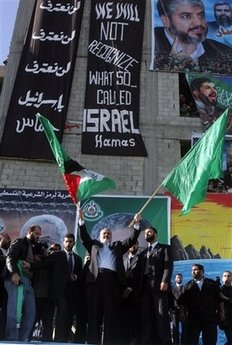
Of course, I’m sure they used “al-Quds” instead of Jerusalem. And it’s true what they say: A picture is worth a thousand words.

Hamas will never recognize Israel

There is no talking to Hamas. You can only defeat this enemy, not talk to it.

Posted in Israel | 8 Comments

Hamas to Israel: We will destroy you

Hamas celebrated its twentieth anniversary by assuring Israel that Hamas will never, ever recognize the Jewish State, and also, Hamas will never stop trying to destroy it.

Large pictures of Hamas leaders, both in Gaza and in exile, were draped across the speakers’ podium. A black banner hanging from a nearby building read, in Arabic, English and French: “We will not recognize Israel.”

In the crowd were dozens of members of the Hamas military wing, among them armed men carrying replicas of home-made Qassam rockets. Some 50 female members of military wing also marched, dressed in long robes and sporting military-style ammunition vests. Some covered their faces with veils, others with ski masks. Several took to the stage, waving green Hamas flags.

In an anniversary message to Hamas TV, the group’s top leader in exile, Khaled Mashaal, said Hamas will not abandon violence. “This is our real choice, our trump card, which causes the enemy to succumb to us,” he said.

He said moderate Palestinian President Mahmoud Abbas, who controls the West Bank, does not have the mandate to negotiate with Israel. “Our people are able to launch a third and fourth uprising until the dawn of victory arrives,” he warned.

Please note that Hamas says, over and over again, that they will never recognize Israel, that they are actively working to destroy Israel and replace her with an Islamic state, and yet, people still think that Israel should talk to Hamas. Because Hamas would offer a ten-year truce, you see. And a truce is better than nothing, right?

Wrong. They want the truce to arm themselves without opposition, so they can then come after Israel with stronger, more deadly weapons and explosives.

By the way, anyone want to take a guess where in the story the information quoted above started?

It’s in the sixth paragraph. One paragraph below the longest of your local paper’s “World News” section, which generally takes 2-5 paragraphs of the AP world stories. These are the first five grafs, the ones that make it into the largest number of newspapers:

Hamas marked the 20th anniversary of its founding with a huge rally Saturday, sending a message of strength and defiance even as it is struggling to keep Gaza the Strip from sinking deeper into poverty.

Tens of thousands of Hamas supporters gathered in a sandy lot and nearby streets, waving green Islamic flags. The crowd appeared to be at least equal in size to a march last month in support of Hamas’ rival, Fatah. That rally drew 250,000 in a major challenge to Hamas.

A large turnout Saturday was seen as critical for the increasingly embattled Hamas, which seized control of Gaza by force in June. Since then, the coastal strip has been virtually cut off from the world, with Israel and Egypt sharply restricting access, and 1.5 million Gazans have been driven deeper into poverty.

“This is the real referendum on the popularity of resistance, the people converging behind Hamas,” said Zayed Herzallah, a 28-year old merchant, who brought a van full of young relatives.

Hamas was founded in Gaza in December 1987, after the outbreak of the first Palestinian uprising against Israeli occupation. It is an offshoot of the Muslim Brotherhood, which was founded in Egypt and is seen as the mother of all fundamentalist factions in the Arab Sunni world.

Do you see a difference in tone and content? In the lede, which will be in the majority of newspapers, Hamas is seen as the romantic, “defiant” resistance organization. The popular organization that “resists” Israeli occupation. The fact that Hamas is a terrorist group, and that “resistance” includes suicide bombings, gunning down civilians, murdering children, and sending rockets into schoolyards doesn’t appear at all. The fact that Hamas has murdered and wounded thousands of Israeli civilians since its founding is not mentioned at all. This is a puff piece on the Palestinian “resistance” movement—as if “resistance” is a legitimate struggle, just as the Palestinians have designated it. Their PR effort has paid off handsomely, as the world media continues to put murdering tyrants in the softest possible light while demonizing all Israeli reactions to the thugs.

Next up: The Reuters take on the same rally.

Posted in AP Media Bias, Hamas | 4 Comments

The very last Hanukkah menorah of the season

I know it’s after the holiday, but I found a new menorah picture that I thought you’d get a kick out of.

The Republican Debate Menorah

Posted in Holidays, Humor, Politics | 2 Comments

Syria and Iran: 2gether 4ever

Syria and Iran are going to stay bestest buddies like, forever!

Syrian President Bashar Assad rejected claims that Syria’s alliance with Iran had been weakened by Damascus’ participation in last month’s US-sponsored Mideast peace conference, saying Thursday that the two countries’ ties will never be shaken.

Assad made the comments as he inaugurated two joint Syrian-Iranian industrial projects – factories for cars and cement. He was joined at the ceremonies by the Iranian industry and housing ministers.

What? You mean getting a Syrian representative at Annapolis was all for naught?

The November conference in Annapolis, Maryland, which relaunched Israeli-Palestinian peace negotiations, was widely seen as also aimed at isolating Iran by bringing together Arab nations. US officials have expressed hopes that Syria’s attendance would mark a start to easing it out of its alliance with Teheran.

Iranian President Mahmoud Ahmadinejad and other top officials denounced the conference, and some officials expressed surprise over Syria’s participation – though none directly criticized it.

It’s a love story made in hell. And cash money.

“I confirm, on this occasion, that relations will not be shaken for any reason or under any circumstance,” Assad said at the factory in Hasya, some 160 kilometers north of the Syrian capital, Damascus. according to the official SANA news agency.

Syria and Iran have growing economic ties, with the annual two-way trade estimated at about US$200 million. The size of Iranian investments in Syria has reached around US$2 billions in sectors such as power generation, automobiles, cement and agriculture.

Syria is Iran’s closest Arab ally. The two countries have had close relations since 1980 when Syria sided with Persian Iran against Iraq in the 1980-88 Iran-Iraq war.

I just love hearing the “experts” talk about how Syria is going to be drawn away from the Iranian influence. Not in this lifetime, bubelah. Syria is Iran’s backup in Lebanon and Gaza. Iranian influence on Syria threatens Israel’s existence. Iranian arms, missiles, and munitions dot the landscape of Syria, Lebanon, and Gaza. The Iranian proxy war against Israel continues, using Syrian influence in the region. Bashar al-Assad learned very hard lessons from his mass-murdering father Hafaz (let’s not forget Hama, the town that was razed to the ground, and the thousands slaughtered there). He knows that without a common enemy, his people will remember that he’s the real reason they live in misery.

Posted in Iran, Syria | 2 Comments

Hamas to Iran and Syria: Let us kill more Jews

Hamas is asking its Iranian masters for permission to kill more Jews.

Hamas has asked Iran to allow the organization to escalate its altercations with Israel, carry out more suicide attacks and if need be – threaten kidnapped IDF soldier Gilad Shalit with execution, Kuwait’s Al-Jarida newspaper reported Friday.

The report, citing senior Hamas officials, Hamas politburo chief Khaled Mashaal recently met with a senior Iranian intelligence official, who accompanied Iranian President Mahmoud Ahmadinejad on his visit to Qatar last week.

The two reportedly discussed Hamas’ retaliation to a possible large-scale IDF operation in Gaza, which may leave Hamas debilitated.

Mashaal, said the report, told the Iranians Hamas will need their political support, as well as Iran and Syria’s go-ahead to carry out a series of major attacks on Israel.

Oh, and Hamas wants permission to carry out more war crimes.

Al-Jarida further reported that Mashaal told the Iranians Hamas wants to kidnap more Israeli soldiers, as well as threaten Gilad Shalit’s well-being in order to “stir Israeli public opinion, pressure Prime Minister Ehud Olmert and hinder the Israeli-Palestinian peace process.”

Once again, let me point out, that a substantial number of politicians in the EU and UN think that Israel should deal with Hamas as a negotiating partner.

The wages of Annapolis just keep on paying off. Let’s be thankful that the Israeli security forces are as good as they are. But remember, they can’t stop 100% of the attacks. Hamas would absolutely love to see the pressure against Israeli checkpoints pay off. That would make this job a whole lot easier.

Posted in Hamas, Syria | 3 Comments

The anti-checkpoint juggernaut revs up

The post-Annapolis crush toward forcing Israel to lift checkpoints is leading the charge (and the USA Today webbot can’t spell “Israel”).

The Palestinian prime minister said he failed to win assurances from Israel’s defense minister Thursday that he’ll ease stifling restrictions on Palestinian movement — a measure seen as key to the success of an ambitious international effort to revive the Palestinian economy.

The World Bank warned that unless Israel removes some of the physical and administrative obstacles to Palestinian travel and trade, donor countries asked to pledge $5.6 billion at a conference in Paris next week may be wasting their money.

Even if the donors pay the full amount, the Palestinian economy would keep shrinking by about 2% a year as long as the Israeli restrictions remain in place, the World Bank wrote in a report Thursday.

Israel’s military has been reluctant to remove some of the hundreds of roadblocks and barriers in the West Bank, saying they’re an effective tool against Palestinian militants, and that the Palestinian government does not have sufficient control over the territory to prevent attacks on Israelis.

The issue of roadblocks was raised Thursday in a meeting between international Mideast envoy Tony Blair, Palestinian Prime Minister Salam Fayyad and Israeli Defense Minister Ehud Barak. Asked whether he won any Israeli guarantees of easing restrictions, Fayyad said: “It’s a one-word answer — no.”

That’s because of a one-word problem: Terrorism. Stop the murders, and I’m sure Israel would be more than happy to lift checkpoints and let the boys in the IDF go home. Not that the problem of Israelis being murdered makes anyone outside of Israel (and the Jewish community) lose any sleep. Certainly not Tony Blair.

However, Blair’s presence made it clear that the international community has a “huge stake in all of this,” Fayyad said.

“Donors are being asked to fund the Palestinian Authority whose funding needs are at least in part caused by these (Israeli) restrictions,” he said. “Clearly, the trade- off is there for everyone to see.”

Definitely not the AP writers and editors.

In violence Thursday, a rocket fired by Gaza militants hit a house in the Israeli border town of Sderot and seriously injured an Israeli woman. The rocket smashed through the roof, and Israeli TV showed medics carrying a woman out of the house on a stretcher.

Palestinian militants fire crude rockets almost daily at southern Israeli border communities, but the inaccurate projectiles rarely cause casualties or damage. However, they disrupt daily life there, and Israel has been indicating strongly that it will launch a large-scale ground attack in Gaza to try to stop the barrages.

See? A woman was seriously injured today, and a woman was lightly injured two days ago, but the rockets “rarely cause casualties or damage.” The fact that they’ve done so two days this week means—nothing.

The incoming U.N. Mideast envoy, Robert Serry, denounced the rocket attack in unusually strong terms. “Let me be clear about this: We consider that to be terrorist acts,” he said.

I’ll believe that means something when I see more than words.

Ahead of Monday’s pledging conference, Israel was coming under heavy pressure to show flexibility on the restrictions issue.

Gordon Brown is supposedly putting restrictions on the British pledge of half a billion dollars in aid.

British Prime Minister Gordon Brown has said he would link an aid package of $500 million to improved security in the region, progress in peace talks, and an easing of Israeli restrictions.

Britain has lobbied Israel to ease restrictions and pressed for the removal of barriers to travel within the West Bank. “The aid is dependent on the conditions the prime minister set out,” a British Foreign Office spokesman said on customary condition of anonymity in line with policy.

Britain is the only country to raise such a condition ahead of the Paris conference, said a diplomat in Paris, who requested anonymity because he was not authorized to speak publicly on the matter.

Yeah, we’ll see how long that lasts. Watch for the conditions to disappear or be satisfied by mere tokens.

Also jumping onboard: The ICRC, the organization that refused to let Magen David Adom use the Star of David as a member, but that lets the Muslim world use the Crescent of Islam.

In Geneva, the International Committee of the Red Cross said the humanitarian situation in the Palestinian territories is worsening. Gaza’s situation is particularly dire; it’s been cut off from the world since June when Hamas seized control, and Israel and Egypt virtually closed their borders with the territories.

Referring to the donors’ conference, the ICRC called for immediate political action to alleviate the suffering. The Red Cross rarely addresses conflict parties so openly, preferring instead to raise its concerns through less-public channels.

“The measures imposed by Israel come at an enormous humanitarian cost, leaving the people living under occupation with just enough to survive, but not enough to live a normal and dignified life,” said Beatrice Megevand Roggo, ICRC’s head of operations for the Middle East.

But that’s not all. Oxfam has leaped into the fray as well. But then, Oxfam has a history of anti-Israel proclamations and actions.

International assistance to the Palestinians will not be effective unless Israel eases travel restrictions that have stalled some aid projects and sent the costs of others soaring, Oxfam International warned on the eve of a donors’ conference.

Israel says the restrictions in the West Bank and Gaza Strip are necessary to ensure its security. But with 80 percent of Palestinians depending on aid, Oxfam urged donor states to challenge Israel on its policies at their meeting in Paris next week.

Now, read this next paragraph carefully, and tell me what is missing:

“It is not enough simply to plow more money into Palestine foreign governments and the Palestinian Authority must increase the pressure on the Israeli government to lift the blockade of Gaza and make it possible for people in the West Bank to go about their business,” Oxfam head Jeremy Hobbs said in a news release.

That’s right. Any words at all urging the Palestinians to stop their murderous attacks on Israelis. Because after all, it’s much more important that the Palestinians be allowed to move freely to get their handouts from the world organizations that are effectively funding the murder of Jews in Israel than it is for Jews in Israel to not be murdered.

Exit questions: Will all this pressure cause Israel to make eliminate checkpoints? And how soon afterward will the first suicide bomber hit Tel Aviv?

Posted in Gaza, Israel | 8 Comments

An Olympic question

Treppenwitz recently wondered if Munich was an appropriate venue for the 2018 Winter games given the city’s unfortunate past when it had hosted the Olympics.

A recent article in OpinionJournal told of Qatar’s Olympic bid. In the whole article not once does the reporter ask the most telling question he could: “Will Israeli athletes be allowed to participate?”

Given the IOC’s shameful past, I don’t expect that a refusal to let Israel participate would disqualify the bid.

Crossposted at Soccer Dad.

Posted in Israel, Israel Derangement Syndrome | Comments Off on An Olympic question