
The original, the one, the only: Adam Sandler and The Chanukah Song, straight from SNL.
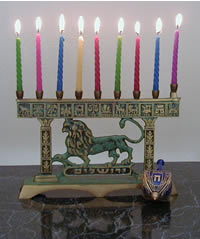
The original, the one, the only: Adam Sandler and The Chanukah Song, straight from SNL.
Boker Tov Boulder (as noted by Jewish Current Issues, Noah Pollak at the Corner, Mere Rhetoric and Daled Amos) collected a series of news items documenting what has been pledged to the PA over the past 3 years.
It’s quite an extensive list that Pollak observes:
While I freely admit to being terrible at math, by my estimation the total runs easily into the many billions of dollars.
To which Mere Rhetoric adds(sardonically):
Apparently electing an intransigent genocidal regime openly committed to the destruction of Western ally – pretty good way to get aid.
There have been a number of articles over the years that have looked at the bigger issue of Palestinian aid and finances.
In September 2004, Honest Reporting issued Understanding Palestinian Poverty that reported
Since the signing of the slo Accords in 1993, the international community has shown unprecedented generosity toward Palestinians, donating approximately $5 billion to the Palestinian Authority. The World Bank noted recently that ‘donor disbursements to the Palestinians currently amount to approximately $1 billion per year or $310 per person ― one of the highest per capita rates in the history of foreign assistance.’ (By comparison, the Marshall Plan to rebuild Europe after World War II provided $68 per year, in today’s dollars, to Europeans.)
Among other things, all this aid made Yasser Arafat a very wealthy man.
Rachel Ehrenfield provided a somewhat more exhaustive accounting of Arafat’s personal wealth.
Nor was Yasser Arafat the only official to benefit from international generosity as the late Michael Kelly wrote back in 1998 in Investing in Yasser Arafat.
THERE WAS A WONDERFUL MOMENT in the annals of diplomacy this week. Yasser Arafat, the president of the Palestinian Authority, had come to town to attend an international conference convened by the White House to raise a new pile of money to give to President Arafat. And the conference had gone splendidly.Everyone had behaved perfectly fine; no one had so much as mentioned the inconvenient London Sunday Times story the day before, which said that the Palestinian Authority had swiped $20 million in British aid intended to build housing for the poor of Gaza, using the money instead to build luxury flats for Arafat’s military and bureaucratic elite. After a day of pleasantries, representatives of 43 nations had pledged $3 billion in new aid to the Palestinian Authority, including an extra $400 million from the U.S. president. Arafat saw that it was good. “I am satisfied with the reality of this conference,” he pronounced.
(Daniel Doron wrote of another, perverse, way well connected Palestinians benefited from “foreign aid.”)
But the top functionaries of the Palestinian Authority didn’t just accumulate their wealth through the generosity of foreign aid. The also earned their money the old fashioned way through monopolies. Ronen Bergman and David Ratner write in The Man who swallowed Gaza.
Rashid means monopolies. Simultaneously with the establishment of the Authority, its leaders decided to control several essential economic sectors through monopolies; and the rights to operate the monopolies were given to several of the Authority’s senior officials foremost among them Rashid. The owner of the monopoly buys the product over which he has control from the Israeli manufacturer or importer, and sells it in the territories for a much higher price. The profits finance Authority operations that the contributing nations refuse to fund, or they disappear that is to say, make their way into private pockets, as representatives of the contributing nations and members of the Palestinian parliament allege.
The leaders of the security services could also use their positions to augment their income.
Another way in which the security apparatuses finance their augmented activity is through the collection of unloading taxes. Rajoub and Dahlan control, in effect, all the discharging platforms at the transit points to the Palestinian Authority. Dahlan is also the owner of the loading pitchforks at the Erez checkpoint. Every merchant and truck owner must pay the preventive security apparatus a tithe in order to proceed. Sometimes, its done in a simpler fashion. An Israeli importer of cleaning products, who opened a branch in Gaza, was asked to pay $2,000, a “donation” to Force 17. A year ago,a rich Arab from East Jerusalem was asked to purchase 14 new jeeps, out of his own money, for Rajoub’s organization’s use.
What’s worth noting is that none of this behavior is new. Back in 1983, Daniel Pipes wrote “How important is the PLO?”
The benefits to the PLO have been staggering. Financial statistics cannot be specified, for the PLO does not circulate its budget, but published reports indicate that in recent years the organization received about $250 million yearly from Saudi Arabia and smaller amounts from other oil states, including $60 million a year from Kuwait. At a summit conference in Baghdad in 1978, the Arab states promised another $100 million annually. Non-Arab governments (such as the Soviet bloc) also gave generously; and if these insisted on cash for arms, third parties might be induced to pick up the tab, as in April 1982 when the Saudis promised $250 million to pay for weapons from Bulgaria, Hungary, and East Germany. When the PLO requested help from the Arab states last summer, the Algerian foreign minister called in the Soviet ambassador in Algiers at four in the morning and gave him a check for $20 million; the weapons reportedly arrived in Beirut several days later by air.About 5 to 10 percent of the pay of the 300,000 Palestinians working in the Gulf states is withheld by the governments there and earmarked for the PLO; were all of this money to reach its stated destination (which is not the case), it would provide the PLO with about another $250 million a year. Aid also comes from the farther away, from radical and Islamic groups around the world: in January 1983, for instance, the Malaysian Islamic Youth Movement in Kuala Lumpur gave a check for $80,000 to the local PLO representative. Terrorist activities have also proved a source of funds; the PLO reportedly received $20 million in December 1975 for releasing the OPEC oil ministers it had helped take hostage.
With this capital, the PLO was able to start large-scale business enterprises. In Lebanon, it ran a conglomerate called Samad (“Steadfast”) whose 10,000 employees and estimated $40-million gross revenues in 1980 made it one of the country’s largest firms. The Popular Front for the Liberation of Palestine (PFLP), an organizational member of the PLO, achieved a near-monopoly over steel products in South Lebanon during the late 1970s by importing steel from the Soviet bloc at concessionary prices and paying no import duties (the PLO controlled the ports of Sidon and Tyre). Its factory, the Modern Mechanized Establishment near Sidon, undercut competitors and drove them out of business; then it raised prices and reaped huge profits. Many Lebanese believed that predatory pricing was integral to the PLO’s plans to retain control over South Lebanon. In addition to its local investments-a hotel in Lebanon, a chicken farm in Syria-the PLO owns a portfolio of investments in the industrial states, including a disco club in Italy and an airline in Belgium.
The PLO also controlled most of the approximately $30 million a year sent by the Arab governments to the West Bank and Gaza, though on some occasions Arab states themselves became directly involved. For example, Mayor Elias Freij of Bethlehem received $600,000 from Kuwait in 1977, reportedly in exchange for refraining from speaking of peaceful coexistence with Israel.
All in all, the PLO’s annual budget in recent years has been estimated at about $1 billion, prompting Time to call it “probably the richest, best-financed revolutionary-terrorist organization in history.” Its leaders could enjoy an unusually opulent style of life; on one occasion, three PLO directors lost $250,000 of the organization’s money at the gambling tables. If Yasir ‘Arafat maintained an abstemious way of life, other of the top PLO brass were notorious for high living; Zuhayr Muhsin, head of As-Sa’iqa, was assassinated while residing in a luxury hotel on the Riviera.
Perhaps at some point the Palestinian Authority’s donors ought to have looked at the history and stopped funding the PA so generously. Sure someone who was generous could have said once that past performance isn’t a guarantee of future results. But once it was established that in this case the corrupt nature of the PLO (and PA) was confirmed donor countries just kept on giving.
Rather the world heard Arafat and his cohorts say
You owe me. Pay up. Or else.
And world listened. And it still listens, continuing to pay tributes to this corrupt organization.Salam Fayyad the new Prime Minister of the PA was cited in the past as trying to straighten up the PA’s tangled finances. But as Barry Rubin points out in You owe us bigtime: the distortion of Palestinian aid politics
But the icing on the cake is the phrase “previous regimes” being responsible for corruption as if the current leadership has nothing to do with it. The current prime minister, a professional economist, may not be corrupt but the PA regime today is a continuation of all the ones before. Personnel have not changed very much.
All the aid that’s currently being arranged will go for naught. It will enrich the top layer of Palestinian leadership. It will finance terror operations. It will not be used to build infrastructure or create an economy.
Foreign aid to the Palestinians has created an entitlement society. No doubt it makes the West and others feel good because they’re “doing something to help,” but they’re only helping a small fraction of Palestinian society. And they’re doing it again and again.
Until the Palestinians are held accountable for their corruption and terror there will never be peace. The latest round of donor promises shows that nothing has been learned from the last quarter century of experience.
Crossposted on Soccer Dad.
Yes, Virginia, there is an anti-Israel bias, and this is the time of year that it becomes the most virulent. Let us take note of two amazing events in the beginning of the “Israel would make the Baby Jesus cry” season. First, an article in the UK Times that actually points out the bias. But I don’t think it counts, because I think I’ve read positive articles about Israel by Michael Gove before:
It has become almost as much a feature of seasonal journalism as stories about how Nativity plays are being subverted and commentaries on how commercialism is snuffing out the true meaning of the festival.
This year we’ve already had our first exercise in demonising Israel for its treatment of Bethlehem with the graffiti artist Banksy enjoying extensive coverage for his trip to decorate the security barrier near the town with his work. The message of Banksy’s work and the coverage it has generated is the same: oppressive Israel has snuffed the life out of the town where the Prince of Peace was born. Herod’s spirit lives on, even as the spirit of Christmas is struggling to survive.
The truth is very different. The parlous position of Palestinian Christians, indeed the difficult position of most Christians across the Arab world, is a consequence not of Israeli aggression but of growing Islamist influence. Israel goes out of its way to honour sites and traditions sacred to other faiths while the radicals who are driving Palestinian politics seek to create an Islamist state in which other faiths, if they survive at all, do so with the explicit subject status of dhimmis. But when it comes to Israel’s position in these matters it’s still a case of O little town of Bethlehem, how still we see them lie.
Next, we have the AFP pointing out that in spite of the separation fence “walling off” Bethlehem (and thus making the Baby Jesus cry), Bethlehem tourism is up 60%. And please note that the reason for the drop in tourism is mentioned five paragraphs down, but never seems to make it out of the news ghetto into the lead.
Tourism to Bethlehem has risen 60 percent in the run-up to Christmas, despite Israel’s separation barrier turning the birthplace of Christ into a “big prison”, its mayor said on Tuesday.
In his annual address as the small West Bank town — whose economy has been decimated by violence — prepares for Christmas, Victor Batarseh said tourism to Bethlehem had grown 60 percent in the past three months.
“In January 2007, 18,509 tourists visited the city of Bethlehem and starting September 2007, the number of tourists started to increase,” he said.
There were 64,420 tourists in November and “we are expecting even more this month,” the mayor said, attributing the increase to churches abroad projecting an image of safety and encouraging Christians to show solidarity and visit.
Before the Palestinian uprising broke out in September 2000, nearly a million tourists and Christian pilgrims visited Bethlehem each year.
Funny. You’d think the real reason for the lack of tourism—the Palestinians shooting and stabbing and blowing people up—might actually be the reason mentioned for the dropoff in, say, the lede. But then, you wouldn’t be a mainstream news editor. You’d be a blogger.
He slammed Israel’s separation barrier, which has sealed Bethlehem off from nearby Jerusalem helping to exacerbate high unemployment caused by dwindling tourism, Israeli closures and limits on Palestinian work permits.
“The cradle of our Lord Jesus Christ has turned into a big prison,” the mayor said.
There you go! The winner for Best “Makes the Baby Jesus Cry” Award goes to: The mayor of Bethlehem, who cannot admit that the reason there are so few Christians in Christianity’s birthplace is because they’ve been driven out by Muslims. (The AFP article refuses to acknowledge that as well, blaming the flight of Christians on Israel.)
And the usual crowd of idiots are in Bethlehem blaming Israel for all the world’s ills.
This is “Santa’s Ghetto,” an ongoing collaborative graffiti project that has evolved into the biggest artistic assault on Israel’s separation barrier and the latest hope among Bethlehem’s leaders to draw tourists back to this troubled town during the Christmas season.
Led by the enigmatic British artist known as Banksy, painters from around the world are adding works daily to the walls around Bethlehem in an attempt to draw attention to the impact the separation barrier has had on life in the Biblical birthplace of Jesus Christ.
The mayor of Bethlehem, he sure knows his talking points.
“I hope people will come visit because I don’t see how things can change for the citizens of Bethlehem as long as the wall is here,” Batarseh said.
“It’s excellent artwork,” he added.
And the McClatchy newspaper group, it sure knows its propaganda points.
Like the rest of the West Bank, Bethlehem was ravaged by the five-year Palestinian uprising that began in 2000 and saw hundreds of Israelis killed in suicide bombings and thousands of Palestinians killed in military raids.
That’s the final paragraph.
The media spin continues.
I was traveling yesterday so I forgot to post that Haveil Havalim #144 (the Jewish/Israel blogging carnival) is UP at Jack’s Shack of Pancakes Latkes.
If you have a post that is about Judaism or Israel feel free to submit it for consideration in this week’s upcoming edition.
This one was submitted by Sarah.
And now, in place of the lame Flash embed from Albino Blacksheep, Sarah found this rockin’ Chanukah video by a group that I would have rocked to during the 70s. Whoa. I’m sensing a little Grateful Dead, a little Mountain, a little Clapton, a little ZZ Top—complete with guitar solo and, uh, an Orthodox bass player. Kewl.
This spot used to hold the Flash embed code of “Hey Ya Hanukah.” I have removed it, because you don’t have a choice to play it or not. Every single time you load this page, the video loads and plays. Screw that. That’s not what “embed” should be used for. I am not interested in any more Albino Blacksheep videos if that’s how they try to push them on people.—Meryl
It’s got a beat you can dance to.
What particularly concerns Gulf Arabs is the possibility that Iran could go nuclear–a concern unlikely to be erased by the ambiguous findings of the new NIE. While this NIE claims that Iran stopped its nuclear-weapons program in 2003 (in direct contradiction to an NIE finding issued just two years ago that “Iran currently is determined to develop nuclear weapons”), it concedes that “Iran’s civilian uranium enrichment program is continuing.” Such a “civilian” program could be converted speedily and stealthily to military use. As the new NIE notes, “Iran has the scientific, technical, and industrial capacity to produce nuclear weapons if it decides to do so.”That thought fills Sunni Arabs with dread. “If we accept Iran as a nuclear power that is like accepting Hitler in 1933-34,” warned one senior Arab official, using the kind of analogy that back in Washington would get him dismissed as a neocon warmonger.
Ynet:
“The manner in which the Americans relate to the intelligence report on Iran is similar to the way in which they viewed those reports they received during the Holocaust on railways transporting hundreds of thousands of Jews to their death at Auschwitz,” Minister Yitzhak Cohen of Shas said during a security cabinet meeting Sunday morning on the Iranian nuclear issue.
(via memeorandum)I don’t believe, as John Bolton does, that the NIE is a “quasi-putsch.”
“This is politics disguised as intelligence,” Bolton was quoted as saying in an article appearing in this week’s edition.Bolton described the report, released Monday, as a “quasi-putsch” by the intelligence agencies, Der Spiegel said.
(via memeorandum)
The NIE is an estimate. It reflects the uncertainty involved in processing intelligence. I can believe that there are uncertainties about whether the Iranians have resumed producing fuel for a nuclear explosive. The problem is not with the NIE but with the way it’s being spun.
Consider Max Boot’s observation above. Or consider this:
British spy chiefs have grave doubts that Iran has mothballed its nuclear weapons programme, as a US intelligence report claimed last week, and believe the CIA has been hoodwinked by Teheran.The timing of the CIA report has also provoked fury in the British Government, where officials believe it has undermined efforts to impose tough new sanctions on Iran and made an Israeli attack on its nuclear facilities more likely.
The security services in London want concrete evidence to allay concerns that the Islamic state has fed disinformation to the CIA.
The report used new evidence – including human sources, wireless intercepts and evidence from an Iranian defector – to conclude that Teheran suspended the bomb-making side of its nuclear programme in 2003. But British intelligence is concerned that US spy chiefs were so determined to avoid giving President Bush a reason to go to war – as their reports on Saddam Hussein’s weapons programmes did in Iraq – that they got it wrong this time.
(via memeorandum)
The latest NIE reflects caution – perhaps excessive caution – in evaluating the Iranian threat. But again the problem isn’t in the NIE. The problem is in the reporting. Suppose that the Telegraph found that British intelligence had confirmed the doubts of the NIE would American newspapers have been reticent to play that up? The Telegraph also quotes favored news source Bruce Reidel critical of the NIE. If Reidel took the opposite view, you can be sure he’d be quoted in the NY Times or Washington Post.
Secretary of Defense Robert Gates made an astute observation about Iran
Mr. Gates mocked Iran’s praise of a new National Intelligence Estimate as a “watershed†— the first time Tehran has accepted the conclusions of American spy agencies. As the audience chuckled, Mr. Gates said Iran’s approval of the American intelligence estimate required it to accept other assessments of its behavior.“Since that government now acknowledges the quality of American intelligence assessments,†Mr. Gates said, “I assume that it will also embrace as valid American intelligence assessments of its funding and training of militia groups in Iraq, its deployment of lethal weapons and technology to both Iraq and Afghanistan, its ongoing support of terrorist organizations like Hezbollah and Hamas that have murdered thousands of innocent civilians and its continued research and development of medium-range ballistic missiles that are not particularly cost-effective unless equipped with warheads carrying weapons of mass destruction.â€
The selectivity that Gates mocks, is the similar to what we see in the media. The skepticism or hostility to President Bush is such that the media will not provide us with any information that may cast the president in a positive light.
Still the immediate effect of the NIE is that politically, military action against Iran is off the table. President Bush seems to believe that. Barring any dramatic new intelligence, the administration will continue trying to keep Iran nuclear weapon free using diplomacy.
Charles Krauthammer writes even though the conclusion of the NIE appears positive there’s no reason to draw conclusions that some have been drawing from it.
Which is why the critics’ claim that this NIE report is a mandate for a new and soft Iranian policy is wrong. John Edwards immediately said the report justified his vote against designating the Iranian Revolutionary Guard Corps as a terrorist organization and imposing sanctions on it. But the NIE’s major conclusion is that Iran calibrates its nuclear efforts–including the suspension of the weaponization part–in a real-world cost-benefit reaction to outside pressure. It makes the case precisely for sanctions.Moreover, the critics seem not to have noticed when uranium enrichment and weaponization were halted: fall 2003–before the rise of the Iraqi insurgency and while the shock and awe of the U.S.’s three-week conquest of Baghdad was still reverberating throughout the Middle East, scaring WMD pursuers, like Gaddafi’s Libya, into giving up their nuclear programs altogether. Timing suggests that the American military option exercised in Iraq contributed to Iran’s suspension of weaponization.
The military option may not be necessary right now. If weaponization has been suspended, the window for sanctions has been widened. But there is no reasonable argument for taking military action off the table. If the Iranians refuse to negotiate seriously–their new negotiator says all previous negotiations are void and talks now return to square one–the military option needs to be on the table and in plain view.
It appears that President Bush has, for now, taken military action off the agenda based on the NIE, something that Krauthammer would disagree with. However among President Bush’s critics much too much confidence was misplace into the NIE.
Crossposted on Soccer Dad.
Chris Muir has been a friend for some time, and I love his Day By Day comic strip. He’s selling a Sam calendar, and, well, the feminist in me is standing on one shoulder screaming “SEXIST!” while on the other shoulder is the fifty-year-old realist who says, well, guys like hot chicks. That’s nature.
So go check out his Sam calendar, which is fairly artsy and fairly sexy, and then buy it. Just go to Day By Day’s main page and see for yourselves.
For some reason, there’s little I want to write about today.
I have nothing to say about the Colorado church shootings, except to express my horror and shock. The fact that the church had an armed guard probably saved many lives.
I am so far from the anti-gun person I was in my twenties, that I barely recognize that person any more.
Off to my staff meeting in northern VA. I’m sure you’ll have plenty to talk about while I’m gone.
When you run out of things to say, put up cat pictures, is my motto. Okay, well, it isn’t really, but it works for me.
First, Gracie in the new kitty condo.
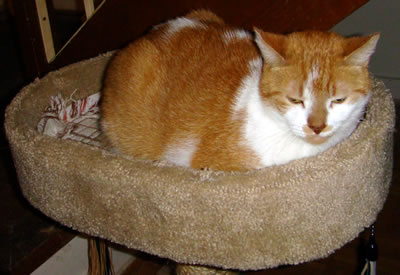
She is, of course, her usual dignified (slightly pissy in this photo) self.
Next, Tig the goofball in the new kitty condo:
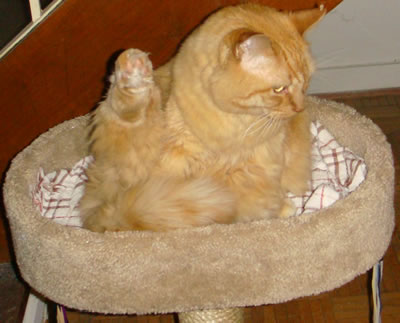
It’s one of his most common—and least dignified—poses, and I can’t resist getting as many pictures as possible of it.
Now we have a shot of Gracie in the kitty condo when Tig wants to be in it. There was a brief battle over possession. Gracie lost. She always loses.
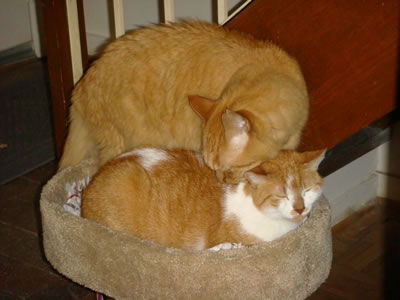
And last, we have one of the cool kitty tube in the guest room at Janet and Chris’, where I stay when I have overnight meetings at work, or just want to hang out with Janet and Chris and friends and do things like learn how to shoot or something.

I would love to tell you that the top of the photo is not my finger, but I keep forgetting where the lens is on this camera and wind up with bits of my forefinger in various shots. Oh, well. Someday I’ll learn.
Reader chsw gave me this one, which started the trend of Chanukah/Hanukkah videos. It’s a Tom Lehrer cover with a little topping of South Park at the end.
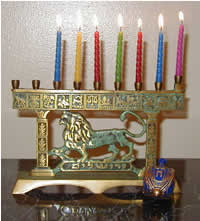
Another one from Sabba Hillel, with some pretty great video.
Apparently, Jews are off the hit list this year. I couldn’t find many menorah-vandalizing stories at all this year.
The Stony Point town hall menorah was vandalized, but that’s about all. Of course, there was the run-of-the-mill anti-Semitic vandalization of a Chabad house at Indiana University, but hey, that’s just your typical anti-Semitic prankster having a little fun, throwing a beer bottle through a window, and removing the word “Jewish” from the “Jewish Student Center” letters on the front of the house.
Anti-Semitism is the one hatred that never, ever goes out of style, and it’s also the one that people almost never have to pay for. Just ask Congressman Jim Moran. Or the Palestinian Authority. Or Mahmoud Ahmadinejad. Or the Economist, that insists that there is no anti-Semitism at all in the current uproar over the David Abrahams scandal, even though shadowy Zionist conspiracy theories have been raised from the get-go. The problem, you see, isn’t the anti-Semitic articles, pictures, and comments being thrown. Listen to what the Economist says the real problem is:
The real cause of the syndrome is subtler than that. It is a vague but powerful sense, which many immigrant antennae pick up, that there is somewhere an inner sanctum of Britishness, an elusive top table, to which, by reason of birth and class, the newcomer is not invited, ostensibly welcomed though he may be. Finding a way to it, through lavish acts of patriotism or patronage, becomes for some a mission more compelling than money. Three or four generations in, most Jews have outgrown those neuroses; but some haven’t, and other, newer ethnic groups, such as some Anglo-Indians, have acquired them.
You see? It isn’t anti-Semitism. The problem here is that silly Jew, David Abrahams, trying to prove to the Brits that he’s mastered his inferiority complext. And gee, nice way of looking at the reason Jews give charity. It couldn’t possibly be because that has been part and parcel of our religion for millennia. No. It has to be because we were poor a few generations ago, so we understand what it’s like to be poor, and give accordingly. Tzedakah? Never heard of it. Maimonides Eight Levels of Charity? Shyeah, why would that have anything to do with Jews giving money?
For every post on anti-Semitism you read here, there are dozens of stories that I refuse to write about. I won’t even link that one directly (thank you, tinyurl!). It’s typically despicable drek by an asswipe who can’t write, but thinks he can; can’t reason, but thinks he can; and can’t cope with his own horrid little life, but thinks he can blame the Jews for all the wrongs in it. Shyeah. Rogue elements in the U.S. government, in association with the Mossad or other Israeli intelligence services, are responsible for 9/11. Someone get “George” back on his meds; he’s suffering from delusions again.
This one’s audio only, but so worth it. Melvin and the Chipmunks sing a Chanukah song.
The Syrians are making sure their kids don’t get Jew cooties. They’re blocking Facebook.
Syrian authorities have blocked Facebook, the popular Internet hangout, over what seems to be fears of Israeli “infiltration” of Syrian social networks on the Net, according to residents and media reports.
Residents of Damascus said that they have not been able to enter Facebook for more than two weeks. An Associated Press reporter got a blank page when he tried to open Facebook’s home page Friday from the Syrian capital.
Syrian officials were not available for comment Friday because of the Muslim weekend, but some reports have suggested that the ban was intended to prevent Israeli users from infiltrating Syrian social networks.
Lebanon’s daily As-Safir reported that Facebook was blocked on Nov. 18. It said the authorities took the step because Israelis have been entering Syria-based groups.
Ohmigod, no! They’re not—writing Facebook comments to each other! Ew! Jew Cooties! Ew!
Heaven forfend the Syrians should find out that Israelis aren’t really the devils that Baby Assad’s spin machine makes them out to be. Score one more for the Dorktator.
Let’s do a little reading between the lines here. The AP has a three-hanky story on how the mean ol’ Israelis are shutting off the Gaza fuel supply, just because Hamas is allowing terrorists to fire over 2000 rockets into Israel over the past twelve months. Witness the horrors:
Service stations across the Gaza Strip shut off their fuel nozzles. Tens of thousands of people have no fresh water because pumps can’t run. Hospitals parked ambulances, and bicycles are the new favored form of transportation.
A month-old Israeli reduction in fuel shipments to Gaza is hitting the seaside territory hard. And things could get worse – seeking to punish Gaza’s Hamas rulers further, Israel is waiting for court approval to reduce the electricity supply as well.
The measures are the latest in a series of sanctions that Israel has imposed since the Islamic militant group violently seized control of Gaza in June and allowed near daily rocket attacks on Israelis. Israel, which considers Hamas a terrorist group, has declared Gaza a “hostile entity” and closed the borders, halting almost all trade.
Okay. That’s the lede that makes it into everyone’s World News section in the local paper. Here’s what didn’t make it in:
The gasoline and diesel reductions, from 15 percent to 75 percent of normal supplies, have hit Gaza’s water system as pumps run out of fuel. The shortages have been compounded by Gaza’s 30 private fuel companies, which halted deliveries this week to protest the Israeli cutback.
Fed up with the finger pointing, Gaza’s gas station owners this week stopped serving the public, saying they were caught in the middle.
Gas pumps were covered in blankets, plastic bags or signs declaring: “No fuel. No diesel.”
“We are the ones who are suffering the beating and the losses,” said Mahmoud al-Shawa, a member of Gaza’s association of station owners.
Did you catch that? The Gazan fuel dealers deliberately shut down their pumps and stopped fuel deliveries. But that’s not all. The Gazan oil companies refused to accept shipments of Israeli fuel as a “protest” against Israel cutting supplies.
Palestinian petrol distribution companies refused to receive the amount of fuel from Israel’s Dor company as a form of protesting the Israeli reduced its fuel supplies to Gaza.
Palestinian said on Sunday that most of the service stations in Gaza Strip have run out of fuel, especially the diesel as Israel started to reduce Gaza fuel deliveries.
The Union of petrol stations owners said in a statement that the Gaza Strip needs 350 thousand liters of diesel everyday while Israel wants to allow only 90 thousand liters in.
And what, exactly, is the reasoning behind this “protest”?
The union said the local petrol companies have refused to receive what Israel is sending “in order not to be partners in punishing the Palestinian people because these quantities are insufficient.”
The Palestinians have never refused to cut of their noses to spite their faces, and this is a prime example of that. But more to the point, there is no such thing as a spontaneous protest in the Palestinian territories. There is no way the union would refuse to accept fuel shipments on their own. Count on it, this is Hamas trying to make the world weep for Gaza.
I think the world seems to be getting a bit tired of the game. Only about 60 versions of this story were on Google News. The Misery Of The Gazans seems to be slipping in popularity.