Giving Obama his due

The Palestinians and the Arab and Muslim world are utterly seething today. Obama’s speech in Israel has utterly convinced them he is a paid Zionist tool, I’m sure.

I recommend that you read it in full. The speech wasn’t perfect–I’m not happy he used “settlements” as the obstructor of peace again–but overall, it was a great, pro-Israel speech. It more than made up for his 2009 Cairo speech, where he linked the founding of Israel to the Holocaust. No, Mr. President, Jews have a millennia-old history in Israel, as you said:

For the Jewish people, the journey to the promise of the State of Israel wound through countless generations. It involved centuries of suffering and exile, prejudice, pogroms and even genocide. Through it all, the Jewish people sustained their unique identity and traditions, as well as a longing to return home. And while Jews achieved extraordinary success in many parts of the world, the dream of true freedom finally found its full expression in the Zionist idea – to be a free people in your homeland.

That is why I believe that Israel is rooted not just in history and tradition, but also in a simple and profound idea: the idea that people deserve to be free in a land of their own. And over the last 65 years, when Israel has been at its best, Israelis have demonstrated that responsibility does not end when you reach the promised land, it only begins.

Seething, I say. Seething. Watch for the poisonous responses in the Arab and Iranian media. Oh, and the neo-Nazi sites and last, but not least, the BBC and the Guardian. The gnashing of teeth will be loud and long.

Posted in Israel, The One | Comments Off on Giving Obama his due

Mideast Media Sampler 03/21/2013

1) Barack and Bibi

The Algemeiner has transcripts of President Obama’s and PM Netanayahu’s remarks at their joint press conference yesterday.

Writing in Tablet, Lee Smith covers the three issues that President Obama and PM Netanyau would be discussing: the Palestinians, Syria and Iran. (via memeorandum) However, Smith concludes:

As he has for the last four years, the American commander in chief will surely promise the Israeli prime minister that when it comes to Iran, “Trust me, I’ve got your back.” But everything Bibi has heard over the last five hours will likely tell him that, as time is running out to stop Iran, the United States is nowhere to be found, at least not in the Middle East.

Based on the President’s speech, Ken Gardner tweeted:

Barry Rubin understood that too, but wonders:

Then Obama made an extraordinary statement:

“I think that what Bibi alluded to, which is absolutely correct, is each country has to make its own decisions when it comes to the awesome decision to engage in any kind of military action. And Israel is differently situated than the United States, and I would not expect that the prime minister would make a decision about his country’s security and defer that to any other country, any more than the United States would defer our decisions about what was important for our national security.”

What Obama just said publicly is that if Netanyahu decided that Israel’s defense required an attack on Iran, the president would not expect the prime minister to be deterred by U.S. opposition. Did Obama mean that? It is hard to believe that he did, yet what no Israeli leader is going to miss that seeming “green light.”

In fact, Professor Rubin questioned a number of the President’s other statements and wondered if the President understood the implications of what he was saying.

This is slightly different that what Thomas Friedman wrote last year in Israel’s Best Friend:

“Preventing Iran from getting a nuclear weapon isn’t just in the interest of Israel, it is profoundly in the security interests of the United States,” the president told The Atlantic. “If Iran gets a nuclear weapon, this would run completely contrary to my policies of nonproliferation. The risks of an Iranian nuclear weapon falling into the hands of terrorist organizations are profound. … It would also provide Iran the additional capability to sponsor and protect its proxies in carrying out terrorist attacks, because they are less fearful of retaliation. … If Iran gets a nuclear weapon, I won’t name the countries, but there are probably four or five countries in the Middle East who say, ‘We are going to start a program, and we will have nuclear weapons.’ And at that point, the prospect for miscalculation in a region that has that many tensions and fissures is profound. You essentially then duplicate the challenges of India and Pakistan fivefold or tenfold.” In sum, the president added, “The dangers of an Iran getting nuclear weapons that then leads to a free-for-all in the Middle East is something that I think would be very dangerous for the world.”

Every Israeli and friend of Israel should be thankful to the president for framing the Iran issue this way. It is important strategically for Israel, because it makes clear that dealing with the Iranian nuclear threat was not Israel’s problem alone. And it is important politically, because this decision about whether to attack Iran is coinciding with the U.S. election. The last thing Israel or American friends of Israel — Jewish and Christian — want is to give their enemies a chance to claim that Israel is using its political clout to embroil America in a war that is not in its interest.

Friedman’s essay is concerning, not just because it has President Obama saying what he figures that Israel’s supporters wanted to hear without necessarily understanding the implications of his words (as it seems that he was doing yesterday) but because he cast the threat in terms of non-proliferation, not in terms specifically of the Iranian threat.

Israel Matzav notes a contradiction in two of President Obama’s statements.

But if Israelis are enthusiastic about President Obama’s visit, Palestinians are decidedly less so.

This might be why PA bans photos, video from Hebron.

The New York Times reports, Some Palestinians Wary of Obama Visit:

There are no American flags lining the streets here, no banners bearing the official “Unbreakable Alliance” logo of President Obama’s visit, as there are seven miles away in Jerusalem. Instead, dozens of posters warn the president not to bring his smartphone when he arrives in the West Bank because there is no 3G service, one of an untold number of complaints Palestinians have about their life under Israeli occupation.

On most posters, Mr. Obama’s face has been painted over or torn off.

“It’s a waste of time,” Osama Husein, 38, who owns a new coffee shop downtown, said of Mr. Obama’s planned journey here Thursday afternoon, in the middle of his three-day stay in Jerusalem. “Four or five hours here for no reason. It’s just for show, just to take some pictures with some young kids. I don’t see any benefit.”

There are other signs of Palestinian dissatisfaction with President Obama.

Also check out the postscript of Barry Rubin’s article (if you haven’t already read the whole thing!)


2) Spinning the visit

Honest Reporting warns about Five Media Spins to Watch for During Obama Visit. Just about all of them are on display in this Q & A with Jodi Rudoren of the New York Times at The Lede blog.

Of the seven tweets that are embedded in the article five are pro-Palestinian, one is trivial and one is actually curious.

The curious question was about going to the Temple Mount. Here Rudoren botches the answer terribly. Part of her answer is:

The second Palestinian intifada, or uprising, was set off in 2000 by a visit to the site by Ariel Sharon, then the leader of the opposition Likud Party. Lately, more and more Jews have been ascending the Mount, and there have frequently been clashes there.

First of all this is false. Nor does Rudoren mention anywhere in her response that Hamas threatened the President against going to the Temple Mount. It’s bad enough that Rudoren hasn’t corrected past history, but here she’s whitewashing Hamas too.

In an answer about whether PM Netanyahu would negotiate with the Palestinians, Rudoren begins her response with:

Mr. Netanyahu has repeatedly stated in the weeks since Israel’s Jan. 22 elections that he is ready to return to negotiations, and he included a promise to do so in one of the agreements that formed his new governing coalition. However, he insists on “no preconditions” – and he considers as a precondition the Palestinians’ demand that the negotiations start on the basis that the future two states would be divided along the pre-1967 borders, with land swaps to balance Israeli settlements.

President Obama could seek to break this stalemate, perhaps by redefining the very notion of a precondition.

So with President Obama it depends on what the meaning of “precondition” is? Regardless, according to Rudoren’s reporting, it’s the Palestinians who are redefining “precondition.”

A Palestinian legislator, Ziad Abu-Amr, said Mr. Abbas would make clear to Mr. Obama that he would return to the negotiating table under either of two conditions. One is a mutual six-month freeze in which Israel halted building in West Bank settlements and Palestinians refrained from using their new observer-state status in the United Nations to pursue claims in the International Criminal Court or other agencies. The other is a broad agreement on borders, dividing the land between the Jordan River and the Mediterranean Sea along the pre-1967 lines, with some land swaps to accommodate the largest Israeli settlements.

Prime Minister Benjamin Netanyahu has said he considers the 1967 borders an unacceptable precondition for negotiations.

So wait a second. If Israel stops settlement construction (and you can be pretty sure that the Palestinians would consider building in many parts of Jerusalem to be settlements) then the Palestinians won’t pursue legal action against Israel in international forums. In other words Israel must stop doing something that was never forbidden and in exchange the Palestinian won’t continue violating one of the premises of the peace process.

As Omri Ceren wrote a few years ago (and others have written repeatedly):

This passage won’t do much to dispel the suspicion that Palestinians pocket Israeli concessions like the Gaza withdrawal and then set up their old obligations – violence, past agreements, recognition – as the bare minimum they’ll give in exchange for new Israeli concessions.

People can complain about “settlements” or Netanyahu’s intransigence, but this claim – Rudoren doesn’t even seem to recognize its significance – is the true obstacle to peace. Israeli concessions are taken as a given; but Palestinian compliance must be rewarded, because, apparently it is optional.

Posted in Israel | Tagged | Comments Off on Mideast Media Sampler 03/21/2013

The Palestinians: Say it with explosions

Hamas isn’t sending flowers. It’s sending missiles. And the AP manages to turn news of a rocket attack on Israel’s southern civilian population into a by-the-way. Note how the AP also manages to blame Israel for the rocket attack–because they don’t have a peace treaty with the Palestinians.

Rockets hit Israel as Obama meets Palestinians
U.S. President Barack Obama is meeting Palestinian officials on the second day of his Mideast tour to emphasize the importance of reaching an Israeli-Palestinian peace deal, a message underscored Thursday when Palestinian militants in Gaza launched rockets into southern Israel.

After a visit to Israel’s national museum — where he inspected the Dead Sea Scrolls, which highlight the Jewish people’s ancient connection to the land that is now Israel — Obama headed to the West Bank to tell the Palestinians that the creation of a Palestinian state remains a priority for his administration.

The story then goes blithely on about Obama and the Palestinians for ten more paragraphs before getting back to the rocket attack. (There have now been five missiles, and one landed in the backyard of a house.) This is the last of the ten paragraphs:

On Wednesday, Obama reaffirmed the unwavering U.S. commitment to Israel’s security and noted there had been no fatal attacks on Israelis from the West Bank, which is controlled by Abbas.

It is also untrue. There have been many fatal terror attacks on Israelis from and in the West Bank. But the AP calls it a “calm”.

That calm has not extended to Gaza, which is run by the militant Islamic Hamas movement. As Obama began his program Thursday, Israeli police said militants in Gaza had fired two rockets at the southern town of Sderot.

The pretend calm that the AP writes about isn’t a calm. It is utterly ignoring all terror attacks and attempted terror attacks from the West Bank. There is no peace. There is only a very good Israeli military and intelligence service keeping the terror cells at bay.

Police said Monday, that three Palestinian men from the Balata refugee camp arrived at the Tapuah junction in the northern West Bank, raising officers’ suspicion.

During a search of the men’s vehicle, police said the officers found eight pipe bombs, a pistol, and a knife.

These stories do not get reported by the AP, because they go against the narrative that there is a “calm” in the West Bank and only Hamas wants to kill Israelis. They also publish the fiction that Mahmoud Abbas condemns attacks on Israelis. He does not. Even Israeli journalists fall for this bullshit.

The Palestinian president’s political advisor, Nimar Hamed, said that Abbas condemned the rocket fire.

“We condemn violence against civilians, no matter where it originates,” Abbas was quoted as saying.

I condemn violence against civilians, no matter where it originates. There. I’ve condemned the firing of rockets at the civilians of Sderot. Right? Right?

Wrong.

But you will never see the AP go against the narrative, not unless someone like Sheldon Adelson buys it (can someone even buy the AP?) and changes editorial policy. Until then, Palestinian terrorists will continue to try to murder Israelis, and the AP and MSM will continue to downplay every attempt and murder, while frantically chastizing Israel for every attempt at self-defense. Just another day in Israeli Double Standard Time. But don’t worry. It only occurs on days that end with a “y”.

Posted in Hamas, Israeli Double Standard Time, Media Bias, Terrorism | 1 Comment

Obama in Israel

You have to give the man credit. He knows how to put on the charm when he wants to. And he has utterly charmed many, many Israelis.

“We were prepped in advance for any question he may ask us,” Farhi revealed. “Obama went one by one and asked us about our jobs personally. When he saw my name tag he immediately addressed me by my name,” she remarked.

“I was very moved by his warm and fatherly attitude. He skipped no once, showed genuine interest, and spoke to us as equal with absolutely no mannerisms. He was just like any other person. It was fun seeing him talk to us common soldiers.”

And oh yeah–he learned of one reason why Israel is so far superior to its neighbors:

The US president was apparently surprised to learn that so many female combatants operate the Iron Dome, Farhi revealed.

Obama was top-notch from the moment he landed. Click the link for the video. The “red line” comment was quite funny. (Amir Peretz running after him and glad-handing him was pathetic, on the other hand.) He even charmed a bunch of kids.

But his real agenda is what lies behind the smiles.

Washington is well-aware it cannot take on such a task alone during this bloody “medieval” period in the region. The solution: Creating an axis of stable Sunni countries to counter the Iran-led radical Shiite axis, which is seeking hegemony in the Middle East. The main candidates to join this pro-Western axis are the Gulf States, Turkey, Jordan, Egypt and perhaps Algeria and Morocco as well. These countries will assist each other in times of crisis, destroy the murderous Global Jihad groups, and coordinate their moves. This is already happening in Syria.

Washington wants Israel to be a quiet partner in this axis so that the Jewish state will be able to cooperate with its neighbors over the table, and mainly under it. This could be beneficial in the event that the US or Israel – or both countries – attack Iran. For the sake of this cooperation Obama will likely ask Netanyahu to show restraint and calm in the Palestinian arena and ask Abbas to refrain from attempting any empty diplomatic provocations that will anger Israel and foment unrest in the territories.

His agenda hasn’t changed much. Obama has learned from bitter experience that he can’t force a peace treaty. But that won’t stop him from trying to make peace in the Middle East part of his legacy. And while the media is claiming that the trip is one big photo op, they seem to forget that symbols matter. The Arab world is watching the American President tour important symbols that depict Israel’s strength (an Iron Dome battery), history, and ties to the land. He’s visiting the Israel Museum to see the Dead Sea Scrolls and will visit Theodor Herzl’s grave. Herzl, in case you didn’t know, was the father of modern Zionism.

As for the Palestinians? Well, they were awfully busy defacing pictures of Obama. They are not happy. No matter what happens tomorrow, the symbolism was all Israel’s this time around. The Palestinians are, effectively, an afterthought. This was Obama’s big Israel trip, and Bibi played it perfectly.

Posted in Israel, palestinian politics, The One | 1 Comment

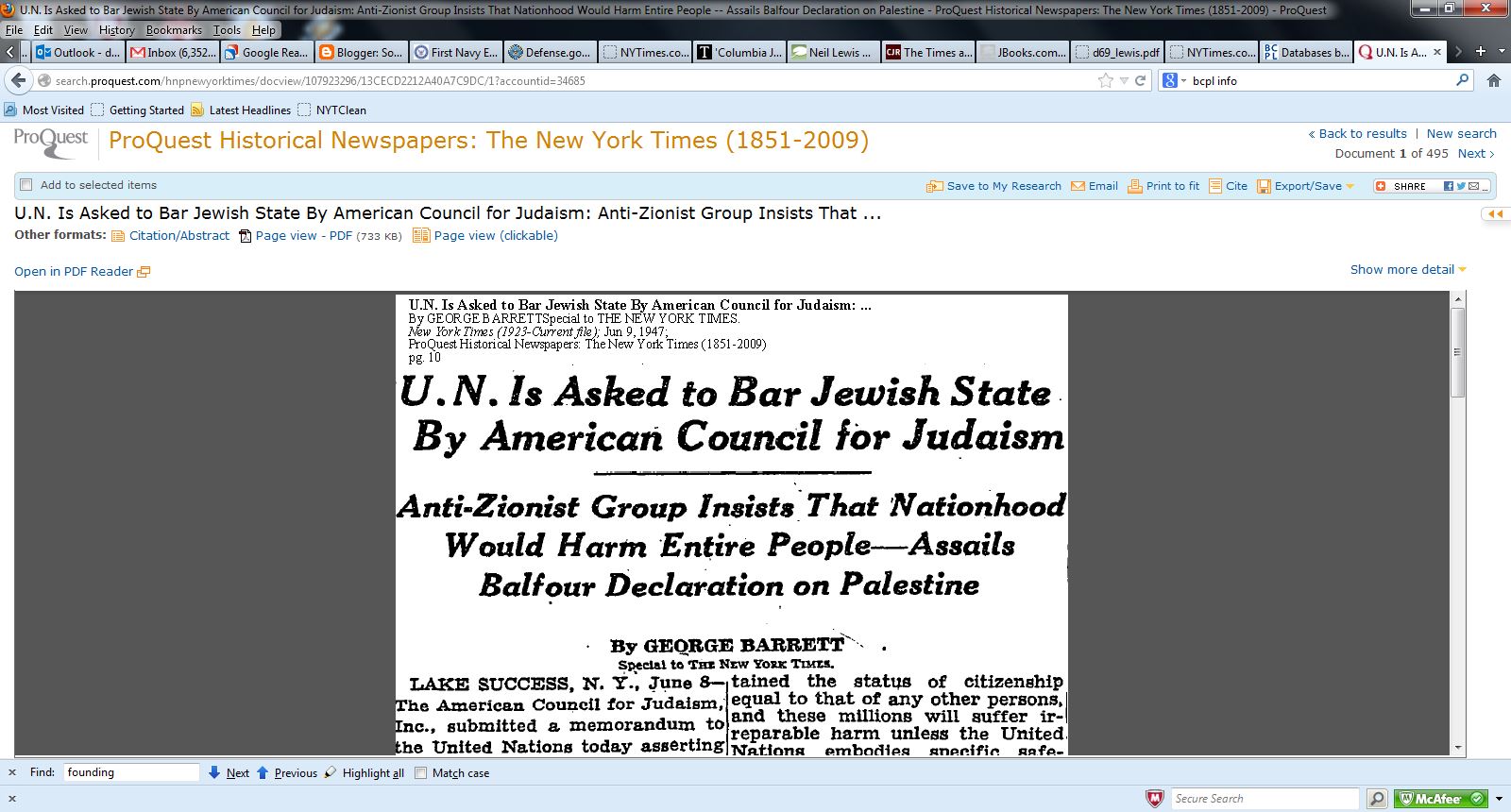
Mideast Media Sampler – The anti-Zionist DNA of the New York Times

The New York Times, the American Council for Judaism and Israel

Last year a former New York Times reporter, Neil Lewis wrote a defense of the New York Times’ coverage of Israel. (.pdf) Lewis writes of Arthur Hays Sulzberger:

Whatever complicated personal themes may have floated in Arthur Hays Sulzberger’s private seas can only be guessed at. (The most common — and plausible — speculation is that he, like many established and wealthy American Jews of German heritage, was profoundly uncomfortable, or simply snobbish, about the more recent waves of Jewish immigrants from Eastern Europe who were seen by them as less cultured.)
So, while downplaying in The Times to a ludicrous degree the Jewish identity of the victims of some Nazi horrors (an editorial about the Warsaw Ghetto uprising
somehow managed to omit that it was a ghetto of Jews), Arthur and Iphigene worked diligently to help distant relatives still in Germany emigrate to the United
States. They surely understood these people were in danger from Hitler because of something more than their “choice” to subscribe to the Jewish, rather than say, the Lutheran, religion.
But it was out of this tradition that Arthur Hays Sulzberger positioned himself as an avid anti-Zionist even going so far to make speeches on the subject. He consistently opposed proposals ranging from the modest, like the (never realized) raising of an international Jewish military force, to the grand, the founding of a Jewish nation – state in the Middle East.

(Lewis’s description of “an international Jewish military force” as “modest” is curious.)

Lewis quotes Laurel Leff’s “Buried by the Times” favorably. Leff’s book documents how the New York Times covered (or didn’t cover) the Holocaust. Indeed Lewis is rather critical of the failure of the paper to give proper coverage to the Holocaust. However, Lewis seems less bothered by Sulzberger’s anti-Zionism.

In this interview, Leff argues that the Sulzberger’s anti-Zionism affected the paper’s coverage of the Holocaust and the founding of Israel:

Groner: One of the notable conclusions that struck me about your book was how strongly committed Arthur Hays Sulzberger was to the anti-Zionist credo that became associated with the American Council for Judaism. You provide meticulous documentation for the conclusion that Sulzberger was not merely a non-Zionist but was actively opposed to the creation of a Jewish state, and was even opposed to establishing Palestine as a refuge for hundreds of thousands of Jews trapped in Nazi-occupied Europe. Did those findings provide a major foundation for your thesis that the Times intentionally downplayed the news of the Holocaust as the news came in?
Leff: Yes, it did. Going into the project, I had assumed that Sulzberger was a fairly typical assimilationist German Jew, meaning that he acknowledged he was Jewish but had only the most tenuous connections to the religion and to the community. It was only when I started poking around in Rabbi Abba Hillel Silver’s papers, a copy of which are at Yale University, that I realized how deeply Sulzberger was involved in the fight against a Jewish state. Silver led several Zionist organizations during World War II. In Silver’s papers I found minutes of meetings where Jewish officials plotted to combat the Times’ anti-Zionism, as well as its downplaying of incidents such as the sinking of the Sturma. (Having been refused admission to Palestine, the unseaworthy boat sank, killing all but one of the 768 refugees aboard.)
Even more surprising, I found evidence that Sulzberger was actively engaged in the fight both publicly—making speeches, publishing letters in Jewish publications, writing widely circulated, angry letters—and privately, by lobbying U.S. and British officials and keeping a close watch on the Times’ news coverage. This contradicted not only my assumption that Sulzberger had no ties to the Jewish community, but also that, as publisher, Sulzberger didn’t involve himself in partisan causes or in the news side of the business.

That led me to explore his and his family’s Jewish background, his relationships with Jewish groups, including the American Council for Judaism and Rabbi Stephen Wise’s World Jewish Congress, his connections to other prominent Jews such as Felix Frankfurter and Henry Morgenthau, and his correspondence with U.S. government officials, including Cordell Hull and Sumner Welles. As a result, I concluded that his attitude toward Judaism, including his anti-Zionist orientation, affected his and his newspaper’s approach to reporting and editorializing on the ongoing destruction of European Jewry.

The American Council for Judaism was against the founding of the state of Israel.


According to the organization, Sulzberger was among its founders.

Many prominent figures in American life were involved in the Council’s earliest days. It was Arthur Hays Sulzberger, publisher of The New York Times, who introduced the phrase “Americans of the Jewish faith” into the Council’s statement of principles. Rabbis who joined the Council led some of the nation’s leading congregations. Among them were Samuel H. Goldenson of New York, Irving Reichart of San Fransisco, Edward N. Calish of Richmond, David Marx of Atlanta, David Lefkowitz of Dallas, Henry Cohen of Galveston, Henry Barnston of Houston and Julian Feibelman of New Orleans.

Why is it relevant now?

In recent weeks, the New York Times has featured articles by anti-Zionists such as Joseph Levine and Ben Ehrenreich. Yousef Munayyer a supporter of a single state has regular column online. In 2010 the New York Times ran an admiring profile of the American Council for Judaism.

Aside from the imbalance that one can see in the opinion pages of the New York Times, one can only wonder what motivates the paper to espouse anti-Zionism so openly with little dissent.

Though Laurel Leff doesn’t go this far, I have to believe that Arthur Hays Sulzberger’s anti-Zionism still dictates much of editorial policy of the New York Times. In the past regular columnists like William Safire and A. M. Rosenthal and, currently, Shmuel Rosner are exceptions.

Anti-Zionism is in the DNA of the New York Times.

Author’s note: I saw a reference about Sulzberger and the American Council for Judaism in a comment to one of my recent posts. Though I can’t find the comment now, I’d like to thank the author for providing me with the idea.

Posted in Israel | Tagged , | Comments Off on Mideast Media Sampler – The anti-Zionist DNA of the New York Times

Another busy day

It’s the NorVA time of the month.

Tomorrow is the beginning of the Barack Obama Goes To Israel news cycle. I’m agnostic about it. But of course, snark will be a huge part of my coverage.

Posted in Life | Comments Off on Another busy day

Mideast Media Sampler 03/19/2013

1) Is there any hope left for Mideast honesty in the New York Times

A few people have pointed out that I missed an op-ed by Rashid Khalidi, Is Any Hope Left for Mideast Peace? One paragraph really stuck out.

Until 1991 most Palestinians, although under Israeli military occupation, could nonetheless travel freely. Today, an entire generation of Palestinians has never been allowed to visit Jerusalem, enter Israel or cross between the West Bank and Gaza. This ghettoization of the Palestinians, along with the unrest of the second intifada of 2000-5 and the construction of seemingly permanent settlements and of an apartheid-style wall, are the tragic fruits of the so-called peace process the United States has led.

Khalidi mentions the second intifada and the travel restrictions (which aren’t as total as Khalidi writes) and the security barrier as if they are unrelated. Of course the intifada – which was orchestrated by Yasser Arafat – is the reason that Israeli had to impose travel restrictions and build a separation barrier.
Later Khalidi writes:

If Mr. Obama decided to devote energy toward resolving the conflict — a big if — it would not be easy. The Palestinians are deeply divided between supporters of Mahmoud Abbas’s Fatah faction, which governs the West Bank, and Hamas, the militant group that controls Gaza. An even bigger obstacle is Mr. Netanyahu’s right-wing government, hellbent on territorial expansion.

“Right-wing?” Really? Hamas isn’t a militant organization but a terrorist organization. It is devoted to destroying Israel. It has stockpiled weapons to threaten much of southern Israel. And the Israeli government is a bigger obstacle to peace? Who does Khalidi think he’s kidding.

Jerold Auerbach critiques the Khalidi op-ed and two others at The Algemeiner:

Columbia professor Rashid Khalidi wants President Obama to guide a peace process that any Palestinian would applaud: an end to Israel’s “intransigence,“ “illegal” settlements, “apartheid-style wall,” and “ghettoization” of Palestinians, with a government “hellbent on territorial expansion.” The Israeli “occupation” must end, and settlements must be removed. What Palestinians must do is not mentioned.
From their quite different perspectives Friedman, Shavit and Khalidi reach the shared conclusion that surely pleases Times editors: the absence of peace is entirely Israel’s fault. And, no surprise, Jewish settlers are primarily responsible. Not a word about the Palestinian terrorism that led to the “apartheid-style wall” separating Israel from the West Bank. Nor about Israel’s 10-month settlement freeze two years ago that Palestinian President Mahmoud Abbas pointedly ignored. Nor about the vast Hezbollah accumulation of rockets in south Lebanon that probably exceeds what Hamas has stored in Gaza. Nor about the absurd claim, echoed by Khalidi, that “5 million” Palestinians live “in a state of subjugation or exile” for which Israel implicitly bears responsibility.
It is highly unlikely that the Times would publish three op-eds in a decade, no less in a single day, that even mention, no less defend, the right of “close settlement” west of the Jordan River enjoyed by Jews ever since the League of Nations approved the Mandate for Palestine nearly a century ago. That right has never been rescinded. Or that UN Resolution 242 following the Six-Day War called upon Israel to withdraw its military forces from “territories,” not from “the” territories or “all” the territories that it had gained from Arab aggression. Or, even in passing, that there already is a state (now known as Jordan) with a Palestinian population majority, in Palestine as originally defined by the League of Nations. Or that settlement in the Land of Israel is what Zionism has always meant. Might the Times recognize that the largest Jewish settlement in the Middle East, endlessly calumnied in its own pages, is the State of Israel?

2) Will apartments sink peace?

On Saturday, Jodi Rudoren reported New Apartments Will Complicate Jerusalem Issue:

With President Obama scheduled to visit this week, the government has postponed action on several East Jerusalem projects, to make sure there are no awkward events like when Vice President Joseph R. Biden Jr. arrived in 2010 and was greeted by an announcement of 1,600 new units.
Those more traditional, government-financed settlements may be delayed, but The Jerusalem Post has for weeks been running advertisements promoting Maalot David and another new apartment block, Beit Orot — both privately owned and developed — as a “dream come true” for their proximity to the Old City and the 3,000-year-old Jewish cemetery on the Mount of Olives.
While most experts on the Israeli-Palestinian conflict have long imagined Jerusalem as ultimately being divided, with Jewish neighborhoods remaining part of Israel and Arab ones joining Palestine, these new buildings make such a plan more complicated if not impossible — which may be exactly the point.

While many (experts) imagined Jerusalem being divided, Yaacov Lozowick has presented an extensive case why Jerusalem can’t and shouldn’t be divided.

The article has one egregious error. Also as Yisrael Medad shows, Rudoren reports facts but doesn’t seem to comprehend the significance of them.

Unlike Rashid Khalidi, or Ben Ehrenreich or Joseph Levine, I don’t think that Jodi Rudoren is informed by  hostility to Israel. Still, her reporting fleshes out the arguments made by the others. If one is anti-Israel, Israel’s actions must also be suspect.

Towards the end of the article Rudoren writes:

After Gilad Shalit, an Israeli soldier kidnapped in the Gaza Strip, was released in late 2011 in exchange for 1,000 Palestinian prisoners, Mr. Zaghal said, some Jews threw stones and water at people celebrating in the street, and made a big sign declaring, “One Jew is Worth 1,000 Arabs.”
“Everyone knows they don’t love us and we don’t love them,” Mr. Zaghal, 32, said. “They think that this is their place and this is their land, but this is not the case. We are here and we are staying here, but they won’t. There are people here who won’t let them.”

Rudoren faithfully reports Dr. Zaghal’s complaint about the bad behavior of “some Jews.” But would she ever report that the “moderate” leader of the Palestinians celebrated the memory of a terror supporter?

In the New York Times it seems that not only is Israel wrong, nothing much it does is right either.


3) A Thomas Friedman postscript

The other day, I dumped on Thomas Friedman. I’m not alone in my assessment of the columnist.
Recently,
Elder of Ziyon interviewed Brig. Gen. Yossi Kuperwasser, head of the Ministry of Strategic Affairs in the Prime Minister’s office. In their second interview, Gen. Kuperwasser asks why Thomas Friedman can’t admit that he’s been wrong about the Middle East.

Posted in Media Bias | Tagged | Comments Off on Mideast Media Sampler 03/19/2013

How much hatred is acceptable?

This is what passes for journalism on CNN these days.

ERIN BURNETT, HOST: An Egyptian woman, her name’s Samira Ibrahim, and she’s done a lot of things, courageous things. She’s also been criticized for sending tweets that are anti-Semitic, anti-American. Does the U.S. need to accept that when we want to make change. You have to support people that do those things – financially in term of awards, in terms of all these things – because it pays off in the end? Is that a trade-off we have to make?

There are two acceptable hatreds on the left. One is anti-Americanism. This is shrugged off as the natural response to the crimes America has supposedly committed in the past, or that America keeps committing. We see, every day, how people get a pass on hating the U.S., but if some American citizens speak their mind about not liking certain practices in other nations–well, they’re eviscerated as bigots. Hate America? Normal. Dislike anywhere else? Bigot. Got that? Because the next acceptable hatred is the one that’s been around for thousands of years longer than most nations and civilizations.

Now we get to the world’s oldest hatred, the hatred of Jews. Not Zionism. Jews.

Last August 4, commenting on demonstrations in Saudi Arabia, she described the ruling Al Saud family as “dirtier than the Jews.” Seventeen days later she tweeted in reference to Adolf Hitler: “I have discovered with the passage of days, that no act contrary to morality, no crime against society, takes place, except with the Jews having a hand in it. Hitler.”

These are the sentiments that Erin Burnett is wondering if we should just overlook them. Hates Jews? Happy that 9/11 occurred? Hey, it’s all good, because she’s against virginity tests for Egyptian women.

Can you imagine if Ibrahim had made racist remarks about President Obama? Can you image a journalist asking if it’s okay to accept them because it pays off in the end? Just overlook the bigoted remarks, after all, she’s against virginity tests for Egyptian women.

Of course there would be no question about the racism, and no explanation that perhaps we need to accept a little hatred because overall, the woman is a reformer.

Sure she is. She is now blaming “Zionists” for her not getting the award she was intended to receive. This is after she lied and said her account was hacked and that she hadn’t sent those tweets. Once the evidence was clear, she didn’t even have the stones to take responsibility for her own words–until she realized she’d be more of a hero in the Arab world now that the “Zionists” took her award away from her.

And don’t worry. Right here in America, people like Eleanor Clift will justify her behavior even while calling it appalling in the previous paragraphs. Because she’s against virginity tests for Egyptian women.

Over lunch she described gangs associated with the government that cut the hair off young women who aren’t veiled, and worse, medical gangs that perform circumcision on girls. “The American administration knows what’s going on and chooses to let it be,” she said, speaking through a translator. She added the dire prediction, “Ten years from now, Egypt will be exactly like Iran.” She was pleading for more U.S. intervention, saying that if America did not deter the Muslim Brotherhood now in their first year of ruling, then it would be impossible. There was nothing anti-American in what she was saying; if anything, she was looking to the U.S. to be democracy’s savior in Egypt.

As is always the case, they hate us–except when they want something from us. Yeah. Good luck with that now, you little hater. You don’t get to decry religious hatred by Muslim extremists against women on the one hand, and spout hatred of America, Israel, and Jews on the other. At least not openly. Too bad you didn’t learn how to use your codewords better. You’d have gone home with an award.

Posted in Anti-Semitism, Media Bias, Middle East | Comments Off on How much hatred is acceptable?

Mideast Media Sampler 03/18/2013

Cheerleading the Intifada

The New York Times has done it again. Less then two weeks after publishing an intellectual attack against Israel, it publishes an article glorifying physical attacks on Israel. The front page story of yesterday’s New York Times Magazine, Is This Where the Third Intifada Will Start? by Ben Ehrenriech. (The cover has the more provocative phrase, “If there is a third intifada, we want to be the ones who started it.”

Chemi Shalev of the left wing paper Ha’aretz lets us in on a little secret about Ehrenreich:

In 2009, Ehrenreich published a direct attack on Zionism in the Los Angeles Times entitled “Zionism is the Problem”. In the article, Ehrenreich castigates not only the “deplorable conditions in which Palestinians live and die in Gaza and the West Bank” but “the Zionist tenets on which the state was founded “as well.

“The problem is functional”, Ehrenreich writes. “Founding a modern state on a single ethnic or religious identity in a territory that is ethnically and religiously diverse leads inexorably either to politics of exclusion or to wholesale ethnic cleansing. Put simply, the problem is Zionism.”

In other words, Ehrenreich is every bit the anti-Israel ideologue as Joseph Levine who recently explained why Israel could not legitimately be both a Jewish and a democratic state. The article is written in a measured, professorial tone. So the outrageous aspects of the article will be omissions that indicate that Ehrenreich is not telling the whole story.

For example, Ehrenreich writes:

But little was resolved in Oslo. A second intifada erupted in 2000, at first mostly following the model set by the earlier uprising. Palestinians blocked roads and threw stones.

But the second intifada didn’t just erupt. It was orchestrated by Yasser Arafat. The available evidence is overwhelming. But Ehrenreich isn’t interested.

At the blog, This Ongoing War, the Roths note another omission:

That’s all he writes about Ahlam Tamimi but we can tell you more. She is a Jordanian who was 21 years old and the news-reader on official Palestinian Authority television when she signed on with Hamas to become a terrorist. She engineered, planned and helped execute a massacre in the center of Jerusalem on a hot summer afternoon in 2001. She chose the target, a restaurant filled with Jewish children. And she brought the bomb. The outcome (15 killed, a sixteenth still in a vegetative state today, 130 injured) was so uplifting to her that she has gone on camera again and again to say, smiling into the camera lens, how proud she is of what she did. She is entirely free of regret. A convicted felon and a mass-murderer convicted on multiple homicide charges, she has never denied the role she embraced and justifies it fully.

Yet all the NY Times says about Nabi Saleh’s favourite one-time resident is that she was an escort “who now lives in exile in Jordan”. Period. This is no mere oversight. The editors at the New York Times showcased this same psychopath once before, six years ago. Then, as now, we felt someone needed to push back and we posted two blog articles: “7-Aug-07: Hot House: Cold Truths” and “28-Jun-07: About sweet-faced young women”, and got a little attention for a while. But it was clear to us that those who thought they perceived greatness of spirit in the woman continued to do so.

One of the children killed at Sbarro’s by Ahlam Tamimi, was the Roth’s 15 year old daughter Malki.

Israelly Cool notes the Roth’s story and adds another detail that was somehow omitted:

I will add the following: As I posted recently with regards to a Ha’aretz puff piece on Bassem Tamimi, his Tamimi Press Facebook page clearly indicates he is fighting for a one-state solution – a palestinian state – and supports terrorism and the terrorists who perpetrate heinous killings in support of this very goal.

Ehrenreich’s goal is to portray another intifada as a justified non-violent response to Israeli “occupation.” But as Elder of Ziyon notes, rock throwing isn’t exactly non-violent:

Too bad Mr. Ehrenreich didn’t think of pushing back on Bassem Tamimi’s irritation at justifying his idea that stone throwing is supposedly “non-violent.”

Because today a three year old Israeli girl is in critical condition as a result of a stone-throwing attack.

Then again, that story cannot be found in the New York Times, so it must not be very important.

Israel Matzav adds:

It’s like the reporters wants it to happen. He wants another violent intifada in which hundreds will be killed, God forbid.

Believe it or not this isn’t the first time the New York Times has glamorized an intifada. The Sunday Magazine of October 29, 1989 featured Inside the Intifada by then Israel correspondent, Joel Brinkley.

In the light from the nearly full moon, the shebab, crouching behind the low boulders, watch the bus approach. Sitting in a front seat is a soldier in olive green, pointing his M-16 out the window. In the jeeps leading and following the bus, troops also sit with their weapons aimed into the dark and their plexiglass face shields lowered. As they reach the town the soldiers hear several shrill whistles – the shebab signaling to one another. From the convoy, as if in reply, comes the sound of rifle bolts snapping into place, loading bullets into chambers.

As the bus lumbers into range, the young Palestinians adjust their face masks and rise quietly in the dark. Each takes careful aim and with all his might hurls his baseball-sized stone. Even as the rocks fly, they turn and run, not waiting to see the results.

Before the crunching sound of shattering glass has stopped reverberating across the field, the soldiers are on the ground, firing volleys of rubber and steel bullets at forms they think they see moving in the dark. The driver, Itzik Meuchas, also leaps down, waving a pistol, agitated and angry.

Joel Brinkley currently teaches journalism at Stanford University. I wonder if he discusses the ethics of running with a group of vandals intent on attacking civilians.

But the bigger problem is with the New York Times. The paper runs frequent editorials castigating the Israeli government for not doing enough for peace. However the paper uses its influence not to encourage compromise, but to promote and prolong Palestinian grievances against Israel. The hypocrisy of the New York is astounding.

Posted in Israel Derangement Syndrome, Media Bias | Tagged | 1 Comment

Mideast Media Sampler 03/17/13

1) When elephants crash land

Recently, I brought up an example of how Professor Barry Rubin handled a mistake. First he admitted it. Then he explained the forces involved. His behavior showed a few things.

1) He is serious about what he has written.
2) He respects his audience’s intelligence.

Neither of these qualities can be attributed to Thomas Friedman.

A few weeks ago, Friedman wrote a column in which he faulted the Muslim Brotherhood for failing to govern Egypt effectively. Nowhere, in the essay does Friedman acknowledge that he had misunderstood the revolution in Egypt from the start.

For example, two years ago in Postcard From Cairo, Part 2 Friedman wrote:

Well, that’s what happened here. The ferocity and popularity of Mubarak’s ouster should have told Israelis that they need to get to work immediately on building a relationship with the dynamic new popular trend here, not to be trying to cling to a dictator who was totally out of touch with his people. And, as we sit here today, the popular trend is not with the Muslim Brotherhood. Indeed, what makes the uprising here so impressive – and in that sense so dangerous to other autocracies in the region – is precisely the fact that it is not owned by, and was not inspired by, the Muslim Brotherhood.

In contrast, two weeks later Barry Rubin wrote:

Finally, there is the issue of the Muslim Brotherhood itself. While the likelihood of the Brotherhood taking power in the near future is very low, the chance of it gaining power in the long run is now enhanced. At any rate, the Brotherhood is going to be an important force in Egypt and perhaps an influence on the government. As it spreads its message of hate, this is not likely to lead to a love-fest for Israel.

But won’t the Egyptians just concentrate on raising living standards and enjoying freedoms? Perhaps. Yet the problem is that there is no money for improving the Egyptian economy and angry frustration is more likely than prosperity. We have seen often in the Arab world how a government that cannot deliver the goods provides foreign scapegoats instead.

Last year, when it became clear that the Muslim Brotherhood had emerged as the leading force of the revolution, Friedman wrote Watching Elephants Fly:

SOMEDAY I’d love to create a journalism course based on covering the uprising in Egypt, now approaching its first anniversary. Lesson No. 1 would be the following: Whenever you see elephants flying, shut up and take notes. The Egyptian uprising is the equivalent of elephants flying. No one predicted it, and no one had seen this before. If you didn’t see it coming, what makes you think you know where it’s going? That’s why the smartest thing now is to just shut up and take notes.

If you do, the first thing you’ll write is that the Islamist parties — the Muslim Brotherhood and the Salafist Al Nour Party — just crushed the secular liberals, who actually sparked the rebellion here, in the free Egyptian parliamentary elections, winning some 65 percent of the seats. To not be worried about the theocratic, antipluralistic, anti-women’s-rights, xenophobic strands in these Islamist parties is to be recklessly naïve. But to assume that the Islamists will not be impacted, or moderated, by the responsibilities of power, by the contending new power centers here and by the priority of the public for jobs and clean government is to miss the dynamism of Egyptian politics today.

The Islamists were taking power and here’s Friedman assuring us that they will be moderated by the responsibilities of governance. Note too, how he uses his authority as a journalist to assure us that he knows more than the rest of us. (I guess this is an implicit acknowledgement that he got the Egyptian revolution wrong at first. As an admission it’s a pretty weak one.)

In response to this column Barry Rubin wrote Friedman Cheers as Egyptians Are Enslaved:

But there’s even more irony here. These women are already living lives governed by Sharia and, as traditionalists, are happy (and told to be happy) with that situation. Thus, they have ample reason for supporting Islamists. There is nothing surprising in their political behavior, except to people like Friedman who predicted last year they would back liberal, Westernized Facebook kids.

The recent Friedman column was called The Belly Dancing Barometer:

The Brotherhood, though, doesn’t just need a new governing strategy. It needs to understand that its version of political Islam — which is resistant to women’s empowerment and religious and political pluralism — might be sustainable if you are Iran or Saudi Arabia, and you have huge reserves of oil and gas to buy off all the contradictions between your ideology and economic growth. But if you are Egypt and basically your only natural resource is your people — men and women — you need to be as open to the world and modernity as possible to unleash all of their potential for growth.

Barry Rubin mocked this attitude:

On top of that, Friedman uses that “needs to understand” phrase, so beloved by editorialists but totally absurd when dealing with dictators. Well, what if they don’t understand, Mr. Friedman?

Friedman’s latest does not acknowledge that he had been wrong for the past two years about Egypt. In fact the tone of his article is more a message to the Muslim Brotherhood, “Hey, guys, you’re getting this revolution thing wrong.” Worse, his final paragraph reads:

It would not be healthy for us to re-create with the Muslim Brotherhood the bargain we had with Mubarak. That is, just be nice to Israel and nasty to the jihadists and you can do whatever you want to your own people out back. It also won’t be possible. The Egyptian people tolerated that under Mubarak for years. But now they are mobilized, and they have lost their fear. Both we and Morsi need to understand that this old bargain is not sustainable any longer.

To Friedman, the problem isn’t even really with the Muslim Brotherhood but with the United States. The United States was so concerned about Israel it allowed Mubarak to oppress his own people for thirty years. Israel isn’t even a factor here. But Friedman brings it in because it sounds good to him. In Friedman’s world everyone is wrong but him.

That works for him. He has a great high profile job and lots of people pay good money to hear him speak. However since he has no capacity for self-criticism, it’s unlikely that you’ll learn anything of value from him except for a few meaningless pithy phrases.

If you want to learn something, read Barry Rubin. Unfortunately too many of our policy makers are drawn in by Thomas Friedman’s clever sounding but ultimately meaningless tropes.

2) The Friedman deficit

“What ails the Arab world is a deficit of freedom, a deficit of modern education and a deficit of women’s empowerment.” Thomas Friedman, A Festival of Lies, March 24, 2012

A couple of weeks ago, Thomas Friedman wrote The Scary Hidden Stressor:

Ditto in Syria and Libya. In their essay, the study’s co-editors, Francesco Femia and Caitlin Werrell, note that from 2006 to 2011, up to 60 percent of Syria’s land experienced the worst drought ever recorded there — at a time when Syria’s population was exploding and its corrupt and inefficient regime was proving incapable of managing the stress.

In 2009, they noted, the U.N. and other international agencies reported that more than 800,000 Syrians lost their entire livelihoods as a result of the great drought, which led to “a massive exodus of farmers, herders, and agriculturally dependent rural families from the Syrian countryside to the cities,” fueling unrest. The future does not look much brighter. “On a scale of wetness conditions,” Femia and Werrell note, “ ‘where a reading of -4 or below is considered extreme drought,’ a 2010 report by the National Center for Atmospheric Research shows that Syria and its neighbors face projected readings of -8 to -15 as a result of climatic changes in the next 25 years.” Similar trends, they note, are true for Libya, whose “primary source of water is a finite cache of fossilized groundwater, which already has been severely stressed while coastal aquifers have been progressively invaded by seawater.”

Friedman sees the water crisis as a major problem going forward.

As Sarah Johnstone and Jeffrey Mazo of the International Institute for Strategic Studies conclude in their essay, “fledgling democracies with weak institutions might find it even harder to deal with the root problems than the regimes they replace, and they may be more vulnerable to further unrest as a result.” Yikes.

Friedman is great at quoting other experts. However, there’s one story he missed, How Israel beat the drought:

Kushnir’s answers: Yes, Israelis must still be wise with their water use. Yes, emphatically, this is a desert region, desperately short of natural water. And yes, we have indeed been worried for years about the possibility of water shortages provoking conflict.

But for Israel, for the foreseeable future, Kushnir says, the water crisis is over. And not because this happens to have been one of the wettest winters in years. Rather, he says, an insistent refusal to let the country be constrained by insufficient natural water sources — a refusal that dates back to David Ben-Gurion’s decision to build the National Water Carrier in the 1950s, the most significant infrastructure investment of Israel’s early years — led Israel first into large-scale water recycling, and over the past decade into major desalination projects. The result, as of early 2013, is that the Water Authority feels it can say with confidence that Israel has beaten the drought.

It’s true that Israel’s area is much smaller than any of the countries, so maybe solutions that work for Israel won’t work for Syria, Libya or Egypt. On the other hand Israel has the technology and know-how to alleviate the effects of drought. Maybe Friedman didn’t see the article about Israel’s success. But is it conceivable that he would have written something like:

Ironically the struggling governments of the Middle East could benefit by putting aside their irrational hatred of Israel and turning to the Jewish state to learn about desalinization and water management.

Of course not.

In 2002, Friedman’s most famous column was his “speech in the drawer” column in which he announced that (then) Crown Prince Abdullah would propose normalization with Israel at the upcoming Arab summit if Israel would agree to end the occupation on the terms dictated by the Arab League.

What was astounding about the column is how overwhelmed Friedman was by the proposal. Abudllah’s offer was very specific about its demands on Israel and very nebulous about what was promised to Israel in exchange. There was no unequivocal statement to the effect of “In return for complying with our conditions, the Arab League promises to treat Israel as it does any other nation.” Rather there were questions as to the degree of normalization promised.

What mattered to Friedman, was not how poorly Mubarak, Assad or Qaddafi were persecuting their own people at that time, but whether they were willing to make the Palestinian cause their first priority. It didn’t make a difference that Israel was now fighting a terror war directed by Arafat, Friedman promoted this proposal, which put pressure on Israel, rather than suggesting any alternative that would have pressured the Palestinians to stop their violence.

By promoting the Abdullah proposal, Friedman was normalizing the Arab rejection of Israel. He effectively endorsed the idea that Arab concern for the Palestinians was sufficient reason for them to treat Israel as a pariah. Concern for Arabs in Egypt, Syria, Libya or Saudi Arabia was absent from his writing back then.

Over the years Friedman would sometimes refer to the deficits of the Arab world. To be sure he’d recommend some form of Westernization as a cure for these deficits. Never, though, did Friedman suggest that accepting Israel and eschewing antisemitism would be a necessary step for these countries to take.

So when Thomas Friedman wrote about droughts in the Arab world it is inconceivable that he’d have suggested that Egypt or Libya turn to Israel for help. (Right now even water technology won’t help Syria.) To Friedman Israel is an inconvenience when it comes to the Middle East, not a benefit.

Posted in Israel, Media Bias | Comments Off on Mideast Media Sampler 03/17/13

Lies the Palestinians told me

Mahmoud Abbas, the author of a Holocaust-denying theme that got him his college degree, is adding more lies to his resume. Now he says that Hamas should be removed from the EU’s list of terrorist organizations because it is now using “peaceful resistance” against Israel.

“If Hamas is committed to the cease-fire and if it openly pledges to stick to the peaceful popular resistance, I don’t see much difference between their policy and ours. In this case, there is no need to label them as a terrorist organization,” Abbas said.

When the interviewer pointed out that unlike Hamas, Fatah was not firing rockets at Israel, Abbas said that “neither we nor Hamas did. Not any longer.”

Riiiiiiight. Pull the other leg.

Here are a few incidents of recent Hamas terrorist activity in Israel and the West Bank.

Peaceful. I don’t think that word means what they think it means.

Posted in Israel, palestinian politics, Terrorism | Comments Off on Lies the Palestinians told me

The forgotten birthday kitty

You know, in all the fuss of Gracie’s 16th birthday, I’d forgotten that Tig turned five a few weeks ago. I brought him home on April 18, 2008, when he was eight weeks old, which makes February 18th (roughly) his birthday.

Oh, well. He gets the lion’s share of the attention here, anyway. So a belated happy birthday to my goofy orange boy. Time to go play with him so he stops bothering Gracie.

Tig 3.0 trying to escape

Posted in Cats | 3 Comments

Mideast Media Sampler 03/15/2013

1) Why is this debate a virtue?

Yesterday, I wrote about Joseph Levine’s outrageous article at the New York Times arguing that Israel is not a legitimate secular democratic state.

At the Daily Beast, Ralph Seliger writes:

I think it’s odd that we should still be arguing the rights and wrongs of “Zionism” nearly 65 years after Israel’s birth. But since anti-Zionists insist, we Zionists should oblige them. Happily, some of their critiques are polite and rational. For example, Joseph Levine wrote this for the New York Times Opinionator; Mira Sucharov responded to Levine’s civilized philosophical critique of Israel’s “right to exist” at Open Zion. And Jerry Haber wrote this, also at Open Zion; like Levine, Haber is an academic philosopher and critic of Zionism.

A debate would be a competition to support or dispute a premise that is unproven.

The critiques of Levine that I quoted yesterday though showed that his argument against Israel was dishonest. Levine didn’t establish a universal set of principles and then show that Israel was in violation of those principles. Rather Levine constructed a specific framework which applied only to Israel and then declared Israel in violation of that framework. But as Gil Troy observed (also at Open Zion):

Obsessed by Israel, Levine indirectly absolved purer forms of these ethnocracies, especially the Arab dictatorships, and instead targeted one of the most porous and progressive ethno-cultural states.

To use a metaphor, Levine didn’t shoot an arrow and hit a bulls-eye. Rather he shot an arrow and drew the target around where the arrow hit. What’s needed here isn’t a debate, but rather exposing the sophistry.

I can’t accept Seliger’s approval of this “debate.” It isn’t odd that we’re still “arguing the rights and wrongs of ‘Zionism’ nearly 65 years after Israel’s birth,” it’s an outrage. The outrage is that Israel’s existence is still being questioned. And it isn’t just being questioned by people like Levine, who, in the scheme of things, can’t affect Israel’s existence at all, but by those who are committed to its destruction. Even if Levine’s argument can’t hurt Israel directly, he provides a justification for those will attempt to attack Jews in Israel.

Palestinians nationalism according to its charter involve the denial of Jewish history. Article 20 states, in part:

Claims of historical or religious ties of Jews with Palestine are incompatible with the facts of history and the true conception of what constitutes statehood. Judaism, being a religion, is not an independent nationality. Nor do Jews constitute a single nation with an identity of its own; they are citizens of the states to which they belong.

Palestinian nationalism entered the world’s consciousness through the use of terror. Terrorism as a tactic didn’t stop after Arafat signed the Oslo Accords and was called a statesman instead of a terrorist. Even now there are elements among the Palestinians who view terrorism as a legitimate response to Israel. The Palestinian media regularly incites against Israel’s very existence. And yet, none of these deep thinkers who feel that Israel’s legitimacy is a topic for debate, question whether a Palestinian state would be legitimate.

In fact there is only one country whose existence and legitimacy seems to be a question. One might reasonably conclude that this “debate,” rather than being an academic exercise, is simply a cover for bigotry.


2) How Barry Rubin was wrong and why that’s a good thing

Last week Barry Rubin wrote, Good News: War Postponed, Egyptian Muslim Brotherhood Angry at Hamas, Cuts Off Weapons:

I predicted that — since Egypt’s ruling Muslim Brotherhood in Egypt is a radical, Islamist group that wants to wipe Israel off the map, and since the ruling Hamas group in the Gaza Strip is part of the Muslim Brotherhood and is a radical Islamist group and wants to wipe Israel off the map — the Egyptian regime would cooperate with Hamas in fomenting terrorism against Israel. Also, that the Egyptian government would facilitate the flow of arms, money, and terrorists to the Gaza Strip for that purpose.

Professor Rubin then observed that Egypt’s government has recently started stopping weapons from reaching Gaza and explained what’s going on:

The answer lies in another point I’ve made: many revolutionary Islamists are overconfident. This is partly due to a weak United States; partly due to their ideology that puts the deity, literally, on their side; and partly because of the big gains they are making throughout the region, and even the world.

These groups also bicker and even fight among themselves, most notably but not exclusively due to Sunni-Shia conflicts. So radical Islamist groups overreach, and thus suffer self-inflicted defeats.

The Muslim Brotherhood’s reasons are not benign. It seeks to consolidate control over a highly populated country and fundamentally transform it into a Sharia state under the Brotherhood’s perpetual rule. Hamas, however, by its nature, cannot accept Islamism in one country (to paraphrase Stalin, see end note). Hamas isn’t interested in building up a Sharia state in the Gaza Strip as its main goal because it seeks to conquer Israel and the West Bank.

One reason why the Brotherhood is stopping more aid or encouragement to Hamas is that the Egyptian regime doesn’t want a war — or even a high level of conflict — right now. A second reason is simply that Hamas has become entangled with smaller radical Islamist groups that are waging armed struggle against Egypt and seek to overthrow the Egyptian government and also to stage (without Egyptian permission) attacks against Israel across the Egypt-Israel border.

Hamas isn’t happy right now and Avi Issacharoff reports Egypt and Hamas Waging Media “Cold War”, As Hamas Threatens To Sue Over Attack Accusations:

Hamas spokesman Abu Ubayda said at a Gaza City news conference today that his group was taking Egyptian magazine Al-Ahram to court over a story published this week that linked three members of the Iran-backed terror group — Ayman Nufal, Raed al-Atar, and Mohammed Abu Shamala — to the August 2012 attack. Nufal had once been jailed in Egypt and was one of hundreds of prisoners who broke free in January 2011 amid the chaos of the country’s Arab Spring. Atar, a ground commander in the Gaza Strip, was involved in the 2005 abduction of Israeli soldier Gilad Shalit. Abu Shamala is a top figure in Hamas’s Izz ad-Din al-Qassam Brigades. Al-Ahram had earlier expressed confidence in the accuracy of its report, noting that the information came from inside Hamas and was verified by Egyptian sources.

The Tower spoke with Israeli officials who described the story as part of a media campaign targeting Hamas and driven by Egyptian army officials and the Minister of Defense. The Egyptians are retaliating for vociferous criticism of Egypt that appeared in Hamas outlets after the Egyptian army’s recent campaign to flood smuggling tunnels running between the Hamas-controlled Gaza Strip and the Sinai Peninsula. The Egyptian army, it seems, has decided to use Egyptian media to push back.

Still Professor Rubin cautions that the long term still presents risks:

But one must also note that things could change in the future, especially with the Brotherhood confident once it has Egypt, the Gaza Strip, and Syria. Remember that the nationalist regime went through a parallel cycle. Gamal Abdel Nasser’s movement seized control over Egypt in 1952, and took 15 years to get around to seeking confrontation with Israel, though within four years such a confrontation seemed possible.

Posted in Israel | Tagged | Comments Off on Mideast Media Sampler 03/15/2013

It’s the eleventh annual Eat an Animal for PETA Day

Every year, PETA manages to do the stupidest things possible in bids to get attention for their cause. And their cause is to raise the status of animals to the same level as that of people.

Right.

The latest stupid thing? Criticizing the videogame Assassin’s Creed 4 because it “glorifies whaling“. I kid you not.

The hypocrites run kill shelters. They don’t want us to keep animals as pets. Of course, they don’t think anyone should eat meat, fish, eggs, or dairy products. That’s where International Eat an Animal for PETA Day comes in. It’s the day where we eat animal products for breakfast, lunch, and dinner.

Meat: It's what's for dinner

Why eat meat? Because PETA doesn’t want us to. They don’t want us to eat eggs, milk, cheese, or any animal product, which means vegetarians who are offended by PETA’s deliberately offensive ad campaigns and a 97% kill-rate animal shelter can join us.

It all started eleven years ago, when PETA ran an offensive ad they called “The Holocaust on your Plate”, using the famous picture of Elie Wiesel in Auschwitz to compare the slaughter of Jews to the slaughter of–wait for it–chickens. Yes, because they’re just like one another. As a bonus, they stole the picture and lied to get the rights to use it. A reader who is a child of Holocaust survivors alerted me to the campaign, and my philosophy has been more of a “Don’t get mad, get even” (or, well, get mad and get even). And so a blogger holiday was born.

Each year on March 15th, we chow down on animal products, tell each other what the menus will be/are/were, and make fun of PETA while we’re at it. Remember, this is the organization whose leader very publicly put in her will that she wanted her skin to be made into purses and she wants her meat barbecued. Yes, really.

Since it’s been eleven years, there’s a Facebook group called EATAPETA (it’s pretty pathetic, because I forgot it existed and haven’t been using it much, but you’re all welcome to join). If someone wants to start a Twitter hashtag, feel free.

But no matter what, on March 15th, celebrate EATAPETA’s eleventh anniversary by eating meat and animal products. As uber-commenter Alex Bensky says, if it didn’t have a mother, don’t eat it.

Posted in EATAPETA | Comments Off on It’s the eleventh annual Eat an Animal for PETA Day

16 years of Gracie

GracieGracie turns 16 years old today. She’s arthritic and rheumy and she can no longer jump onto the bathroom vanity, a.k.a. “The Petting Place,” so I lift her up to it these days and place her down on the floor when she is finished drinking from the tap and getting (mostly) enough pats from me. To be honest, I put her down on the floor when I get tired of skritching her, because she would live there if she could. Back when she could still leap up there, in the evening just before bedtime, I’d be playing with Tig (our usual nighttime routine) and Gracie would be waiting, lying comfortably on the vanity beside the sink for her turn. I alternate between the two of them. Tig makes me laugh, and Gracie always purrs her deep, throaty purr when you pet her.

She has a heart murmur. She is allergic to dust, and it gives her asthma. The asthma almost killed her in NJ before it was diagnosed. She had IBD and nearly died from an incompetent vet’s missed diagnosis. And yet, here she is, sixteen years old today, while my poor Tig 2, her “brother” that was raised with her, died five years ago from cancer. Color me still surprised. I thought for sure that Gracie, with all her ailments, would go first.

She got tunafish for breakfast on today, EATAPETA Day. She would have gotten it regardless. She’ll get her usual morning wet food for lunch. And she will get much attention paid to her today, because she is my sweet Princess Gracie, who is the most neurotic cat I have ever had. She is literally afraid of an ant. A carpenter ant crawled on her haunch when I lived in my old apartment complex and the cats were outside on my patio. Gracie saw it, reacted in horror, and ran frantically inside while I collapsed in laughter. I have a picture of it somewhere.

She is the smartest cat I have ever had. She always knows when I’m going to take her to the vet, no matter what I do or how different I try to make the routine. She deduced a long time ago that when I’m wearing my sneakers upstairs, it usually means I’m going to grab her and cage her. So I can no longer wear sneakers upstairs, no matter what. She runs under the bed. If I have to give her medicine, she knows when I’m going to do it. It’s always a battle to grab her before she gets to the bedroom. I swear, she can tell when I’m thinking about giving her medicine.

And yet, she’s used to my friend Sarah’s children, who are the reason Sarah’s blog is called “Life at Full Volume.” When I used to have the four of them over here on an overnight, and Gracie could still walk down the stairs, around 8 or 9:00, she’d slowly walk downstairs and wind her way through the four noisy children to come to me for her evening skritches. Those children and one other are the only people Gracie will stay in the office for. Everyone else gets to see her tail as she zips under the bed.

I adore my sweet girl. And I almost didn’t take her. I just wanted an orange boy to replace my first Tigger. The girl who had him was also fostering Gracie, who, the day I met her, was whiny and crying and covered with milk and rather ratty looking. But look at her now. Gorgeous Gracie, sixteen years old, and still going strong.

Posted in Cats | 3 Comments