Cypriots and hypocrites

Have the EU or the U.S. ever held the Palestinians to any kind of standard at all? Have they stopped, or threatened to stop funding if the Palestinians don’t cease inciting hatred of Israel and Jews? Did the Palestinians ever suffer for fabricating human rights violations outright, like Jenin? Has anyone insisted that the Palestinians sit down to the table and talk, period, no preconditions?

Of course not.

But they will load condemnation on top of condemnation for Israel. The latest EU directive to ban funding to any Israeli organization inside the Green Line is reprehensible. The Green Line is not a border. It is the armistice line from the 1949 cease-fire, and includes the Jewish Quarter of Jerusalem, which was Jew-free from 1949 to 1967 after Jordan took it in the war. And the EU directive aims to crush Israel financially and force her to go along with European and American dictats.

The Obama Administration has made clear that it has no problem with the EU edict.

“The US position on settlements is clear and has not changed,” a State Department spokesman told The Jerusalem Post, referring questions on the details of the decision to European officials.

“We do not accept the legitimacy of continued Israeli settlement activity.”

Looks like he’s feeling a lot freer to screw Israel in his second term. Which we knew would happen.

So settlements are wrong, illegal, against international law, and the EU is coming down with all of its financial force on Israel.

So here’s a question for you: Where are the EU dictats when it comes to the illegal occupation of Cyprus? Is the EU boycotting all Turkish businesses on the Green Line in Cyprus? Has the American State Department come down on the side of the Cypriots, who have suffered an occupation for about the same time as the “occupation” of the West Bank?

Of course not. Because there are no Jews in Cyprus. Nobody cares that Turkey invaded and took over half a Greek island and has been holding it since 1974. No one cares that over 120,000 Turkish settlers were put on the Island and have stayed there ever since, even though there were no ties of Turkey to Cyprus.

There are, of course, millennial-old ties of Jews to the West Bank, and the Temple Mount is in east Jerusalem–but the EU is saying that Jews are not allowed to live in the Jewish Quarter of Jerusalem, because nineteen years ago Jordan took it in war and threw out all of the Jews.

I have two words for the EU: Fuuuuuuuuuuuuuuuuck you.

(This is why I can’t write for any organization. I just can’t remove my feelings from my posts.)

Posted in Israeli Double Standard Time, palestinian politics, The One, United Nations, World | 2 Comments

Mideast Media Sampler – 07/17/2013

1) The Union Strikes Back

The European Union (EU) has just released new regulations governing certain dealings with Israel.

Starting in 2014, the EU (as a unit, individual states are not governed by these guidelines) will prohibit any dealings with private Israeli entities that live or operate in Judea and Samaria, what is otherwise known as the West Bank. The idea is to make a distinction to show Europe’s seriousness about considering Israel’s “occupation” to be in violation of international law.

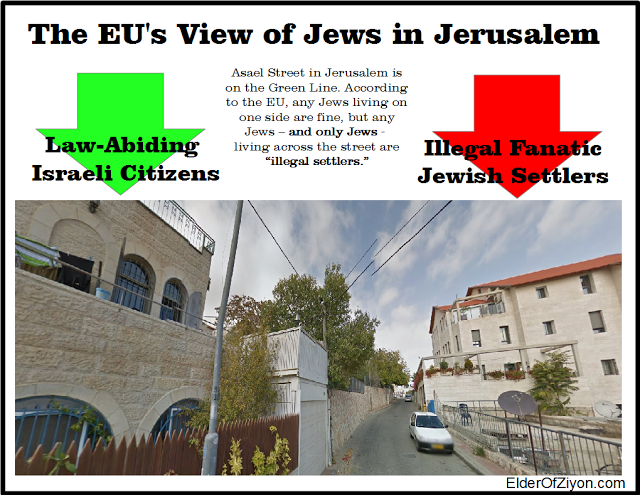
One side of the street, “good Jews;” the other side “maniacal fanatics.”

(image courtesy of Elder of Ziyon)

The Washington Post reported:

The Europeans seem ready to give Israel a little shove, which could either bring Israel back to the table or backfire. Many Israeli officials say the blame for the impasse on negotiations lies not with them but with a dysfunctional, fractured Palestinian leadership that refuses even to talk without preconditions.

This is typical reporter-speak, using a qualification to obscure a truth. Yes, “many Israeli officials say,” but what they’re saying is the truth, as documented by the Washington Post’s own Jackson Diehl.

The New York Times gives more space to the pro-EU voices, but quotes an anonymous Israeli, who, as we show later on, is exactly correct.:

But a senior Israeli official, speaking on the condition of anonymity because of the sensitivity surrounding Mr. Kerry’s diplomatic initiative, said Tuesday night that the Europeans were “intentionally or inadvertently undermining” the active American engagement in the peace process that they had been calling for for years.

“Why would any Palestinian leader agree to re-engage if they can get what they want without negotiating?” the official said. “Why enter the give and take of negotiations when you can just take what is offered by international bodies?”

Israel Matzav quotes the ADL, which makes an excellent point.

Commenting on the directives target, ADL stated settlements should not be considered an obstacle to peace.

“Successive Israeli governments from the start of the peace process, including the current one, have maintained that construction beyond the ‘Green Line’does not contradict the Israeli commitment to a negotiated resolution of all the core issues,” ADL stated in the letter to the EU foreign policy chief.

Even people who claim that “everyone knows” what shape an eventual agreement between Israel and the Palestinians will take acknowledge that Efrat, for example, will remain part of Israel.

Elder of Ziyon observes:

Israel is partially at fault for not having a clear, consistent, legal-based message to world diplomats on issues like Jerusalem, Judea and Samaria.

Beyond the legalities, though, is the reality that the poster above means to show: the world is targeting Jews, and only Jews. See this great post by Yaacov Lozowick on Beit Safafa for examples of Arab Israelis who moved to the other side of the Green Line and are never considered “settlers”.

Israel is doing a poor job at explaining its side of the story, and EU documents like this – even if only an incremental step – are the result. Nothing Israel is doing points to moving the discourse in any other direction. So things like the verbiage “borders,” instead of causing a firestorm, are roundly believed to be accurate.

As noted above, however, the EU is also showing that even as a member of the Quartet, it has no interest in adhering to the premises of the so-called peace process.

Back in late 1995, the LA Times reported:

In the last seven weeks Israel has handed over six West Bank towns and more than 400 villages to the Palestinian Authority. The authority now controls about 90% of the West Bank’s more than 1 million Arabs, and about one-third of the land in the Delaware-size territory.

For nearly 20 years, the occupation has been over. Subsequent to Israel’s relinquishing political control of most Palestinians the Palestinians have twice refused to make final deals with Israel. (In 2000-1 it was Yasser Arafat who wouldn’t make a deal with Israeli PM Ehud Barak and in 2008 it was Mahmoud Abbas who wouldn’t response to Israeli PM Ehud Olmert’s offer.) In 2000 Arafat launched a terror war against Israel in contravention of the very premises of the peace process and the PLO’s supposed rehabilitation from being a terrorist organization. Yet the Palestinian refusal to deal in good faith prompted no comparable action by the EU. Why not?

In fact the European guidelines play into the hands of Palestinian President Mahmoud Abbas who wrote two years ago in the New York Times:

Palestine’s admission to the United Nations would pave the way for the internationalization of the conflict as a legal matter, not only a political one. It would also pave the way for us to pursue claims against Israel at the United Nations, human rights treaty bodies and the International Court of Justice.

That was a clear declaration that he had no interest in negotiating with Israel, preferring instead, to rely on international organization to pressure Israel into giving him all he wants. Abbas showed his contempt for the peace process, and Europe has just provided support for his strategy.

The timing of this announcement is also beyond bizarre. The guidelines state:

These guidelines do not cover EU support in the form of grants, prizes or financial instruments awarded to Palestinian entities or to their activities in the territories referred to in point 2, nor any eligibility conditions set up for this purpose. In particular, they do not cover any agreements between the EU, on the one hand, and the Palestinian Liberation Organization or the Palestinian Authority, on the other hand.

But who benefits from such funding? A few weeks ago a senior official of the Palestinian Authority wrote an op-ed published at several Palestinian websites criticizing the PA’s President Mahmoud Abbas. Part of Sufian Abu Zayda’s complaint was summarized by Khaled Abu Toameh:

Abu Zayda and other Palestinian officials say that Abbas’s autocratic regime reminds them of the days when Yasser Arafat ran the Palestinian Authority as his private fiefdom.

No one dreamed that we would reach a situation where all the powers and top positions would be concentrated in the hands of one man, said Abu Zayda. Today, Abbas even has more powers than Arafat.

Abbas, according to Abu Zayda, has also appointed himself as the chief judge and prosecutor, making a mockery of the Palestinian judicial system.

Yesterday, in Those Boring Palestinians, Bret Stephens added (or access the complete article via a Google Search):

Two days after the publication of Mr. Abu Zaida’s op-ed, WAFA, the official Palestinian news agency, carried a rebuttal signed only by “The Security Establishment.” It denounced Mr. Abu Zaida for serving “a foreign agenda” and being a tool of “enemy media.” Then it sang Mr. Abbas’s praises in a style worthy of Egyptian state media under Hosni Mubarak.

It was a characteristically thuggish performance, which unwittingly proved Mr. Abu Zaida’s point. If Palestinians want to be interesting again, and worthy of decent respect, they could start by not playing to tin-pot type.

The European Union should not be credited with a good faith effort to restart negotiations. It is using the peace process as a cover for supporting an increasingly authoritarian Mahmoud Abbas, whose main concern is his own wealth and power, as it becomes gradually more hostile to Israel.

Stephen Leavitt suggests a number of ways Israel could strike back against the EU, including hitting it where it hurts: the pocketbook:

The third step is financial.

The EU invested close to 1 billion dollars in research grants and investments, some of which could now be lost.

Israel should approach private, patriotic wealthy Jews — Sheldon Adelson, who put his money where his mouth was this past U.S. election, comes to mind — to pick up the slack. In return, those who invest in Israeli research will reap the benefits in royalties, shared patent ownership and so on. They could stand to make a lot of money.

2) It makes them feel good but who will they hurt?

Sodastream, an Israeli company with factories in the West Bank, could be impacted by these regulations.

Posted in Israel | Tagged , , | 1 Comment

Milestones

Have you bought my book yet?

Well, if you have, you have contributed to two milestones: I made the 250th sale a couple of weeks ago, and this week, I passed four figures in earnings.

While that may not seem huge to you, realize that many, many independent authors barely get a few dozen sales.

So I would like to thank all of you who have purchased the book, let you know that book 2 is due out this October (although I’m behind schedule, so it may be delayed a month), Hugo-nominated Julie Dillon will be creating the cover art again, and I am determinedly on my way to a writing career.

You can read four chapters online. Amazon has been discounting the paperback edition. You can buy the discounted Kindle version, or purchase it on B&N and Kobo.

If you like young adult fantasy adventures (like Harry Potter), you’ll like Darkness Rising: Book One of The Catmage Chronicles. And if you don’t like them, but have children or cousins or nieces and nephews and grandchildren that do, well, buy a copy for them. Or contribute a copy to your local library.

I don’t have a tipjar here. I don’t get paid a dime to write this blog. But buying my book? Well, that will actually help keep this blog alive, because every dollar earned through my book helps make up for being downsized to part-time at my day job. And it makes me happy. And when I’m happy, I write more.

Meantime, I’m chugging away at the writing career, and pretty darned happy about it so far. I’m getting there. Step by step.

Posted in Writing | Comments Off on Milestones

Tuesday briefs

No money for terrorists: Canada closes down a “charity” that sends money to Hamas. Too bad the EU doesn’t have the courage to close down Hezbollah’s fundraising. But then, they’d have to declare Hezbollah a terrorist organization first, and they don’t think that an organization that murders Israelis all over the world fills that particular bill.

Rockets in Tel Aviv: That’s what Hamas is working for. Thankfully, Canadians are no longer supporting them financially. Good thing for us the IDF is fighting the next war, while its enemies are fighting the last one.

Europeans against the Jews, again: The EU is banning all contracts that include the West Bank.

The decree, which will go into effect Friday, will forbid any cooperation, awarding of grants, prizes and funding for any Israeli entity in the specified areas.

Yes, “occupation” is the problem, not Palestinian intransigence.

The protesters called for “cleansing” the PLO of “the generals of normalization with Israel,” first and foremost PLO Secretary-General Yasser Abed Rabbo.

The protesters chanted, “Abed Rabbo, go away!” and “Normalization is destructive!” The protest came following meetings in Ramallah and Jerusalem organized by the Geneva Initiative group.

And when does the news of this European decree, banning all contact with the Jews of Judea and Samaria, come out? Why, on Tisha B’av, the Ninth of Av, the day both Temples were destroyed, and many other tragedies occurred or were initiated. Perfect timing, EU.

Meantime, you know what doesn’t make a peep from the EU? The annual anti-Semitism by Muslims during Ramadan.

Posted in Anti-Semitism, Hamas, Israel, World | Comments Off on Tuesday briefs

The misleading AP headline of the month

Ah, AP bias: Check out the headline on this beauty.

Israel angered by Polish ban on Jewish slaughter

Holy crap! The Jews are slaughtering people? Who? What? Where? How? And the Poles are stopping them? Good for the Poles.

Israel is condemning a recent decision by the Polish parliament to forbid the traditional Jewish slaughter that makes meat kosher.

The Foreign Ministry says Israel is disappointed with the decision to “forbid an important religious ritual which has been common practice among millions of Jews since ancient times.”

Ohhhhhhhh. Jewish RITUAL slaughter. The koshering of animals. Well, why didn’t you say so in the first place, AP?

Gee. Let’s think. Why?

Also, note how the AP goes to Israelis for quotes, not, say, Polish Jews. Or even American Jews. Nope, gotta get that Israel in there. And then complain in other places that Israel doesn’t speak for all Jews (which is true).

Yep. I still hate the AP.

In the statement Monday, Israel said it was “totally unacceptable” and a blow to restoring Jewish life in Poland after World War II, when most Polish Jews were killed.

Posted in Israel Derangement Syndrome, Jews, Media Bias, Religion | Comments Off on The misleading AP headline of the month

Sunday briefs

CNN discovers racism in the Zimmerman case: Honestly, could they be any more hypocritical?

Good for you, Jo: J.K. Rowling wrote a crime novel under a pseudonym–and people loved it. The difference between its reception, and the reception of The Casual Vacancy, is enormous. Jealous people wanted to bring her down. This proves it.

The Jewish history of Israel: Once again, archeology proves the Palestinians are liars. You can’t separate Judaism from the land of Israel because that is where Judaism was born. The “Judaization” of Jerusalem is merely returning things to the way they were before the Jordanians threw all the Jews out of east Jerusalem. Which houses the Jewish Quarter, don’t forget.

A warning to the world: Israel tested a long-range ballistic missile today. Meantime, Jane’s says that Saudi Arabia has a missile base that is targeting both Iran and Israel. I can’t believe the Saudis are that stupid, but I’m not a Middle East analyst. I’ll wait and see what they think.

Oh, look, another natural gas field off the shore of Israel: More energy! More money! More ways to turn Europe’s frown upside down when dealing with Israel! This one has trillions of cubic feet of natural gas–and it’s the fifth one discovered. I’ve said this before, and I’ll say it again: This is a game-changer. Europe will start siding with Israel when Israel starts supplying Europe with energy. When they don’t need Arab oil, they will stop caring for the Palestinians–except for the most lefty of their citizens. Am I calling them shallow? Why yes, yes I am.

Posted in American Scene, Israel, Media Bias, Writing | Comments Off on Sunday briefs

Zimmerman verdict: Not guilty

The Zimmerman verdict is in, and he’s been found not guilty.

(CBS) SANFORD, Fla. – Following nearly three weeks of testimony, a jury of six women in the George Zimmerman trial has found the former neighborhood watch volunteer not guilty of second-degree murder.

He was also found not guilty of the lesser offense of manslaughter, which the jury also weighed.

At least this time, CBS News isn’t calling him a “suspected murderer“. But they sure do go on and on about the prosecution’s side and give short shrift to the defense. Gee. I wonder what verdict CBS News wanted? Remember, this is the network that gave us the forged George W. Bush National Guard memo.

Five bucks says they charge him again with “civil rights” violations.

Posted in American Scene | Comments Off on Zimmerman verdict: Not guilty

Friday brief briefs

New IDF terror report: The IDF is now devoting a subsite to news of Hezbollah terrorism. So, remember UN Security Council Resolution 1701? The one that put UN peacekeeping forces in Lebanon so that another war with Israel wouldn’t occur? The one that everyone swore would disarm Hezbollah? Yeah, not so much. Seven years later, Hezbollah can now reach every inch of Israel with its missiles. The good news is the IDF is already fighting the next war, and Hezbollah is still fighting the last one. The better news is that working with Bashar al-Assad and murdering civilians is causing the Arab world to hate Hezbollah.

It seems equally clear that Hizballah has very much reduced support from the Lebanese, Syria, Sunni Islamist leaders, and others. Given this situation, Hizballah cannot attack Israel, certainly not while its best troops are tied down in Syria. And if the rebels win in Syria, they will take on Hizballah, also supporting Lebanese Sunni Islamists. Hizballah will be too busy fighting against fellow Arabs to start a war with Israel.

Read the rest of that link. Barry Rubin presents a report on how Israel is now in the best position in the Middle East they’ve been since the end of the Six-Day War.

I have company this morning. Sarah’s off on a day trip with eldest boy, second-oldest is out of town, Larry has to work, and the twins would be home alone. So they’re with me, and that’s all you get for now.

Posted in Israel, Lebanon, Middle East, United Nations | Comments Off on Friday brief briefs

Mideast Media Sampler – 07/11/2013

1) Where did Hezbollah get American arms

Last month Lee Smith attempted to clarify if the administration had sent army to the Syrian rebels as it said it would, or not. All he (or anyone) got was studied ambiguity:

In fact, it’s still not clear what the White House is doing. In a June 13 conference call with reporters ostensibly rolling out the new policy, deputy national security adviser for strategic communications Ben Rhodes failed to provide any details. Reporters asked several times what kind of aid the administration had in mind, and whether Obama was actually going to arm the rebels. “We’re just not going to be able to lay out an inventory of what exactly falls under the scope of that assistance,” said Rhodes.

Last week, Obama himself addressed the Syria issue, without providing any more clarity than his point man for strategic communications. In an appearance on the Charlie Rose show, the commander in chief told his host, “I’ve said I’m ramping up support for both the political and military opposition. I’ve not specified exactly what we’re doing, and I won’t do so on this show.”

Maybe someone in the White House is advising Obama that obfuscation and ambiguity make a president look presidential. His administration is stealthy and indirect—instead of communicating with the public through press conferences, it prefers leaking to the media via unnamed officials. Accordingly, it was through several press reports that the “inventory,” as Rhodes repeatedly called it, was laid out. The White House will send the rebels small arms and ammunition—lethal aid, to be sure, but hardly game-changing, or even likely to tilt the balance of power on the ground in Syria.

Citing expert, Phillip Smyth, USA Today reported, though, that Hezbollah has been boasting of somehow acquiring American arms:

U.S. and Western weapons have been reaching Iranian-backed Shiite militias fighting to keep Bashar Assad’s forces in power in Syria.

Analysts say it’s unclear if the weapons were captured, stolen or bought on the black market in Syria, Turkey, Iraq or Libya. Propaganda photographs from Shiite militias posted on dozens of websites and Facebook pages show the weapons were acquired in new condition, said Phillip Smyth, an analyst for Jihadology.net, a site affiliated with the Washington Institute for Near East Policy.

Many of the weapons are things the militias “shouldn’t really have their hands on,” Smyth said. Iranians love to show “they have weapons and systems that are very close to the Americans.”

The article cites Rep. Ileana Ros-Lehtinen, who fears that in the future similar weapons were captured from rebels.

Does that mean that United States has been arming the Syrian rebels? Not necessarily. Another expert, Nic Jenzen-Jones, says that a likely source of these American weapons is Lebanon.

Given the degree to which Hezbollah has co-opted the Lebanese army this would not be a surprising result.

2) Who’s isolated now?

A few years ago a mantra among Israel’s critics was that Israeli by fighting terrorists on the Mavi Marmara and building apartments in Jerusalem had isolated itself internationally. Israel had needlessly alienated moderate Islamist Erdogan in Turkey and moderate autocrat Abbas in Ramallah. Worse Netanyahu had alienated Israel’s best friend, President Obama in Washington.

It’s useful to remember this background when reading Thomas Friedman’s Morsi’s Moment from last November.

It is impossible not to be tantalized by how much leverage Morsi could wield in the peace process, if he ever chose to engage Israel. Precisely because he represents the Muslim Brotherhood, the vanguard of Arab Islam, and precisely because he was democratically elected, if Morsi threw his weight behind an Israeli-Palestinian peace deal, it would be so much more valuable to Israel than the cold peace that Sadat delivered and Hosni Mubarak maintained. Sadat offered Israelis peace with the Egyptian state. Morsi could offer Israel peace with the Egyptian people and, through them, with the Muslim world beyond.

Ironically, though, all of this would depend on Morsi not becoming a dictator like Mubarak, but on him remaining a legitimately elected president, truly representing the Egyptian people. That is now in doubt given Morsi’s very troubling power grab last week and the violent response from the Egyptian street. President Obama has to be careful not to sell out Egyptian democracy for quiet between Israel and Egypt and Hamas. We tried that under Mubarak. It didn’t end well. …

So, as you can see, the unresolved Israeli-Palestinian conflict, the future of Egyptian democracy and the U.S.-Israel-Arab struggle with Iran and Syria are now all intertwined. Smart, courageous leadership today could defuse the Israeli-Palestinian conflict, advance Egyptian democracy and isolate the Iranian, Syrian and Hamas regimes. Weak or reckless leadership will empower all three. This is a big moment.

Friedman makes some assumptions here. He presumed that Morsi could be swayed to democracy and ignored the authoritarian nature of the Muslim Brotherhood. He presumed that the Palestinians want an agreement with Israel, which they don’t. And most of all he presumed that Israeli leader would act as he wanted them to act (“smart, courageous”).

In subsequent months, Iran and its proxies have continued to alienate themselves from the Sunni world. The Muslim Brotherhood, at least in Egypt, managed to do the same.

Erdogan after briefly flirting politically with Assad, then turned against him. And his much vaunted moderation was shown to be a sham once he turned his troops violently against protesters. Abbas can’t keep a functioning government together.

Smart Israeli leadership waited this events out and didn’t proceed recklessly as Friedman advised.

Barry Rubin provides an overview of recent events in the Middle East and how they enhanced Israel’s posture. A couple of them are:

Hamas: With Egypt’s Muslim Brotherhood thrown out of office, Hamas poses much less of a threat. Instead of having Egypt as a patron, Egypt is now a greater enemy than it was under Mubarak. That then breaks up the issue of a Brotherhood Egypt, Hamas, and Syria.

Egypt: And speaking of Egypt, the transformation for Israel’s strategy almost approaches the victory of the 1967 war except this is not a victory over Egypt but a tremendous enhancement of cooperation. The threat of the dissolution of the peace treaty and a potential new war has been replaced by a prospect of deeper peace and more strategic help.

The draining of terrorist resources and energies. Syria is now a target, as well as Iraq, for Sunni terrorists; and now Egypt is, too.

Would Israel have been better off it had made deal that would have passed muster with the now deposed Morsi? (Assuming that one was possible.) Should Israel have given in to the extremist, Erdogan’s demands? Once again Israel is considering making a confidence building gesture to bring Mahmoud Abbas back to negotiations. Given Abbas’s record and rhetoric, it’s hard to believe that he will respond positively.

Friedman’s reading of the Middle East is seen solely through his rose colored glasses of Arab moderation. Events of the past months have proven him wrong.

3) Ozymandias in the Gulf?

Martin Kramer comments on Qatar’s latest grandiose plans:

Well, Deloitte reports that Qatar is spending $200bn—yes, that’s billion—for infrastructure to host the FIFA World Cup in 2022, including six stadiums (http://usat.ly/1atXzNV). In the distant (or not-so-distant) future, Doha will make a splendid ruin. It will draw tourists for millennia.

Posted in Israel | Comments Off on Mideast Media Sampler – 07/11/2013

A busy day

Worked in NorVA today, met Barry Rubin and a bunch of other people for dinner tonight (including coblogger Soccer Dad) and had a simply lovely time.

The drive home was not so great, except for the amazing lightning. Lots of rain to go with it.

I am tired. There will be more posts tomorrow.

Posted in Life | Comments Off on A busy day

Mideast Media Sampler 07/10/2013

Who shot first?

Yesterday’s New York Times ran an editorial, Bloodshed in Egypt:

It has been all downhill for Egypt since the military ousted President Mohamed Morsi last week. On Monday, according to reports in The Times, Egyptian soldiers fired on hundreds of Mr. Morsi’s supporters as they were praying outside the facility where he was believed to be detained. At least 51 civilians were killed and more than 300 were wounded. . The military claimed its soldiers fired in response to an attack by gunmen from an unnamed “terrorist group.” But other evidence — bullet casings with the army stamp, indications that the gunfire came from the top of a nearby building — suggest a military all too willing to use excessive force.

While it places political blame on ex-President Morsi and the Muslim Brotherhood for the events Monday, the violence is blamed on the army.

The editorial linked to the initial report on Monday’s violence as reported by the paper’s Cairo bureau chief, David Kirkpatrick, Army Kills 51, Deepening Crisis in Egypt:

It was by far the deadliest day of violence since the revolt that overthrew former President Hosni Mubarak in early 2011. Within a few hours around dawn, advancing soldiers and police officers killed at least 51 civilians and wounded more than 400, almost all hit by gunfire, health officials said.

Army and police spokesmen said that one soldier and two policemen had also been killed. But according to witnesses and video footage, one of the policemen appeared to have been shot by soldiers, and the military provided little evidence to back its claim that the fighting had been instigated by the Islamists.

Was there “little evidence” that the fighting had been instigated by the Islamists?

Here’s an eyewitness account reported by the New Yorker.

A doctor who said he preferred not to give his name lives in an apartment building that overlooks the Republican Guard barracks in Cairo. He told me he woke for the dawn prayer before 4 A.M. Shortly afterward, he heard gunfire and went onto his neighbor’s balcony for a better view.

“I saw that the Army retreated about ten metres and began to fire tear-gas cannisters, about ten or fifteen of them,” he said. “I couldn’t see if the other side [the protesters] was shooting, but I heard people through megaphones encouraging jihad. Then I saw four to six motorcycles coming from the direction of the Rabaa intersection to the Republican Guard barracks. Some people were still praying, some were not, because the dawn prayer had finished by then. The men on the motorcycles were all masked, and it was hard to see them through the dark and the tear-gas smoke, but they seemed to be shooting, they were coming from behind the protesters, so they were shooting toward the protesters and the Army. Then the Army started firing. And the protestors were firing. I saw firing from both sides.” As for details, though—what they were firing, whether it was one or two protesters or something more organized—he said that it was dark and that he couldn’t exactly tell.

The Islamists remained adamant that the Army fired on peaceful demonstrators. The Army says that they were provoked. Although many eyewitnesses and video clips corroborate some details—tear gas was fired by the Army at the start; gunfire came from at least some people on both sides, even if the Army did most of the shooting—there’s no clear indication of what sparked the violence. It is clear, however, that the vast majority of fatal injuries were caused by live ammunition, and that most of the dead were protesters. (An Army officer, a policeman, and a soldier were also reported killed.) Over the past two and a half years in Egypt—melee and propaganda and obfuscation—it has always been nearly impossible to separate fact from conspiracy theory and actual conspiracy. Crowds are routinely seeded with paid thugs and provocateurs, guns have become much more prevalent, tensions and emotions are raw and ragged.

Though the New Yorker doesn’t say it explicitly past experience shows that these thugs have been on the side of Muslim Brotherhood.

Similarly, though he largely ignores the implication of this account Robert Mackey at the New York Times blog, the Lede, cited another eyewitness.

In her retrospective Facebook account, Ms. Helbawi wrote that she first became aware of trouble in the street below her home shortly after the end of dawn prayers, when the protesters began to loudly bang on the lamp posts and chant “God is great” to warn that the military was beginning to move in. Then, she said, officers fired large amounts of tear gas and many protesters fled while others stood their ground.

“The protesters responded at first with rocks and stones, and then suddenly I heard the sound of gunfire — I could not tell if it was birdshot or live ammunition — and the police and army retreated very quickly to past the gas station and it became clear that these bullets were from the protesters’ side,” Ms. Helbawi wrote. It was when the security forces returned, she said, that the officers began shooting as well.

Two eyewitnesses tell basically the same story, and Kirkpatrick (who tweeted links to both stories) claims that there’s “little evidence” to confirm the army’s account.

But there are more problems with Kirkpatrick’s reporting.

Some who vehemently denounced Mr. Mubarak’s use of brute force to silence critics were far more tepid about criticizing the killings of Mr. Morsi’s supporters, calling only for an inquiry to determine the root cause. The United States, which has conspicuously not condemned Mr. Morsi’s ouster, was also mild, calling on security forces to exercise restraint.

Perhaps the reason that the criticism of the army has been muted, is that Egyptians are well familiar with the Muslim Brotherhood’s tactics and understand that the army was reacting (or if you prefer, overreacting) to very real provocations. If you pay attention to Kirkpatrick’s timeline you’ll see that he frequently retweets Gehad El-Haddad and Shadi Hamid. The former is a spokesman for the Muslim Brotherhood; the latter is an apologist for the organization. This suggests that Kirkpatrick’s view of the Muslim Brotherhood is largely sympathetic.

Thus he demands proof of evidence against the Muslim Brotherhood, while accepting its version of events uncritically.

The police, who had never fully accepted Mr. Morsi’s authority, reveled in the day and sought to revise history: a spokesman contended that the Muslim Brotherhood — and not the police — had been responsible for killing protesters during the revolt against Mr. Mubarak. “Policemen never thought that history would speak so quickly to prove the complete innocence of the policemen in the events of the January 2011 revolution,” said the spokesman, Hany Abdel Lateef.

Some also suggested that Mr. Morsi’s supporters might be to blame for the fighting.

“We expect violent actions from the side of the Muslim Brotherhood, and we cannot accept that armed gatherings be labeled as peaceful protests or sit-ins,” Khalid Talima, a representative of the coalition formed around the anti-Morsi protests that preceded his ouster, said at a news conference under the banner “Muslim Brotherhood-American conspiracy against the revolution.”

Note the contrast. The police were revising history – no qualifications – but, on the other side, some “suggested” that the Muslim Brotherhood could be a violent organization.

Seeking to capitalize on the killing to rally supporters, the Muslim Brotherhood claimed that the soldiers had killed women and children. But hospitals and morgues reported no such casualties.

Actually it was worse than that.

It wasn’t just that the Muslim Brotherhood made uncorroborated claims, but that the claims were shown to be false. But Kirkpatrick didn’t report the more damaging version of the claim.

If there was one positive aspect to Kirkpatrick’s reporting it is at the end when he writes of Egyptian anger at Al Jazeera.

Mr. Ali, the military spokesman, raised alarms about the Arab Spring itself — heresy here just a few months ago.

He called Islamist charges the military had massacred demonstrators a new kind of “information warfare” that “runs through the Middle East region and we see since the breaking of the Arab Spring revolutions.”

“They’re all wars against the state by its own citizens,” he said, “and the main weapon in these wars is the circulation of strife, rumors and lies.”

It’s clear that Kirkpatrick is skeptical, but it’s important that he wrote this. Maybe the police and army overreacted. I wasn’t there. But based on history, it’s reasonably clear the the Muslim Brotherhood provoked or instigated the violence on Monday.

Well no, it’s not just history, it’s Twitter too.

That’s one more data point that Kirkpatrick omitted.

He also didn’t mention Muslim Brotherhood violence elsewhere in Egypt.

Postscript: The Tweets included in this post all came from Patrick Poole’s Twitter timeline. If you compare Poole’s timeline with Kirkpatrick’s it’s hard to believe that they are writing about the same events. That is not a compliment to Kirkpatrick.

Posted in Israel | Comments Off on Mideast Media Sampler 07/10/2013

Mideast Media Sampler 07/09/2013 (belated)

1. The Misadventures of Morsi

Commenting on Reuel Marc Gerecht’s thesis that having Islamists take power was probably a necessary step for political liberalization in the Arab world, Ross Douthat writes:

As I said two years ago, I have serious doubts about whether Gerecht’s thesis — which sees Islamist rule in Middle Eastern countries as a necessary-if-fraught step on the way to any kind of liberal democracy in the region — can serve as a guide for responsible U.S. policymaking. But it has always offered the most plausible script for how the Islamic world might eventually escape from its current cycle of repression feeding extremism feeding repression and so on.

The question is whether this week’s events in Egypt are following the Gerecht script or not. Is the failure of the Morsi government an example of how “time moves quickly now,” with the Egyptian public swiftly seeing Islamist rule for what it is and rejecting it decisively, opening the door for more liberal alternatives? Or is this a case where the process Gerecht hopes for hasn’t even had time to get off the ground, and the military’s intervention will just return us to the same old cycle of secular dictatorships pre-empting democracy in order to keep the lid on fundamentalists, whose popular appeal endures and eventually prompts another upheaval down the road? The Morsi government was in power long enough to produce a mass protest movement against the Muslim Brotherhood, but was it in power long enough to actually discredit the Brotherhood (at least in its current form) as the most plausible alternative to military rule? If the military actually holds new elections now, will they produce anything like a viable third way between Islamism and dictatorship, Morsi and Mubarak, the minaret and the tank?

If Douthat’s first possibility is correct, the swift failure of the Muslim Brotherhood was largely Morsi’s.

Jeffrey Goldberg recalls:

A few months ago, King Abdullah II of Jordan told me about his meetings with Mohamed Mursi, the now-deposed president of Egypt. The king wasn’t fond of Mursi, both because the Egyptian was a leader of the Muslim Brotherhood, and because Abdullah found Mursi exceedingly stupid.

“I see a Muslim Brotherhood crescent developing in Egypt and Turkey,” the king said. He despises the movement, partly because it is revanchist, fundamentalist and totalitarian, and partly because in Jordan it seeks his overthrow. “The Arab Spring highlighted a new crescent in the process of development.”

The saving grace in Egypt, he said, was that Mursi seemed too unsophisticated to successfully pull off his vision. “There’s no depth to the guy,” he said of Mursi. The king compared him unfavorably to Recep Tayyip Erdogan, the Islamist prime minister of Turkey. Like Mursi, the king asserted, Erdogan was also a false democrat, but one with patience. “Erdogan once said that democracy for him is a bus ride,” Abdullah said. “Once I get to my stop, I’m getting off.”

(Goldberg notes that Erdogan’s style has now lost some of its luster.)

Eric Trager describes how Morsi became president. He had no charisma and didn’t win based on his charm but on the effective organization of the Muslim Brotherhood. Thus:

Morsi thus won the presidency without having to be liked – thereby making it easy for people to start hating him as soon as his many flaws became apparent.

Morsi’s total reliance on the Brotherhood for his political success had another damaging effect: it made pleasing his Brotherhood colleagues a top priority, even though he campaigned promising to govern inclusively.

Morsi thus continually expanded the number of Brotherhood ministers and governors with each round of appointments, further alienating non-Islamists.

Trager then goes on to recount how Morsi sought to seize power for himself last November. Though this is slightly off topic, it’s important for another reason.

David Kirkpatrick is the Cairo bureau chief of the New York Times, an thus one of the more influential reporters in the region. He sees no threat from the Muslim Brotherhood as a political party. The other day he tweeted:

Morsi’s power grab last year was an attempt to bring the judiciary under his control but the reporter for the New York Times didn’t bring it up. (The context of the tweet is important too. Someone had argued that there was no justification for arresting Morsi.) Instead he tweeted that Morsi had been arrested unjustly before.

It’s important to remember that the New York Times’ lead reporter from Egypt is an apologist for the Muslim Brotherhood generally, and Morsi, in particular.

2. The Brotherhood’s Coup

While violence in Egypt has been increasing, it’s important to remember that there was a coup in Egypt prior to the June 30th protests. That coup occurred November 22, 2012. That’s when President Morsi attempted to seize power for himself by fiat.

Here’s how Eric Trager later characterized the events:

The Brotherhood’s most blatantly undemocratic act, however, was Morsy’s Nov. 22 “constitutional declaration,” through which he placed his presidential edicts above judicial scrutiny and asserted the far-reaching power to “take the necessary actions and measures to protect the country and the goals of the revolution.” When this power grab catalyzed mass protests, Morsy responded by ramming a new constitution through the Islamist-dominated Constituent Assembly, and the Brotherhood later mobilized its cadres to attack the anti-Morsy protesters, and subsequently extract confessions from their captured fellow citizens. So much for promises of “consultation.”

At the time Matt Bradley and Charles Levinson of the Wall Street Journal reported Egypt Sees Largest Clash Since Revolution:

Egypt’s opposition was galvanized last month when Mr. Morsi issued a decree granting him nearly unrestricted powers and placing him above the judiciary. The decree paved the way for hurried approval of a constitution that was drafted by an Islamist-dominated body that the opposition says was working illegitimately and produced a charter weighted with Islamic law. The government has set a referendum on the draft for Dec. 15.

Anti-Morsi Egyptians took to the streets. On Tuesday, they marched on the presidential palace to denounce Mr. Morsi, the first time in recent memory that protesters made it to the palace walls. On Wednesday, Muslim Brotherhood leader Essam El-Eryan, speaking on al-Jazeera, called on millions of Egyptians to go to the presidential palace to “defend the state and its legitimacy.”

Mohamed ElBaradei, one of the leaders of the opposition, countered on Wednesday that Mr. Morsi had lost all legitimacy. The president, he said, bears full responsibility for the current violence and is in danger of drawing Egypt into “something worse.”

Jeffrey Fleishman of the Los Angeles Times reported Islamists clash with rivals in Egypt:

Pro-Morsi factions overran about 200 protesters camped outside the presidential palace in north Cairo. The clashes came after the Muslim Brotherhood-allied Freedom and Justice Party called thousands of its members into the streets in a counter-demonstration to drive opposition movements from the presidential palace. …

More than 200 people were injured across a cityscape that had the charged air of a fluorescent-lighted battlefield with competing banners, bandaged men and dinner trays used as shields to block barrages of rocks.

Egyptian news reports said clashes spread to other cities, including attacks on several Muslim Brotherhood offices. There were unconfirmed reports of at least three deaths.

And as protests continued, a few days later, Stephanie McCrummen of the Washington Post reported In Egypt, a show of force from Morsi supporters:

As opponents of President Mohamed Morsi again marched to the presidential palace Tuesday night, his Islamist supporters packed a square about two miles away – near enough, several said, to take action to protect the building and their president if necessary.

“Of course, we will protect the palace,” said Mohamed Abdelsalam, 59, a government worker who was at Rabaa al-Addaweya Square with thousands of other Morsi supporters waving the green flags of the Muslim Brotherhood, Egypt’s dominant political Islamist organization. “We will not allow anyone to go inside there.” …

In recent days, opposition protesters have described having their wrists bound, being brutally beaten and interrogated by Morsi’s Muslim Brotherhood supporters during 15 hours of violent street clashes outside the presidential palace last week, during which both sides hurled rocks and wielded clubs. Protesters said their Islamist captors called them “infidels” and forced them to “confess” to being paid to stoke violence, an interpretation of events that a spokesman for the Brotherhood’s political party denied.

David Kirkpatrick of the New York Times reported further Morsi’s Allies Beat Protesters Outside Palace:

Khaled el-Qazzaz, a spokesman for Mr. Morsi, said Monday that he had ordered an investigation into the reported abuses and asked the prosecutor to bring charges against any involved. He said that Mr. Morsi was referring only to confessions obtained by the police, not by his supporters.

But human rights lawyers involved in the cases of the roughly 130 people who ended up in police custody Wednesday night, all or most of them delivered by the Islamists, say the police obtained no confessions. “His statement was completely bogus,” said Karim Medhat Ennarah, a researcher on policing at Egyptian Initiative on Personal Rights, whose lawyers were on hand about an hour after the speech when prosecutors released all the detainees without charges. “There were no confessions; they were all just simply beaten up,” he said. “There was no case at all, and they were released the next day.”

Officials of the Muslim Brotherhood said the group opposed such vigilante justice and did not organize the detentions. And in at least one case one victim said a senior figure of the group rescued her from captivity. But the officials also acknowledged that some of their senior leadership was on the scene at the time. They said some of their members took part in the detentions, along with more hard-line Islamists.

Reading these articles makes clear that the dissatisfaction with Morsi and the Muslim Brotherhood is not new. In fact it makes the events of the past week even less surprising, if not predictable.

But something else needs to be said. When the New York Times argues that the recent coup, was a “rejection of democracy,” it proceeds from an assumption that democracy equates with a free election. But a free election a necessary but insufficient condition for democracy. The winner of a free election needs to understand that he is limited by the will of the people who elected him for an election to be sufficient. Morsi (and the Muslim Brotherhood) never accepted any such limit. They saw an election as a license to rule according to their ideology and seize more power.

After Morsi’s power grab in November a New York Times editorial exhorted the administration “… to speak out when [Morsi] tramples on democratic principles at home.” But the premise of the editorial was that Morsi’s power grab was an aberration, not his expected behavior.

With the Muslim Brotherhood, an attempt to seize power once it achieves political power is a feature of its ideology, not a bug.

What Morsi did in November was, effectively, a coup. That he backed down when enough pressure was brought to bear, didn’t mean that he thought he was wrong. Subsequently, he and the Muslim Brotherhood intimidated opponents, attempted to impose their standards on the Egyptian artistic community and appointed allies to political positions. Maybe last week’s news was a coup, but it wasn’t the first. Maybe it wasn’t democratic, but it was no less democratic than the power it replaced.

Posted in Israel | Comments Off on Mideast Media Sampler 07/09/2013 (belated)

Tuesday briefs

It’s not just Jews: Terrorists in Egypt are targeting Arab-Israelis who visit the Sinai. You know, for a religion of peace, Islam sure does seem to have a lot of violent adherents.

It’s not just Israelis: Red-on-red in Lebanon today, as a huge bomb explodes in the heart of Hezbollah territory. And Egypt may be headed for civil war. Meantime, John Kerry is concentrating on–peace talks between Israel and the Palestinians. Smart power!

Yeah, the boycott isn’t going to work: Ender’s Game is probably going to be a huge hit, and I’m pretty sure the gay activists calling for a boycott because Orson Scott Card is against gay marriage isn’t going to affect the box office. Except in San Francisco and the Village. In any case, Card has released a rather in-your-face statement about the boycott.

Bad days for Hamas: I love the pullquote from this article.

Stunned silence among Hamas officials in Gaza greeted Morsi’s overthrow last Wednesday by the Egyptian military.

May Hamas continue to have many, many bad days. And then disappear.

Fighting anti-Semitism in France: It’s a losing battle, Rabbi. As long as the French authorities allow the “youths” to continue what they’re doing with little or no fear of punishment, Muslims in France will attack Jews with impunity.

Posted in Anti-Semitism, Hamas, Israel, Lebanon, Middle East, Terrorism | Comments Off on Tuesday briefs

Sunday briefs

Now we know why Abbas is so optimistic: Kerry’s plan for talks between the Palestinians and Israel include concessions by Israel, more concessions by Israel, and even more concessions by Israel–and nothing from the Palestinians except to sit down and talk. Release of prisoners? Check. Freeze on “settlements”? Check. Money to the Palestinians? Check. And what do the Israelis get? If you said, “Nothing,” you could be a Zionist/neocon/whatever they’re calling us today.

More bad news for Hamas: Egypt is destroying more Gaza tunnels, as well as clamping down on the Sinai. Pass the popcorn, this can only get better.

The Brotherood Blues: Hamas may be upset, but Abbas is celebrating the fall of the Muslim Brotherhood in Egypt. Yeah, Hamas is in trouble now. If only Qatar would stop funding terrorists, maybe we could get some progress in the Middle East. But then there are always the Saudis still there. Come on, fracking and shale oil–drive that price down and drain their pockets!

Mamas, don’t let your babies grow up to fight Syria: Apparently, Lebanese parents don’t want their children dying for Bashar al-Assad. Sounds like the Arabs have got Foreign War Syndrome.

Posted in Hamas, Israel, Lebanon, Middle East, Syria | 1 Comment

Mideast Media Sampler – 07/05/2013

1) Debating the coup at the New York Times

Much of the editorial opinion and some of the reporting in the mainstream media has opposed the Egyptian military’s forcible removal of Mohammed Morsi as President of Egypt. Actually, surprisingly, there’s a debate about it on the opinion pages of the New York Times. It’s surprising because the reporting of the New York Times has been skeptical of the Tamarod, the protest movement that sought Morsi’s resignation. It’s doubly surprising because the New York Times isn’t usually known for offering a diversity of opinion.

On the one side there’s an unsigned editorial, and an op-ed by Shadi Hamid. But perhaps the clearest anti-protest expression came from Samer Shehata, In Egypt, Democrats vs. Liberals.

Egypt has a dilemma: its politics are dominated by democrats who are not liberals and liberals who are not democrats.

In this case, the favored democrats are defined narrowly as the group that has won an election, but ignoring how it behaved once it achieved power.

On the other side are Roger Cohen and David Brooks. But the clearest anti-Morsi sentiment came from Sara Khorshid, A Coup, but Backed by the People.

Make no mistake: there is no democracy under military rule. Yet I supported the June 30 protests knowing that military rule was imminent, because Mr. Morsi’s rule had not been democratic, either.

Throughout the year of his presidency, protesters who opposed him were violently crushed by the police and by Muslim Brotherhood members. He supported the Interior Ministry in its violent tactics against demonstrators and failed to investigate incidents in which protesters were killed. Journalists and activists were arrested, and the president issued an edict giving him immunity from judicial review. The presidential election, conducted without a clear legal framework, was not enough to make Mr. Morsi’s rule democratic.

Despite Mr. Morsi’s constant claims that someone was undermining his efforts, his actions always seemed aimed at extending the Muslim Brotherhood’s domination of state institutions. He was in constant conflict with the judiciary, most recently with a proposal to lower the retirement age to clear the way for the appointment of his allies.

The nature of the Muslim Brotherhood seems to have been grasped by David Brooks, but not Roger Cohen.

I’ll include Thomas Friedman as a special case. For the most part, he sided with the protesters and he even got a nice mention by Eric Trager.

His column, Egypt’s Revolution Part II made a number of good points but the problem is how it how it meshed with some of his previous columns.

Always remember: Morsi narrowly won the Presidency by 51 percent of the vote because he managed to persuade many secular and pious but non-Islamist Egyptians that he would govern from the center, focus on the economy and be inclusive. The Muslim Brotherhood never could have won 51 percent with just its base alone. Many centrist Egyptian urban elites chose to vote for Morsi because they could not bring themselves to vote for his opponent, Ahmed Shafik, a holdover from the regime of Hosni Mubarak. So they talked themselves into believing what Morsi was telling them.

As it gradually became apparent that Morsi, whenever he had a choice of acting in an inclusive manner – and pulling in all sectors of Egyptian society – or grabbing more power, would grab more power, a huge chunk of Morsi voters, Islamists and non-Islamist, started to feel cheated by him. They felt that he and his party had stolen something very valuable – their long sought chance to really put Egypt on a democratic course, with more equal growth.

However, a year and a half ago, Friedman wrote in Watching Elephants Fly:

If you do, the first thing you’ll write is that the Islamist parties — the Muslim Brotherhood and the Salafist Al Nour Party — just crushed the secular liberals, who actually sparked the rebellion here, in the free Egyptian parliamentary elections, winning some 65 percent of the seats. To not be worried about the theocratic, antipluralistic, anti-women’s-rights, xenophobic strands in these Islamist parties is to be recklessly naïve. But to assume that the Islamists will not be impacted, or moderated, by the responsibilities of power, by the contending new power centers here and by the priority of the public for jobs and clean government is to miss the dynamism of Egyptian politics today.

Friedman’s old assumption was that the responsiblities of governing would moderate the Muslim Brotherhood. It wasn’t a hope, but an expectation (despite the qualification about not being worried.) So I don’t think it was “gradually apparent” that Morsi wouldn’t respect the rule of law; it was to be expected. (I have a similar reservation about Cohen’s column.)

Six months ago, in a remarkably prescient article, Think Again, Eric Trager laid out why the Muslim Brotherhood should have been expected to moderate, and noticed that the opposition was starting to coalesce.

Jackson Diehl of the Washington Post sees no good coming of the coup. He writes in Egypt’s Misguided Coup:

Applauders of military coups have in common two illusions: that the generals share their agenda and that their hated opponents, despite their electoral victories, can be politically nullified. Invariably, neither turns out to be true. Armed forces aren’t good at convening roundtables or implementing liberal platforms; they are good at using force. Even if they don’t torture and kill, they sweep up nonviolent political leaders, shut down media they regard as troublesome and try to impose political rules protecting their own political and economic interests.

That is what the Egyptian army did after removing Hosni Mubarak in 2011. On Wednesday it began shutting down television stations and rounding up Muslim Brotherhood leaders while Egypt’s self-described liberal democrats were still celebrating their supposed popular revolution.

Unlike Thomas Friedman, Diehl is serious. He compares Egypt’s recent coup with others in recent years. However, his failure here is a failure to acknowledge the nature of the Muslim Brotherhood.

The Egyptian Organization of Human Rights wrote One year into Mohamed Morsi’s term Manifold abuses and the systematic undermining of the rule of law:

One year after Morsi became president, it is now clear that the priority of the presidency—and, of course, the Muslim Brotherhood —was to firmly establish the underpinnings for a new authoritarian regime in place of the Mubarak regime. It is no surprise, therefore, that the past year witnessed widespread human rights crimes, on a scale that rivaled than under the Mubarak regime. The brutal suppression of political and social protest movements did not cease; indeed, the security forces are no longer the only party to use of excessive force against demonstrators, as MB supporters have also been given free rein to use violence to punish and intimidate their opponents, including through torture and even killings, whether at the gates of the presidential palace, in front of the main MB headquarters in Muqattam, or in squares in other governorates. The situation has recently culminated in the incitement of violence against Shiites and against participants in the protests planned for June 30; the incitement took place at a recent press conference attended by the president, government officials, and leaders in the Muslim Brotherhood. Repercussions of this incitement have already become all too clear – days later, four Shiites were killed by a mob in the village of Abu Muslim in Giza.

To be sure a coup is a tricky thing and Egypt’s army mustn’t be confused with enlightened Western democrats. Still it’s likely that their self interest will lead to a more open government than would be possible with Muslim Brotherhood rule.

Let me allow Barry Rubin to get the last word in:

And, sorry, but if that means that popular totalitarian movements don’t get to enjoy the fruits of their election or military victories so that they can better wipe you out, then so be it. So that government of the people, by the people, and for the people shall not perish from this earth. And one day, others can enjoy those benefits when conditions are ripe.

2) Without the coup

A coup is, obviously, not an ideal way to change power. However, sometimes it needs to be asked, what would happen without the coup? Three recent stories raise this question.

  • Egypt steps up Gaza tunnel crackdown, dismaying Palestinians

    Report: Egyptian military deploys tanks on Gaza border

    Six Hamas operatives arrested in Cairo

  • While closing the tunnels affected traffic both ways, the arrest of the Hamas operatives suggest that the military authorities saw them as a threat to support the Muslim Brotherhood leadership (violently) against the protesters. Did Egypt’s military see Hamas as source of instability? An Egyptian court recently ruled that the Muslim Brotherhood conspired with Hamas and Hezbollah to orchestrate a massive jailbreak – freeing, among others, Mohammed Morsi – in 2011. (There might also be a larger question about how the Muslim Brotherhood is now being viewed in the Arab world.)

    While the degree that Hamas threatens Egypt is speculative, Egypt continues to close its border with Gaza.

    Posted in Israel | Tagged , | 1 Comment