Mideast Media Sampler Feb. 17

The revolution + 2 

Two years ago last week, growing protests against Hosni Mubarak eventually (with a nudge from the military) forced him from power. Here’s a sampling of news and comment from the New York Times of those momentous events, plus contrasts to current commentary and news.

What they thought then:
Uncharted Ground After End of Egypt’s Regime – News Analysis by Anthony Shadid – February, 11 2011

Egypt’s revolution earned many names in 18 days: Revolution of the Youth, of the People, of Anger, of Freedom, of the Hungry, and most poetically, the Revolution of Light. In the end, it was called the January 25 Revolution, the date of the first protest. In that, it was a departure from another revolution, that of July 26, when Gamal Abdel Nasser and fellow officers seized power from a decadent king and mobilized Egypt for wars with Israel. It evolved into something far less ambitious: a mantra of security and stability, in which Egyptians and many Arabs were forced to give up their rights.
Even in his very last days, Mr. Mubarak understood the conflict in those terms; in his last speech to the nation, he spoke of security and stability 10 times. The protesters in Cairo wrecked the regional formula, though their ambitions have yet to offer a paradigm to replace it. “Leaders in the Arab world are weaker now,” said Sadiq al-Azm, a prominent Syrian thinker and writer.
Whatever order emerges will almost certainly be less favorable to Israel and the United States, both symbols to many protesters of Egyptian subservience. It was no coincidence that the most outspoken proponents of Mr. Mubarak’s rule were Israel and Saudi Arabia who, with Egypt, formed the spine of American dominance in the region. Nor will economic reforms of the kind mandated by the International Monetary Fund make headway in a country that blames them for creating a class of crony capitalists.

A Tunisian-Egyptian Link That Shook Arab History – by David D. Kirkpatrick and David E. Sanger – February 11, 2011

The White House had been debating the likelihood of a domino effect since youth-driven revolts had toppled President Zine el-Abidine Ben Ali in Tunisia, even though the American intelligence community and Israel’s intelligence services had estimated that the risk to President Mubarak was low — less than 20 percent, some officials said.
According to senior officials who participated in Mr. Obama’s policy debates, the president took a different view. He made the point early on, a senior official said, that “this was a trend” that could spread to other authoritarian governments in the region, including in Iran. By the end of the 18-day uprising, by a White House count, there were 38 meetings with the president about Egypt. Mr. Obama said that this was a chance to create an alternative to “the Al Qaeda narrative” of Western interference.
American officials had seen no evidence of overtly anti-American or anti-Western sentiment. “When we saw people bringing their children to Tahrir Square, wanting to see history being made, we knew this was something different,” one official said.

Iran Uses Force Against Protests as Region Erupts – Neil MacFarquhar and Alan Cowell – February 14, 2011

The unrest was an acute embarrassment for Iranian leaders, who had sought to portray the toppling of two secular rulers, Zine el-Abidine Ben Ali in Tunisia and Hosni Mubarak in Egypt, as a triumph of popular support for Islam in the Arab world. They had refused permission to Iranian opposition groups seeking to march in solidarity with the Egyptians, and warned journalists and photographers based in the country, with success, not to report on the protests.
Iranian demonstrators portrayed the Arab insurrections as a different kind of triumph. “Mubarak, Ben Ali, now it’s time for Sayyid Ali!” Iranian protesters chanted in Persian on videos posted online that appeared to be from Tehran, referring to the country’s supreme leader, Ayatollah Ali Khamenei.
The Iranian authorities have shown that they will not hesitate to crush demonstrations with deadly force. Other governments across the Middle East and the Persian Gulf also moved aggressively to stamp out protests on Monday.

Secret Report Ordered by Obama Identified Potential Uprisings – by Mark Landler – February 16, 2011

President Obama ordered his advisers last August to produce a secret report on unrest in the Arab world, which concluded that without sweeping political changes, countries from Bahrain to Yemen were ripe for popular revolt, administration officials said Wednesday.
Mr. Obama’s order, known as a Presidential Study Directive, identified likely flashpoints, most notably Egypt, and solicited proposals for how the administration could push for political change in countries with autocratic rulers who are also valuable allies of the United States, these officials said.

The 18-page classified report, they said, grapples with a problem that has bedeviled the White House’s approach toward Egypt and other countries in recent days: how to balance American strategic interests and the desire to avert broader instability against the democratic demands of the protesters.

They did it – Thomas Friedman – February 12, 2011

This could get interesting — for all the region’s autocrats. Egypt’s youthful and resourceful democrats are just getting started. Up to now, the democracy movement in the Arab world was largely confined to the U.S.-led liberation of Iraq, which, because it was U.S.-led, has not been able to serve as a model for emulation. If, and it remains a big if, Egypt can now make the transition to democracy, led by its own youth and under the protection of its own armed forces, watch out. The message coming out of Cairo will be: We tried Nasserism; we tried Islamism; and now we’re trying democracy. But not democracy imported from Britain or delivered by America — democracy conceived, gestated and born in Tahrir Square. That will resonate among Arabs — and in Iran.

What Egypt can teach America – Nicholas D. Kristof – February 12, 2011

It’s a new day in the Arab world — and, let’s hope, in American relations to the Arab world. The truth is that the United States has been behind the curve not only in Tunisia and Egypt for the last few weeks, but in the entire Middle East for decades. We supported corrupt autocrats as long as they kept oil flowing and weren’t too aggressive toward Israel. Even in the last month, we sometimes seemed as out of touch with the region’s youth as a Ben Ali or a Mubarak. 

From 9/11 to 2/11 – Roger Cohen – February 13, 2011

Perhaps the most effective antidote to 9/11 will prove to be 2/11, the day Hosni Mubarak conceded the game was up with his 30-year-old dictatorship and left town under military escort for the beach. We’ve tried invasions of Muslim lands. We’ve tried imposing new systems of government on them. We’ve tried wars on terror. We’ve tried spending billions of dollars. What we haven’t tried is tackling what’s been rotten in the Arab world by helping a homegrown, bottom-up movement for change turn a U.S.-backed police state into a stable democracy. This is the critical opportunity Egypt now presents. Islamist radicalism has thrived on the American double standards evident in strong support for the likes of Mubarak’s regime. It has prospered from the very brutal repression that was supposedly essential to stop the jihadists. And it has benefited from the reduction of tens of millions of Arab citizens to mere objects, shorn of dignity, and so more inclined to seek meaning in absolutist movements of violence.

What we know now:

The Muslim Brotherhood’s 213 year revolution – Eric Trager – February 15, 2013

Thus, Al-Dardery said, the significance of Egypt’s 2011 uprising was that it represented the first opportunity for Egyptians to finally answer collectively, “What is the future of Egypt? Where Egypt should go?” And the Muslim Brotherhood’s successive electoral victories have legitimized its preferred formula, which reconciles “the Islamic tradition with…Euro-American developments.” Al-Dardery traced this approach back to late nineteenth- and early twentieth-century Islamic thinkers such as Muhammad ‘Abduh and Rashid Rida, as well as Brotherhood founder Hassan al-Banna, who aimed “to take from Europe the best we could, add it to the best traditions we have, and try to create the third alternative.” It bears emphasizing that this “third alternative” takes “Euro-American developments” — specifically western scientific advances and administrative procedures, such as electoral politics — but uses them to advance the Brotherhood’s “Islamic tradition,” which emphasizes “instituting the sharia” and, thereafter, building a “global Islamic state.” This approach makes it different from, say, traditional Salafists, who until recently largely rejected western advancements as illicit “innovations.” But the Brotherhood’s approach ultimately views western values — such as political secularism and pluralism — as imports against which, according to Al-Dardery, Egyptians have been fighting for 213 years.
This is, of course, not what motivated most of the revolutionaries who bravely took to Tahrir Square two years ago, demanding political freedom and touting their ecumenism. But the Islamist organization that seized the revolutionaries’ initial momentum has been fighting a very different battle for nearly a century, and Washington should note that the Brotherhood essentially views Egypt’s revolution as part of an ongoing struggle against western influence and values. One of the Brotherhood’s own spokesmen, after all, said as much in Washington.

Little Princes survive the Arab Spring – Michael Rubin – February

Alas, the Arab Spring may have swept away one generation of dictators but it did not do away with the “Little Prince” phenomenon. David Schenker, perhaps Washington’s most consistently correct Arab affairs analyst, notes the pattern has now re-emerged in Cairo. According to the Associated Press:

Egypt’s aviation minister says the hiring of President Mohammed Morsi’s son to a highly-paid government job was justified, dismissing accusations of nepotism… Omar, one of the president’s five children and a recent university graduate, got the internally-advertised job in a department that usually hires with a starting monthly salary of $5,000. Such a figure is unheard of for new graduates in Egypt, where the starting salary for a government job can be as low as $75.

Clearly, the Muslim Brotherhood is just as corrupt as the regime it replaced, if not more so.

True Belief, Cynical Manipulation, Peer Pressure: How Arab Governments Manage the Israel Issue – By Barry Rubin – February 15, 2013

Islamist Era: Indeed, the rise of revolutionary Islamism put additional Peer Pressure on all Arab regimes. They needed the Israel issue more for Cynical Manipulation and, except for the always moderate Jordanian regime and the Sadat-altered Egyptian one, could not afford to think of peace. The non-Saudi Persian Gulf states were tempted, however, as were the main Lebanese Christian forces. In 2013, support from the UN for the first time made the original two-stage theory seem possible in practice. If Palestine was now an independent state, it could win that status without making concessions or commitments. Using international backing, it could create an entity which—unlike the one existing under the Camp David accords—could eventually be used as a base for attaining total victory. Many Palestinian nationalist leaders were, literally, of two minds. >Simultaneously, they understood better Israel’s strength yet they could not shake the need for True Belief, reinforced both by Cynical Manipulation and Peer Pressure from their own movement and from Hamas. Islamist regimes and groups—notably Hamas and Hizballah as well as the Muslim Brotherhood and of course al-Qaida and other Salafists plus the Iranian Islamist regime—followed the pattern of the early Arab nationalists. Only the lack of Islam had prevented Israel’s extinction but they were going to do the task the proper way.

Plus some headlines:
Concerns over media freedoms in Mursi’s Egypt – Al Arabiya – January 24, 2013
Egyptian Currency Reserves Running Critically Low – Wall Street Journal – February 5, 2013
Protests turn to street clashes across Egypt – AP – February 8, 2013
Official: Funds allocated to diesel subsidies have run out – The Egypt Independent – February 16, 2013 (h/t Eric Trager)

What we knew back then:

Taking A Clear-Eyed Look at the Obama Administration’s Full Two-Year Record on Reform in Egypt – ABC News – February 11, 2011

Perhaps more glaringly, while the Bush administration tried to directly fund civil society in Egypt – pro-democracy groups and the like – the Obama administration changed that policy and cut funding significantly, ending an effort to provide direct funding to democracy groups not “approved” by the Egyptian government, and reduced funding in the budget for programs to promote civil society groups.

Posted in Israel, Media Bias, palestinian politics | Comments Off on Mideast Media Sampler Feb. 17

Mideast Media Sampler 02/18/2013

1) The Obama administration vs. Hezbollah

Today’s New York Times features an op-ed, Hezbollah unmasked by President Obama’s national security adviser, Thomas Donilon. After providing the details of Hezbollah’s blood drenched history, (similar to a case made recently by Ambassador Michael Oren) Donilon concludes:

Now that Bulgarian authorities have exposed Hezbollah’s global terrorist agenda, European governments must respond swiftly. They must disrupt its operational networks, stop flows of financial assistance to the group, crack down on Hezbollah-linked criminal enterprises and condemn the organization’s leaders for their continued pursuit of terrorism.

The United States applauds those countries that have long recognized Hezbollah’s nefarious nature and that have already condemned the group for the attack in Burgas. Europe must now act collectively and respond resolutely to this attack within its borders by adding Hezbollah to the European Union’s terrorist list. That is the next step toward ensuring that Burgas is the last successful Hezbollah operation on European soil.

I’m not a big fan of the administration, but this is a welcome development.

2) Bob Simon vs. Iron Dome 


Two thirds of Bob Simon’s segment Will Israel’s Iron Dome help bring peace? isn’t bad. While his emphasis on American funding is a bit disconcerting (especially because of what it’s setting up later) overall, the first part of his report is straightforward. But then he starts twisting the report to make his point:


Barak argues that if Iron Dome makes Israelis feel more secure, less threatened, they’ll be more willing to make peace with the Palestinians. You wont find many Palestinians who agree.

Husam Zomlot: Before the Iron Dome, they felt no pressure to make any concessions. After the Iron Dome, they will feel the pressure to make concessions? Of course not.

Husam Zomlot is a PLO diplomat and a professor at Bir Zeit University.

Zomlot, of course, is a disinterested observer. (Not!) Why is this even relevant? It recalls Thomas Friedman who argued in Iron Empires, Iron Fists, Iron Domes:

Meanwhile, with a few exceptions, the dome and wall have so insulated the Israeli left and center from the effects of the Israeli occupation that their main candidates for the Jan. 22 elections — including those from Yitzhak Rabin’s old Labor Party — are not even offering peace ideas but simply conceding the right’s dominance on that issue and focusing on bringing down housing prices and school class sizes. One settler leader told me the biggest problem in the West Bank today is “traffic jams.”

The problem isn’t that Israel somehow “insulated” from the peace process, but that no one wishes to negotiate with them. Abbas hasn’t budged on insisting on a full settlement freeze before he would negotiate.

Though Zomlot here seems to be implying that terror helps bring needed pressure on Israel, when Simon asks him specifically about that, Zomlot denies that he meant that.

Later Simon badgers Barak:

Bob Simon: But how does it work? I mean, right now, Israel has just announced the building of a gigantic settlement project. This is at the same time that the Americans are providing the money for Israel’s most important defense system.

Ehud Barak: You know, we are highly grateful to the administration, to American people as a whole for this support. I don’t think that it’s relevant to the issue of Iron Dome.

Israelis argue that America’s commitment to their security must be kept separate from political disagreements between the U.S. and Israel.

Simon, of course, is exaggerating what the announcement of E-1 was. He’s also misleading in that E-1 had always been assumed to remain part of Israel. But he’s making a point, “how can Israel disrespect the United States?”

Strangely he doesn’t ask a similar question of Zomlot: “The United States has been giving millions of dollars of aid to the Palestinians, why did they refuse to heed the administration and head to the UN in order to gain statehood status?”

Bob Simon is stuck on believing that only Israel is responsible for making peace. Somehow it escaped him that even though Israel withdrew fully from Gaza in 2005, it did not achieve peace in its south. If concrete Israeli concessions really brought peace, Israel would not have had to build Iron Dome. This irony is somehow lost on Bob Simon.

Posted in Israel, Middle East | Comments Off on Mideast Media Sampler 02/18/2013

Paying attention, Rihanna?

A sad case about a woman who left one violent boyfriend only to be murdered by another.

Pistorius and his family claim it was a horrible “accident”. He’s saying he thought she was an intruder. The police have found a bloody cricket bat and are testing to see whose blood is on it.

“The suspicion is that the first shot, in the bedroom, hit her in the hip,” one source was quoted as saying. “She then ran and locked herself in the toilet. She was doubled over because of the pain. He fired three more shots. She probably covered her head which is why the bullet also went through her hand.”

Meantime, Rihanna is not only back with the man who beat her, but she shows up at the Grammy Awards with him. Those would be the selfsame Grammys that she missed attending because he beat the shit out of her.

I rarely post about celebrities. But sometimes, stuff happens that makes me want to hit them upside the head and say, “WHAT THE HELL ARE YOU THINKING?”

Leave him. He’s hit you once, he’ll hit you again. He couldn’t even perform his court-mandated community service. He had his mother help him play the system and used a starstruck, corrupt police chief (who resigned before he was fired) to fake his community service records.

Yeah, he’s gonna hit you again, Rihanna. And the public is going to shrug its collective shoulders and say, “Shoulda left him, idiot.”

Just hope that he doesn’t kill you, next time.

Posted in American Scene, Music, Pop Culture | Comments Off on Paying attention, Rihanna?

Not here, you won’t

Just say no: If you’re looking for news on the cruise ship that lost power and became the cruise from hell, you’ll have to go somewhere else for the details.

STOP RUINING THE NARRATIVE! Israeli soldiers treat wounded Syrians near the northern security fence.

Chicago: Deadlier than Afghanistan and Iraq. Afghan vet survives Afghanistan and is murdered in Chicago–shielding his two-year-old son from a sudden rain of bullets.

This is why you need a gun: Father killed trying to stop home invaders from entering his 11-year-old daughter’s bedroom.

Hiroshima times 30: That’s how strong the Russian meteor was when it blew up.

Posted in American Scene, Guns, Israel | Comments Off on Not here, you won’t

Friday briefs

Hamas goes to Bulgaria: They’re visiting the country privately, not meeting with the government.

Hamas leaves Bulgaria: The Bulgarian government gave them the bum’s rush. Two words: Awe and Some. Bulgaria just reported that the bombing of the Israeli tourist bus was done by Hezbollah. Good for them to throw Hamas terrorists out of their country.

A big, big, BIG fish: Ynet profiles the Iranian terrorist/general killed in Syria. Iran and Hezbollah are hurting today.

STOP SCREWING WITH THE NARRATIVE:

Knesset Member Moshe Feiglin ( Likud) who is commonly associated with extremist political and religious views, made a surprising announcement on Thursday: “I decided to shake hands with women. There is no halacha against it if it’s done out of courtesy.”

Meteor strikes Russia, windows hardest hit: You know, after seeing the video, I read this post by Instapundit and realized that we are sorely lacking in disaster preparedness. Duck and Cover may have saved over 1,000 Russians from the flying glass injuries they suffered. You may want to watch this video and learn more.

Posted in Israel, Media Bias, Terrorism | 2 Comments

Got a big one in Syria

There was a HUGE hit in Syria on the Iranian Revolutionary Guards. A general was assassinated in Syria. If I were a betting person, I’d say that Israel has agents inside the country that are helping the rebels.

None of the dozens of rebel groups fighting in Syria claimed responsibility for the killing, though all are outspoken about their enmity for Iran because of its consistent support for Assad’s regime.

The AP, of course, spins the story in the weirdest way possible. Does it headline that the general was assassinated? Well, they started that way with the blurbs. But now the focus is on–yes, really–mourning him.

Iran Mourns Slain Senior Military Commander
Prominent Iranian politicians and clerics led mourners at a funeral Thursday for a senior commander of the country’s powerful Revolutionary Guards who was killed this week while traveling from Syria to Lebanon, local media said.

Also, get this part:

The semiofficial Fars news agency identified the slain commander as Gen. Hassan Shateri, and said he was in charge of reconstruction projects in southern Lebanon. He was killed on the road linking Damascus with Beirut on Wednesday, it said.

Really? Reconstruction projects? What would those be? This was
the guy who helped rebuild southern Lebanon after Israel bombed it in the last war.

Gen. Shateri headed Iran’s efforts to help southern Lebanon rebuild after the 2006 war with Israel, according to Iranian media, which said he had arrived in Beirut immediately after the conflict. In Lebanon, Gen. Shateri worked under the alias Husam Khoshnevis, according to Iranian and Lebanese media, which have quoted Gen. Shateri and published his picture under that name in articles discussing rebuilding activities, suggesting he was hiding his military background while serving in a civilian role.

In other words, he led the effort to bring in more missiles hidden in more civilian houses for the next war. The AP utterly whitewashes this, and the WSJ doesn’t do a very good job pointing it out, either. (Which is why you read this site, of course, because I give you the information the news media withholds.)

Good riddance to bad rubbish. May there be more joining him, and soon.

Posted in Iran, Lebanon, Media Bias, Middle East, Syria | Comments Off on Got a big one in Syria

Meryl fixes a chair

Once in a blue moon–nah, not even that often–I do something that is actually handy. Like today, I finally decided to take the whole cushion off my kitchen chair with the broken legs, and replace the ripped cushion on my kitchen chair with the good legs. And because my family would demand photographic evidence that I actually did this, here it is:

The good and the bad:

Chairs

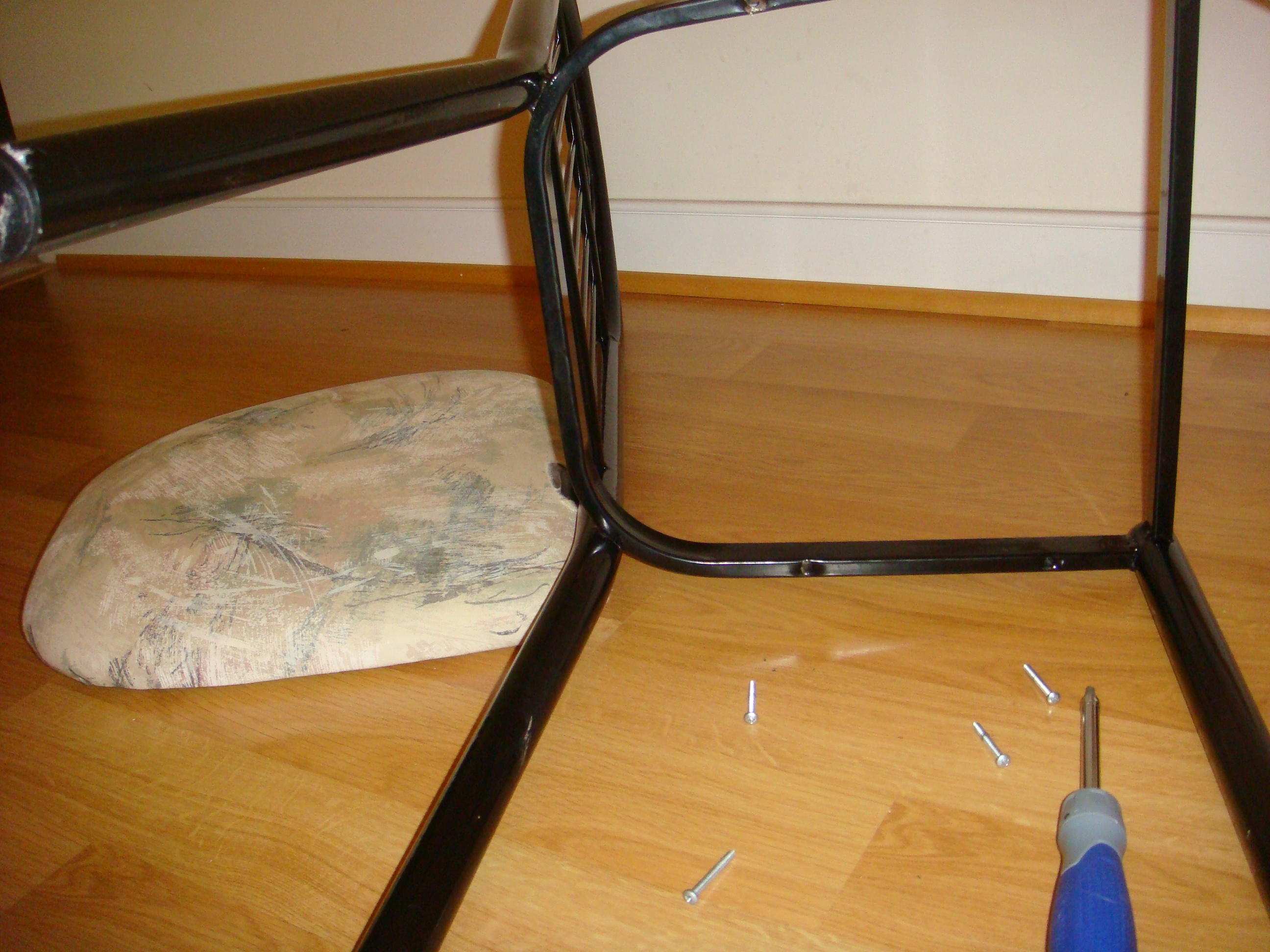
First things first: I unscrewed the bad cushion from the good chair and took the thing apart. I used a screwdriver that my brother suggested I buy, one of those deals that has interchangeable screw tips, or whatever they’re called. “This isn’t so bad,” I thought as the screws came out easily.

Chair taken apart

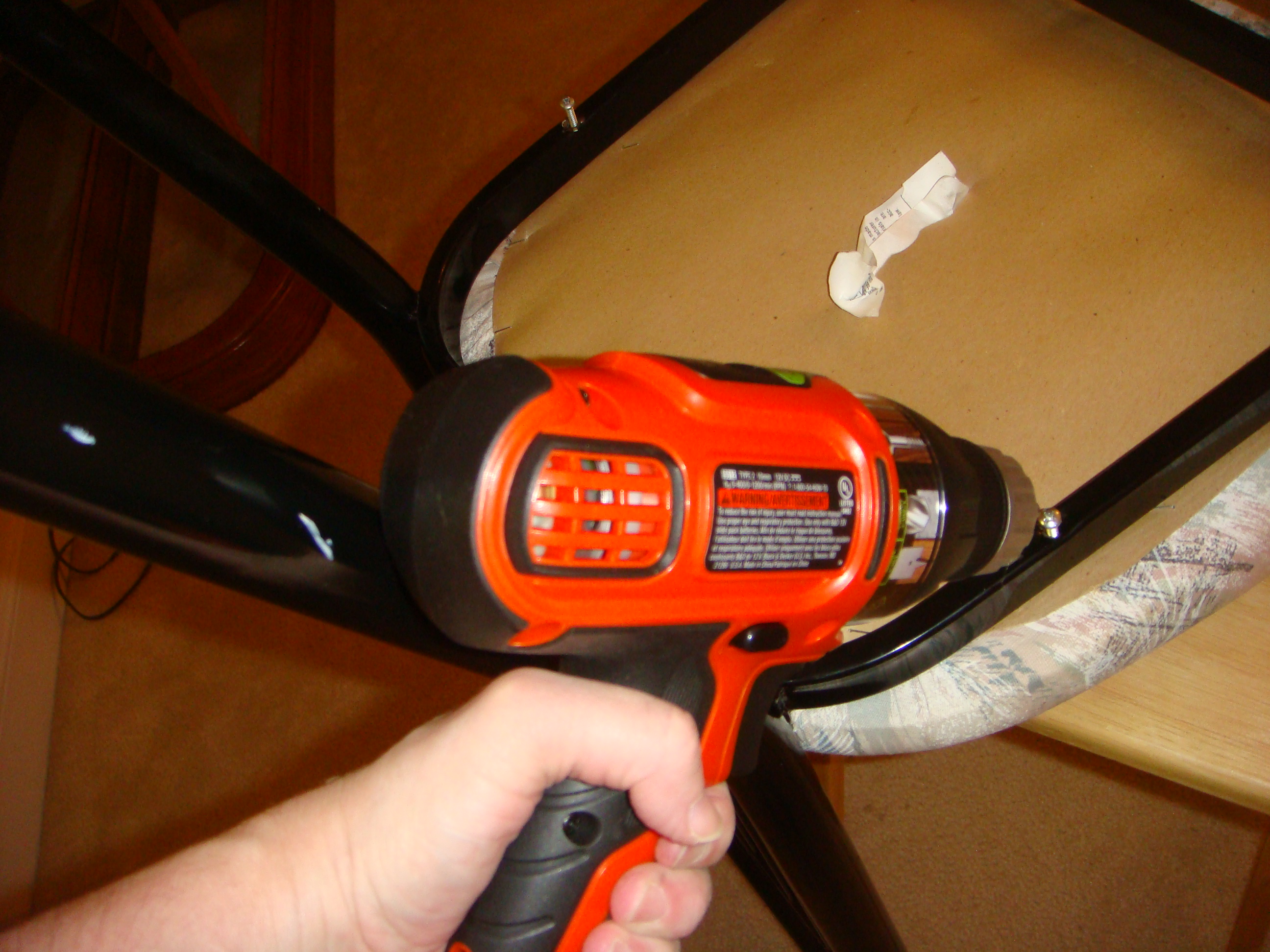
Next, I took the good cushion and fitted it to the good chair frame and discovered that, oh, making chairs is not an exact science and the holes in the cushion from one isn’t necessarily going to fit exactly in the frame of another. Okay. Time to rethink this. So I thought. I probably can just put new holes in the cushion, I realized. But that would be hard with a hand screwdriver. So I decided that it was time to take out the drill that I bought last summer and hadn’t yet used. I think it was summer. I have no idea. I just realized I should probably have a drill at some point, and I had a Home Depot card, so I bought one. Oh, and I never charged it. Which I discovered when I tried to use it. But that was after I had to figure out how to open the “chuck”, and after about five minutes’ hard work, realized that I was trying to turn it clockwise instead of counterclockwise. Figuring that out speeded up the process of removing the chuck and inserting the Phillips-head bit.

Now, I could take the drill and use it to make new holes in the good cushion. Well, except there wasn’t much of a charge, so it was a matter of plugging it in and waiting a minute or so, and then screwing in a screw and when the power drained waiting another minute or so.

Me using a drill

Oh, yeah. That’s a wooden tray table the chair is on. I don’t have a worktable. But it worked, so maybe it is a worktable.

Finally, my work is done. I have two good kitchen chairs now (one died a long time ago), and I’m hoping the two remaining chairs don’t collapse under any company. The cushion from the one in the garage collapsed under my niece while she was over for dinner, thankfully not causing any harm to her. But it was embarrassing. Oh. The good chair:

Finished chair!

Ta-dah! Meryl fixes a chair. Write this down in your diary, folks, because I think it may never happen again in your or my lifetimes.

Posted in Life | Comments Off on Meryl fixes a chair

HRW accuses Israel of rights violations without waiting for the IDF to submit its report

Really, could Human Rights Watch be any more obvious? They issued a report accusing Israel of violating the laws of war, yet they did not wait for the IDF report refuting the charges.

Human Rights Watch sent detailed information about the cases to the Israel Defense Forces (IDF) on January 14, 2013, requesting further information. At a meeting on January 24 and in subsequent phone conversations, the military spokesperson’s office told Human Rights Watch that the military chief of staff had ordered a general (aluf) to conduct an “operational debriefing” (tahkir mivtza’i) concerning “dozens” of Israeli attacks during the conflict, including the cases Human Rights Watch investigated, which would be completed by late February.

Because previous Israeli “operational debriefings” involving attacks were not conducted by trained military police investigators or dedicated to investigating alleged laws-of-war violations, Human Rights Watch has decided to publish its findings rather than wait for their results.

It’s like they’re not even pretending to be unbiased anymore. And here we also find how Israel’s military is held to the highest possible standards, while so many other nations apparently get a bye. Take a look at the incident below. There is no mention that hiding among civilians is in violation of the laws of war. But there sure are a lot of excuses for the collateral damage that occurs when a Hamas terrorist is killed hiding among them.

Several other strikes may have been targeting military objectives, but the harm to civilians and civilian objects appears disproportionate, Human Rights Watch said. The laws of war prohibit attacks in which the expected loss of civilian life and property exceeds the anticipated military gain.

An aerial bomb that may have targeted a member of Hamas’s armed wing on November 20 killed him but also destroyed his family’s house in Rafah, killed his 17-year-old brother, blinded their father’s wife, and wounded six of their siblings. A Hellfire missile strike that may have been targeting the home of a member of a Palestinian armed group killed at least three civilians and wounded at least 20 others, many of them outside on a crowded street. The alleged militant was not at home at the time.

They also title a section “Attacks with No Apparent Military Objective,” yet how would they know there was no military objective if they refuse to wait for the IDF report, and also discount the IDF investigation regardless?

This is a kangaroo court, in which Israel was tried, found guilty, and sentenced without any representation of the Israeli side.

Nice going, HRW.

By the way, I’m really glad I never contributed a dime to HRW in my younger, foolish, liberal days.

Footnote: Of course the AP is spreading this propaganda far and wide. Paragraphs five and six, which will be cut off in most World News sections of your local paper, are where the AP chooses to publish the other side of the story.

An Israeli military spokeswoman said the army “established an inquiry board” headed by a major general to look into the eight-day operation, including incidents raised by HRW. She said the board’s work hadn’t yet been completed.

“It is regrettable that the organization has opted to publish unverified claims,” the spokeswoman said. She could not be identified, citing military policy.

Just another day in anti-Israel land (a.k.a.: Real life).

Posted in Israeli Double Standard Time, Media Bias | Comments Off on HRW accuses Israel of rights violations without waiting for the IDF to submit its report

Wednesday Israel briefs

Kosher pigs are flying: The AP has an article about religious Israeli Jews that seems almost balanced. But don’t worry, their anti-Israel, pro-Palestinian bias remains strong (see below).

Funny, I never see this on the AP wire: Israel destroyed six homes built without permits, but nobody but the Israeli press seems to be noticing. That’s odd. Hm. Wonder why that is? Oh, right. They’re Jewish squatters, not Palestinian, so it’s not a human rights issue or anything.

Guilt by association: The AP doesn’t have Avigdor Lieberman to kick around anymore, since he resigned as Foreign Minister. But that’s not stopping them from slamming Netanyahu for Lieberman’s words. It’s more than a slam. They are drawing a clear line between what Lieberman says and what Netanyahu thinks.

A powerful partner of Israel’s prime minister says sanctions and negotiations will not stop Iran from pursuing its disputed nuclear program.

So this “partner” is so powerful that he’s no longer in the government, and yet, he controls what happens. Hey, that sounds just like what everyone says about Jews influencing, gee, America. Awesome! The AP has found a new level of anti-Semitism: Jews out of power influencing Jews in power! Woo!

Israeli Prime Minister Benjamin Netanyahu often hints about a possible strike on Iran’s nuclear facilities.

Lieberman stepped down from his post two months ago after he was indicted for breach of trust in a fraud and money-laundering case. But he remains a powerful lawmaker and Netanyahu’s top political ally.

Have I mentioned lately how much I loathe most of the AP writers and editors?

Posted in Israel, Media Bias | Comments Off on Wednesday Israel briefs

Tuesday briefs

How the Mossad killed Mughniyeh: The blow-by-blow on how the Mossad got the world’s most dangerous terrorist. And may I say, it couldn’t have happened to a more despicable man.

He’s not going by the narrative: Well, this is going to cause fits in the anti-Israel media. What? The scary religious party leader urges unity? I don’t know a lot about Israeli politics, but I do like seeing Naftali Bennett urge secular and Haredi Israelis to join together–and he calls serving in the military a mitzvah.

Stop confusing me, Mr. President: The itinerary for Obama’s Israel visit shows a lot of Israel and only a little “Palestine”. Let’s have no illusions: He can’t stand Netanyahu. But he’s probably finally realized that he can’t force the Israelis to do what he wants and dump Bibi. I’m reserving judgment until I see what he says and does during his trip.

After the fall: If Bashar al-Assad falls, Hamas and Hezbollah are already training militias to assure us that the fighting will continue until Syria is as broken as Libya. But don’t worry, it won’t cause the EU to declare Hezbollah a terrorist organization. Not blowing up Israelis in Bulgaria. Not building up its network in southern Lebanon again. Nothing will get them to do that, not even Hezbollah changing their name to “We are Hezbollah the Terrorist Organization”. (Oh, they’d find a way to say, “But they only target Jews Israelis” to excuse that last. Really, these are the people who said this:

EU counterterrorism official Gilles de Kerchove argued the day before the announcement that there “is no automatic listing just because you have been behind a terrorist attack… It’s not only the legal requirement that you have to take into consideration, it’s also a political assessment of the context and the timing.”

Right. It isn’t enough that you blow up Israeli civilians on a tourist bus. Your motives have to be understood first. It’s good to see that Europeans have learned their lesson from the Holocaust. Just ignore the terrorists murdering Jews, because you’re not Jewish. And… well, you know the rest.

Sarah Palin FTW: The layers and layers of fact-checkers, and the journalists who are SO much smarter than us, took a satirical piece from a parody site and tweeted that Sarah Palin was going to work for Al Jazeera. Click the link for the Palin tweets, they are comedy gold. My favorite is the one where she says she’s having coffee with Elvis.

Posted in Iran, Israel, Lebanon, Media Bias, Middle East, Politics, Syria, Terrorism, The One | 1 Comment

NY Times discovers women like to shoot

The New York Times has noticed that not all Second Amendment advocates are male.

In the debate over firearms regulations, the voices of gun owners have largely been those of men. But at firing ranges across the country, a growing number of women are learning to use firearms and honing their skills.

Women’s participation in shooting sports has surged over the last decade, increasing by 51.5 percent for target shooting from 2001 to 2011, to just over 5 million women, and by 41.8 percent for hunting, according to the National Sporting Goods Association.

And this woman is my new hero:

Advocates of tighter firearms regulations have argued in the past that advertising by gun manufacturers manipulates women into buying guns for protection. An advertisement by Colt in the 1990s showed a mother tucking a child into bed — “Self-protection is more than your right … it’s your responsibility,” the ad said — and academics argued in 1991 in The Whittier Law Review that such ads were intended to trick women.

But Ms. Tartaro bridles at the idea that women are not smart enough to decide for themselves whether to buy a gun. After the article appeared, her publication went on the counterattack, running a cover line that said, “Are You Too Stupid to Read This Magazine?”

Give her a Master of Juvenile Scorn™!

Posted in American Scene, Guns | Comments Off on NY Times discovers women like to shoot

Monday morning briefs

Think the AP will cover this? Egypt is pumping water into smuggling tunnels, without caring if there are people in them. Imagine the world outcry if Israel did this. Double standards? Yeah, we got that. Oh, and the AP thought it was much more important to cover the detainment of a Palestinian AP photographer than to cover this story.

Israel Derangement Syndrome starts early: I get a lot of Israel stories in my news feed, including from college newspapers. I challenge you to find the details of the headline in this Stanford story about a UN simulation in one of their classes. I couldn’t.

The headline: “Students debate Iran’s nuclear program in United Nations simulation.” The lead:

“As a permanent member of the United Nations Security Council [UNSC], the delegation of France formally requests that Israel join the [Nuclear Non-Proliferation Treaty],” the delegation chair of the French Republic said.

Gasps rose from delegates at the emergency UNSC session as the American delegation huddled urgently outside. Called to speak by the chair, the Americans rushed to the lectern as foreign delegates scrambled to find out exactly why the world’s western powers had demanded transparency from the Israeli nuclear program.

Yep. Teach ’em early that in a debate about whether or not a terror-sponsoring nation like Iran should get nuclear weapons, you immediately go on the offensive against–Israel. This is why the BDS movement is gaining traction on college campuses.

Don’t bend over backward or anything: This is what passes for an argument against anti-Semitism in the major Pakistani paper.

This silence in the Muslim world reflects the deep anti-Semitism rife in the Islamic world. To most Muslims, there is no difference between ‘Jew’, ‘Zionist’ and ‘Israeli’. This ignorance and prejudice is reinforced by the virtual absence of any personal contact between Muslims and Jews.

Wow, that looks about right. But wait, there’s more!

It is certainly true that the Palestinian conflict has fuelled the virulent anti-Semitism rife in the Muslim world today.

And yes, there’s more.

Israelis have long equated criticism of their country with anti-Semitism, seeking to use this ploy to silence its critics. Even Jewish detractors of Israel are subjected to this slur by the powerful Zionist lobby in the US. But by using shrill anti-Semitic rhetoric, Muslims have undercut their own credibility. Now, even rational criticism of Israel is ascribed to anti-Semitism. Ultimately, this has damaged the Palestinian cause.

Even Muslims writing about Muslim anti-Semitism can’t stop themselves from blaming Israel as the cause. Do us a favor: Don’t do us any favors.

No side boobs: The dress code memo for the Grammy awards was leaked. The memo is ignored every year. And yes, side boobs are really banned from the Grammys.

Posted in Anti-Semitism, Gaza, Israel Derangement Syndrome, Israeli Double Standard Time, Media Bias, Middle East, Music, Pop Culture | Comments Off on Monday morning briefs

Sunday briefs

The era of entitlement: A high school girl was removed from classes after violating the school’s policy on hair coloring (natural colors only). Her mother says that she refuses to change her daughter’s pink and purple hair and will be fighting the school. Parents sign a policy that includes dress code and hair coloring at the beginning of every year. This is what happens when you raise a generation that wins trophies just for showing up. Pick another school district if you want your daughter to keep her pinnk and purple hair, and get over it, you selfish, entitled person.

Oh, look. Obama is pivoting to the economy again: Not that I intend to watch the SOTU address, but Obama has realized that maybe things aren’t so hot out there for millions of Americans who were laid off and still can’t find work, or who were downsized to part-time and lost their benefits (present, and if you want to send people the link to my book so I can make a little extra money during these hard times, that would be lovely). So he’s going to talk about the economy and jobs. Is he going to do something about it, like, say, approve the Keystone Pipeline? Shyeah. Don’t hold your breath on that. He’s too busy making new regulations at a record pace, which is costing us three times as much to do business as, well, ever.

The Imperial Presidency: Obama thinks he can kill Americans without due process if he wants to.

Shocking, I know: Hamas and Fatah got together and didn’t come to an agreement. Again. Also, Hamas is blaming Abbas. Gee, after all those nice words were said in Egypt just last week. I’m so disappointed, aren’t you?

Israel puts Hezbollah on notice: Israel will attack Syria any time it thinks that game-changing weapons are heading to Lebanon. Makes sense to me. Weapons from Libya wound up in Mali and Yemen. Since the Obama administration is unwilling to make sure this doesn’t happen in Syria, Israel must protect itself.

Israel, he said, has defined four types of weapons whose transfer to militant groups would not be tolerated: advanced air defense systems, ballistic missiles, sophisticated shore-to-sea missiles and chemical weapons.

Israel has twice attacked Syria successfully without loss of any planes or men. Do I think this will stop Hezbollah from trying to get sophisticated weapons? Of course not. But I don’t think they’ll succeed in getting them from Syria.

Posted in American Scene, Hamas, Israel, palestinian politics, Syria, The One | Comments Off on Sunday briefs

Warm Bodies

Run, do not shuffle, to see Warm Bodies. It’s a zomromcom (zombie romantic comedy) that’s clever and funny and leaves you smiling at the end of the movie.

It’s a great date movie, guys, and you know what day is coming up next week….

Posted in Movies | 2 Comments

Well isn’t that interesting…

Update: The story is based on a joke that was not interpreted as such.

Chuck Hagel reportedly got funding from a group calling itself “Friends of Hamas“. Breitbart has apparently broken the story.

Wouldn’t that be illegal, as Hamas is a terrorist organization?

Posted in Israel, Politics, Terrorism | Comments Off on Well isn’t that interesting…