
George W. Bush’s Clintonian diplomacy

He hasn’t invited Yasser Arafat to the White House, but you could pretty much substitute any major Clinton speech on Israel and the Palestinians for the speech W. gave yesterday.

In addition to these three tracks, both sides are getting down to the business of negotiating. I called upon both leaders to make sure their teams negotiate seriously, starting right now. I strongly supported the decision of the two leaders to continue their regular summit meetings, because they are the ones who can, and must, and — I am convinced — will lead.

Mahmoud Abbas and Ehud Olmert are the weakest leaders in their respective people’s histories, bar none. But then, Bush is one of the weakest leaders we’ve had since Jimmy Carter.

I share with these two leaders the vision of two democratic states, Israel and Palestine, living side by side in peace and security. Both of these leaders believe that the outcome is in the interest of their peoples and are determined to arrive at a negotiated solution to achieve it.

Yes. Abbas is of the school that thinks in terms of the two-stage Palestinian state. The first stage is the West Bank, Jerusalem, and Gaza. The second stage is the destruction of the Jews on the remaining portions of “Palestine.” If you don’t believe me, try to find a map of “Palestine” on any Palestinian website that shows Israel.

The point of departure for permanent status negotiations to realize this vision seems clear: There should be an end to the occupation that began in 1967. The agreement must establish Palestine as a homeland for the Palestinian people, just as Israel is a homeland for the Jewish people. These negotiations must ensure that Israel has secure, recognized, and defensible borders. And they must ensure that the state of Palestine is viable, contiguous, sovereign, and independent.

George W. Bush was the first U.S. President to declare his hope for the establishment of a Palestinian state in a major speech. Now he’s the first U.S. President who, while still in office, decries the Israeli “occupation.” The problem, you see, is Israeli occupation. It isn’t Palestinian terror. And yet, on the day W. gave this speech, more kassams were fired at Israel.

The day before, W. invoked the “right of return,” the phrase that the Palestinians used to co-opt Israel’s Law of Return, and which is code for the destruction of the Jewish character of Israel. The “right of return” is a dealbreaker.

Bush said he was the only US president to articulate a two-state solution. But, he added, “Saying two states really doesn’t have much bearing until borders are defined, right of return issues resolved, Jerusalem is understood, security measures – the common security measures will be in place. That’s what I’m talking about. I’m talking about a clear, defined state around which people can rally.”

It’s funny how people constantly talk about the Palestinian refugees, yet no one ever mentions the 700,000 Jews who were driven out of the Arab and Muslim states after 1948. The Iranians brag—and the wire services repeat their propaganda—of having the largest Jewish community in the Middle East. They never seem to mention that the Jewish community of Iran was about three or four times larger in 1979, the year the Islamists took power. Iranian Jews would likely leave Iran today if they could. But they can’t, not without losing all of their property.

Bush, who spoke beneath a portrait of Arafat, also stressed the importance of establishing a contiguous Palestinian state.

Uh-huh. There were no American flags in sight in Ramallah today. But there were plenty of pictures of the biggest mass-murderer of Jews since Hitler.

Although Bush was only a few meters away from Yasser Arafat’s mausoleum, he did not stop at the site – much to the dismay of some PA leaders. But portraits of Arafat were visible almost everywhere in the Mukata.

A source in Abbas’s office said the portraits were intended to deliver a protest against Bush’s refusal to pay respect to the former PA leader.

The source said the PA did not hang US flags in the city to avoid “provoking” residents.

If a U.S. flag “provokes” the Palestinians, they are not our friends. They are not our allies. And Abbas—well, listen to the snake oil salesman:

“We hope the talks [with Israel] would lead to ending the occupation and the establishment of a Palestinian state in accordance with President Bush’s vision,” he added. “Peace in the world starts from the Holy Land.”

So, peace in Israel is going to stop Muslims in Thailand from beheading schoolchildren? Ya think? It will stop the conflict in Sudan? And the Phillippines? All over the world, jihadis are going to stop what they’re doing because Palestine comes into existence?

I think not.

As for those peaceful Palestinians, well, read on:

Unprecedented security measures forced many here to remain indoors, turning Ramallah into a ghost town.

[…] During the press conference, PA policemen used clubs and tear gas to disperse hundreds of demonstrators who took to the streets to protest against Bush’s visit.

Yep. They totally “deserve” a state. Because they already know how to run one. Well, no, think about it—they do know how to run an Arab state. “Palestine” won’t be much different from any of the others. Corrupt leadership, graft, theft, honor killings, jihadis, oppression of women and non-Muslims—yep, it’ll be just another Arab state in the Middle East. On Israel’s borders.

I think the best thing to come out of this ridiculous trip is that I think neither Bush nor Olmert are strong enough to get anything past their respective governments on the Palestinian state. The minute Olmert gets serious about dividing Jerusalem, the government falls.

We should have known that the apple doesn’t fall far from the tree. The George Bush administration was the worst for Israel since Carter. W. is obviously following in his father’s footsteps. And he’s doing it in a Clintonian way. Genius.
Posted in Israel, palestinian politics | 2 Comments

Not a good month for fluffy orange cats

Lair Simon lost Frisky.

My condolences, Lair.

Posted in Cats | 1 Comment

Tigger’s farewell tour

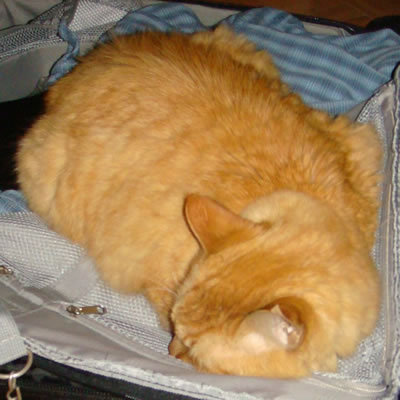
Tig in suitcaseThe vet wanted another bunch of bloodwork from Tig this week. In spite of the fact that Tig looks better than he has since he was first diagnosed with renal failure, and in spite of the fact that Tig is acting better than he has since he was first diagnosed with renal failure, the bloodwork keeps coming back worse and worse. The vet says it’s bizarre that Tig is acting like he’s feeling so well when he is getting sicker and sicker by the day. So I am forced to believe that Tig’s remaining time with me is not going to be very long.

Today, I took home a bag of fluid to be administered subcutaneously every other day. Sarah‘s going to try to help me with the first one. I’ll do the scruffing, she’ll do the needle-sticking. Tig will do the hissing, no doubt, and the growling.

He’s not quite eleven. He and Gracie were born around March 15. They were part of two litters of ten-day-old kittens that were dumped at a shelter in a town in NJ, where I was living at the time. I had lost my original Tigger in January, and was obsessed with getting another orange cat. My downstairs neighbor’s daughter was a vet’s assistant at one of the local clinics that fostered the kittens. I had told everyone I knew that I wanted another orange cat to replace The Tig. He was such a great cat that yes, he had a title. My friends would ask me, “How’s the Tig?” during casual conversations. Tigger the Second had big, big paws to fill.

I met him on Easter Sunday, 1997, when my neighbor’s daughter brought Tig and Gracie over to meet me. With Tig, it was love at first sight. And as he grew, I fell more and more in love with him. I loved his long fur, and his great big paws, and his goofy charm. I loved his deep, loud, frequent purrs. I loved the way he had to always be near me, and follow me around the house. He made me laugh, always. As he got older, I started noticing that he looked an awfully lot like a Maine Coon cat. I’d always wanted one of those, but was never willing to pay $500 for a kitten. One afternoon, I chatted with a woman manning a table asking for donations for a local animal shelter. We started talking cats, and I started talking about how Tig hugs me, and how he won’t sit on my lap, but sort of would climb on my torso and roll down until he was lying upside down in my lap. Or he’d sit next to me on the sofa or on the arm of the chair, but never on my lap. Hers too, she told me, and hers was a Maine Coon. So I started looking at pictures online. Tufts of hair on the ears, check. Hair between his toes, check. Big, ringed, fluffy tail—markings, fur, check, check, check. I had, after all those years of wanting, a Maine Coon cat.

Tig is my great big goofball. I taught him how to stand up on command. I’ve never had a cat that would do that. He can still do it, sick as he is. He has never, ever failed to make me laugh or smile on a daily basis. Just this past Tuesday, I packed most of my clothes for a two-day business trip to Northern VA, then went downstairs to eat breakfast. Tig was sound asleep in his box when I left the room. I heard some strange noises from upstairs but didn’t have time to do more than wonder what he was doing. The picture above is what he was doing. Making me laugh, just by sleeping.

Tig used to sleep next to me every single night. On many nights, I wished he wouldn’t, because he also used to yowl in my ear at 3 a.m. when he was bored and wanted me to wake up and pet him. I once woke up and found four or five of his toys scattered around my hand. He’d dropped them near me while I was sleeping and waited for me to wake up and throw them. Lately, though, Tig avoids the bedroom. Something about it frightened him, and he stopped sleeping in the bed for a long, long time. That didn’t stop him from standing next to it at four a.m., yowling for me to get up and pet him. It’s gotten worse now, though. The second he sets foot in my room he starts licking himself compulsively. The last time he came in, he ran to the window. I opened the closet door and he dashed inside. I don’t know what it is about my room that scares him, but I do know that I miss having him on the pillow next to mine, purring himself to sleep. Or asking for a bellyrub last thing at night. He doesn’t want bellyrubs any more. He doesn’t lie on his back any more. And his belly, well, it’s not really there. Last time he got a bellyrub, I could feel his ribs. Now, Tig sleeps in a box in my office. I found him in it a week or so ago, and took it down from a pile of boxes so that he wouldn’t have to work too hard to get to it. And I filled it with towels. I check it first thing every morning, and last thing every night. Last week, when it was very cold out, I had a scare: I reached in to pet Tig, and he was cold to the touch, and he wouldn’t wake. It was just his fur in the cooler air of winter, and the lethargy from kidney disease, but I thought he was gone.

He’s going to be gone one day, and I’m afraid it’s going to be sooner rather than later. I hope he just passes in his sleep, frankly. I’ve already decided that I’m paying the extra for a housecall from the vet if it’s needed. I will not put him in the carrier that one last time. When he goes, he’s going here, preferably in my arms.

I do think there’s something for us after we’re gone. I really hope that our cats go wherever we go. I’ll be just fine with both Tigs, and all the other cats in my life.

But I wish I didn’t have to say goodbye to Tig this year. Really. I was hoping for another five years.

I am really going to miss my goofball.

Posted in Cats | 17 Comments

Thailand giving Hizbollah-TV a wider reach

Say thanks to the good folks at THAICOM, a satellite company in Thailand, who have picked up the Hizbollah propaganda station, Al-Manar.

THAICOM, a private satellite company in Thailand, has begun airing the broadcasts of Hizbullah’s Al-Manar TV. The satellite covers Asia, Australia, Africa, the Middle East, and most of Europe.

The Thai satellite has significantly boosted the resonance of Al-Manar’s propaganda messages around the world, said the Intelligence and Terrorism Information Center (ITIC) in Herzliya, Israel. “This is an outrage,” said ITIC head, Dr. Reuven Erlich. “Other satellites have stopped airing Al-Manar, so Hizbullah has found a way round it.”

Approached by The Media Line THAICOM said it is considering its response and will only offer a formal reaction over the weekend. However, company sources said the decision to transmit Al-Manar broadcasts was a “purely business decision, which had nothing to do with politics.”

THAICOM considers Al-Manar programming as “news and entertainment,” the sources said.

Sure. News and entertainment, with a terrorist, anti-Israel, anti-Semitic, anti-American theme. And oh yeah, the Islamist point of view.

“It’s a war. Al-Manar is Hizbullah’s main communication tool, through which it spreads anti-Israeli, anti-Semitic, and anti-American incitement. It spreads Hizbullah and Iranian values of radical Islam,” Erlich explained. He added that the fact that Al-Manar can now be seen in south-east Asia, means that Indonesia and Malaysia, two countries with a large Muslim population, are open to its messages of hatred.

In the past few years since the European satellites stopped airing Al-Manar, the station could only be seen via two Arab satellites: Nilesat and Arabsat. The former is an Egyptian-owned satellite, which broadcasts to the Middle East, North Africa, and a few countries in southern Europe. The latter is a pan-Arab satellite, with approximately the same reach.

It is a war. It’s a propaganda war. And we just lost a major battle to the Islamists.

Posted in Iran, Lebanon, Terrorism | 1 Comment

Shavit’s prescription

One of the most consistently interesting Israeli columnists, is Ari Shavit from Ha’aretz. Though a member of the Left and of the peace camp, he has consistently demonstrated an intellectual honest that makes him readable even if I don’t agree with everything he writes. But today’s “On a Divine Mission” is just about perfect. At first he sounds a bit condescending.

The man standing at the window this morning is a very lonely man. He is vilified in his own country and almost a leper in the international community. The America that he tried to save has turned against him, and the West that he wanted to defend is dismissive of him.

But Shavit comes back by dismissing that superficial judgment.

But George W. Bush is not deterred, nor does he bend to public opinion, to the media and to trendy thinging.Unlike some of his friends, he is not an opportunist who changes his stripes. He conducts his dialogue with history and with God. And since he is a man of moral clarity and simple principles and character, he does not tend to give in. Even when the current turns against him he remains faithful to his truth.

What must President Bush do?

The right formula is the Bush vision. To act with determination in order to create Palestinian capability before precisely defining the borders of the Palestinian territory. To promote Paris before devoting ourselves to Annapolis. To help the Palestinians bring about their conversion rather than pretending that the conversion has already taken place. In short: to return to George W. Bush’s fundamental truths.

The contrast between Shavit’s reading of the president and Bush recall 1998 trip to Israel by Michael Abramowitz in the Washington Post is stark.

Those close to Bush believe the trip made a very strong impression on the future president and would bond him to the future Israeli prime minister — and, in the view of Bush’s critics, would ultimately tilt the United States away from its role as a more independent broker of Middle East peace.

The Washington Post article portrays an easily convinced rube. The notion that Israel has legitimate security concerns is negated by the unchallenged comments of unspecified critics of the president.

Still it appears that the President is ignoring Shavit’s advice and pushing for a Palestinian state ready or not. Still that hasn’t exactly made him popular among the Palestinians.

Jericho, a relatively tranquil town of about 25,000 Palestinians north of the Dead Sea, was on the short list of West Bank Palestinian Authority destinations for the presidential visit, with Bethlehem and Ramallah, the site of the Palestinian authority headquarters. The governor of Jericho, Arif Jaabari, said that American security and diplomatic staff had been to his compound twice and checked the area where Yasir Arafat’s helicopter used to land.But Jericho was not included in the president’s final schedule, causing little disappointment among residents. “He’s the worst, Bush,” said a 64-year-old man who identified himself only by his nickname, Abu Muhammad. “He supports Israel and mocks and deceives us.”

What’s remarkable is how much aid – financial and political – the United States has given the Palestinians during the Bush administration and how little these contributions have helped. They haven’t made the Palestinians more receptive to Israel or even to fulfilling American conditions. Still the president pushes for them to have a state. And they keep demonizing him.

Crossposted on Soccer Dad.

Posted in Israel | 1 Comment

Crossdressing Clifford

children-misc-009.jpg

My six year old decided to dress Clifford up.

In a skirt and blouse.

Who knew?

Maybe he found Emily Elizabeth’s clothes.

Maybe it’s a John Ritter thing.

Crossdressedposted at Soccer Dad.

Posted in Humor, Pop Culture | Comments Off on Crossdressing Clifford

Hard at work

Sorry for the absence today, but I was at Company in Northern VA, training on a program that I now have to document. Busy day yesterday, busy day today, and a two-hour drive both times. Well, a shorter drive back as there weren’t two accidents on 95 on the way home. Just the usual slowdowns.

I am tired, though. I was up very early this morning. So you’ll have to wait for my outrage at Condi Rice’s statements that Israel has no right to Jerusalem suburbs, or that George W. Bush has the nerve to think that the “right of return” must be granted to the Palestinians. Nice to see that State and the Prez are getting together to mug the Palestinians, even as missiles are falling on Sderot and just missing infants in their beds.

Meanwhile, in the West Bank, where PA security insists that they have everything under control, terrorists are tossing molotov cocktails at Israeli cars. Yep. They’re in control, and the Pals want peace. In Bizarro World, anyway.

Posted in Israel, Terrorism | Comments Off on Hard at work

4 + 1 on President Bush in the Middle East

Bush’s last year: The best, one hopes, is yet to come by Barry Rubin

The gap between the real Middle East and how it is perceived by all too many people in Washington and in the academic-journalistic elite is far too wide.Three quick examples are useful to underline this point. First, the Annapolis summit was widely hailed throughout America and the West as a big success, even by Bush’s biggest enemies. (That means, of course, it achieved the main goal, which was not primarily about the Middle East itself.) In the region, however, less than one-fifth of Israelis and Palestinians thought it had done any good. People in the region knew better.

Second, many in the United States have hailed what seems to be a de-escalation of U.S. pressure on Iran over the nuclear issue. The response by Gulf Arab states, though, has been to conclude America is weak and retreating, followed by their escalated efforts to make their own appeasement deal with Tehran.

Third, the same is true for Syria, where American efforts at conciliation have emboldened Damascus and demoralized the Lebanese moderates resisting Syrian domination.

One can only hope that Bush and his administration consider the effect of what it does on the Middle East.

The Bush Visit and Tensions in the U.S.-Israel Relationship by Gerald Steinberg

* The December “surprise” resulting from the publication of the U.S. National Intelligence Estimate disrupted fifteen years of Israeli policy based on working with the international coalition to pressure Iran to drop its nuclear weapons program through sanctions and the threat of military action, and has reminded Israelis of the limits of American security guarantees and strategic cooperation.
* Within two weeks following publication of the NIE report, China signed a major contract on energy development and supply with Iran, and Russia quickly dispatched two shipments of nuclear fuel for the Bushehr nuclear reactor. Egypt moved to improve relations with Iran, and Saudi Arabia welcomed Iranian President Ahmadinejad to Mecca for the Haj.
* Prime Minister Olmert had explained the logic of the “Annapolis process” in terms of the coalition to stop Iran, but two weeks after Annapolis, with the release of the NIE report, this rationale has lost much of its relevance.
* Another source of stress comes from differences over renewed U.S. efforts to forge a quick agreement with the Palestinian Authority at a time of continued terrorism, the violent conflict between Fatah and Hamas, the failure to develop functioning Palestinian institutions, and the PA’s ongoing incitement and rejection of the legitimacy of a Jewish state.
* In addition, the overall decline of U.S. influence, as reflected in Iraq, the return of Russia as a world power, the chaos in Pakistan, and other developments, has highlighted the limits of Israeli reliance on American assistance, and the need for Israel to maintain an independent capability to act when necessary.

Bush of Arabia by Fouad Ajami

Suffice it for them that George W. Bush was at the helm of the dominant imperial power when the world of Islam and of the Arabs was in the wind, played upon by ruinous temptations, and when the regimes in the saddle were ducking for cover, and the broad middle classes in the Arab world were in the grip of historical denial of what their radical children had wrought. His was the gift of moral and political clarity.In America and elsewhere, those given reprieve by that clarity, and single-mindedness, have been taking this protection while complaining all the same of his zeal and solitude. In his stoic acceptance of the burdens after 9/11, we were offered a reminder of how nations shelter behind leaders willing to take on great challenges.

We scoffed, in polite, jaded company when George W. Bush spoke of the “axis of evil” several years back. The people he now journeys amidst didn’t: It is precisely through those categories of good and evil that they describe their world, and their condition. Mr. Bush could not redeem the modern culture of the Arabs, and of Islam, but he held the line when it truly mattered. He gave them a chance to reclaim their world from zealots and enemies of order who would have otherwise run away with it.

Mr. Bush in the Middle East – the Washington Post

The patrol boat incident was part of a confusing mix of signals from Iran, where Mr. Ahmadinejad’s hard-line position may be weakening even as Iranian-sponsored violence against American forces in Iraq has diminished. Mr. Bush’s confrontational regional strategy may make it difficult to exploit these conditions. That’s one reason the president would be better off to return to the themes of Middle East policy he pursued before last year: the stabilization of Iraq and the promotion of democratic reforms. The focus on Iran and the peace process has stripped energy and attention from these causes; Saudi Arabia and Egypt have been allowed to continue boycotting the Iraqi government and jailing their own proponents of liberalization. Iraq’s own political leaders still dither on desperately needed political accords. There is speculation that Mr. Bush will make a surprise stop in Baghdad; whether or not he does, the stabilization of Iraq should be his top Middle East priority during his last year in office.

These four views on the President’s trip to the Middle East highlight certain differences in perception but seem to have a common theme: The President was correct to emphasize democratization and would be stronger if he continued his policy of confronting Islamic extremism.

Steinberg’s analysis doesn’t quite say that, but laments its absence especially as evidenced by the NIE that played down the Iranian threat.

Steinberg’s essay is echoed in a recent report from the Washington Post.

But some Arabs suspect the Bush administration may decide it has to work with Iran to preserve security gains in Iraq. Khalid al-Dakheel, a political scientist at King Saud University in Riyadh, said “some people here think, or have the jitters, that this administration or the next administration . . . might find themselves in a position to reconcile themselves with the Iranians.”

While there’s a lot of tendentiousness in the article, casting President Bush in the worst possible light, what comes out is concern among the Arab world that the United States isn’t committed to facing down the Iranians.

Ajami credits the president with changing the nature of the Arab/Islamic world. Perhaps he overstates the case with the recent accommodation seen among Egypt, Saudi Arabia, Hamas and Iran. Still he correctly credits the president for trying to show that the Israeli-Palestinian is not the central issue in the Middle East as the Arab world claims. (Or at least he did until now.)

Rubin seems consistent with Ajami, at least in terms of what President Bush needs to do. However Rubin isn’t nearly as positive about the current situation as Ajami.

Even the Washington Post which is congenitally condemned to bring up “illegal settlements” at every turn concedes that stabilizing Iraq is a more important goal than Arab-Israeli peace.

While these others have analyzed President Bush’s actions, Fiery Spirited Zionist as analyzed his words and found them wanting. It’s well worth reading.

Crossposted on Soccer Dad.

Posted in Israel, Politics | Comments Off on 4 + 1 on President Bush in the Middle East

No gaza = more terror

I generally like Max Boot. (In fact I even have relatives who like reading him.)However his take on the withdrawal from Gaza, More on the decline of Terror is mistaken for a number of reasons. Boot writes:

I wrote in this Los Angeles Times op-ed in August 2005 that the withdrawal was the right move even though it would undoubtedly turn Gaza into a “Hamastan.” I argued that the evacuation would regain the initiative, strategically and morally, for the Jewish state, and that Israel would actually be more free to respond to terrorism from Gaza if it were no longer under “occupation” but the territory of a sovereign state.

But by withdrawing Israel allowed a terror infrastructure to develop. Last week we saw an escalation in the technology used against Israel. And as Backspin noted, the moral initiative was rather fleeting.

Hebrew University researchers studying thousands of news articles found that Israel’s image in the MSM deteriorated after the Gaza disengagement.

Remember how the World Bank blamed Israel for closing Gaza and further hurting the Palestinian economy?

Boot writes further:

The growing number of rocket attacks from Gaza into southern Israel has led me recently to start wondering whether I was wrong. But the figures Hazony cites suggest that the rockets are much less deadly than the suicide bombers of old. Moreover, Israel is starting to respond more effectively to those provocations, with, for instance, targeted strikes on terrorist masterminds.

Until now, the rockets have been less deadly than suicide bombers. But given the porous border with Egypt the possibility of an escalation of rockets is a frightening possibility.

I also figure that another thing that has helped Israel is that in the wake of the 2006 war in the north, Israel’s defense minister has been replaced with someone who, despite his limitations as a politician, knows how to operate an army.

If Israel still had a military presence in Gaza those targeted strikes would be easier and the infrastructure could have been disrupted. Rather the terror infrastructure has been able to grow due to a lack of an Israeli military presence.

Think back to the terror attacks of early 1996. What led to that escalation? Israeli withdrew from 6 Palestinians cities in late 1995 and when the PA took over it gave Hamas a free hand.

Even last year’s war with Hezbollah could be attributed to the 2000 withdrawal from Lebanon.

Seraphic Secret quotes Israeli Nobel Laureate Prof Aumann

“The expulsion of Jews from Gaza was stupid, venal, and barbaric. The expulsion of Jews from Gaza led directly to the war with Hizbullah, and now to the rain of missiles on S’derot.”

(read the whole thing, of course.)The decline in terror is due to factors other than the withdrawal from Gaza, which only encouraged terror.

Crossposted on Soccer Dad.

Posted in Israel, Terrorism | Comments Off on No gaza = more terror

That political money

This was one surprising message:

An Israeli Arab anti-Zionist group is calling for the boycott of Jewish agencies looking to contribute to Israeli Arab communities in Israel.

The agencies, united under the rubric of the Inter-Agency Task Force on Israeli Arab Issues, are in Israel on a three-day trip to study needs and opportunities for philanthropy in Israeli Arab communities in the Galilee and among Negev Beduins.

So, here are some Jews who have decided to contribute to the well-being of the Israeli Arab community, and what do you know? The money smells wrong to some people.

As a blogger who contributed his puny voice in the aftermath of the second Lebanon war, protesting against some fellow Jews who objected to the emergency aid from UJC and other US Jewish agencies going to the Arab population of Israel, I am quite discombobulated by this strange turn of events.

Of course, the first impulse would be to say “do you know what, dear Makhoul – if you don’t want the money – go climb a tree” (I am being tongue-tied on this blog by the restrictions put on me by the owner).

But, upon second thought – dear Makhoul, just pass the money to me. My sense of smell is not what it used to be, so…

Cross-posted on SimplyJews.

Posted in Israel, Israel Derangement Syndrome | Comments Off on That political money

Insecure security

I wondered how secure the President’s security detail felt with the Palestinain police and who knows how many other “security” organizations in charge of making Ramallah safe. (Shira bat Sarah wondered too.)

Well apparently, the Secret Service felt that the Palestinians needed some help.

US snipers will take up positions on rooftops and local traffic will be barred from some downtown districts as part of unprecedented security precautions during US President George W. Bush’s visit this week, Palestinian security officials said Tuesday. 

Bush is expected to travel to Palestinian President Mahmoud Abbas’ Ramallah headquarters, known in Arabic as the muqaata, by helicopter on Thursday.


Apparently not even a number of show arrests alleviated American anxiety over the state of Palestinian security.

Nine top Fatah gunmen from Nablus on Tuesday surrendered their weapons to the Palestinian Authority security forces out of fear of being targeted by Israel.


And it is the PA security forces that Israel will once again be asked to trust its own security to, even though they can’t even secure a single building in advance of the President’s visit.

Crossposted on Soccer Dad.

Posted in Israel | Comments Off on Insecure security

Well intentioned damage

At the end of 1998, then-President Clinton visited Gaza to oversee the fictional revocation of the clauses in the Palestinian Charter that call for the destruction of Israel. It’s not surprising that on the eve of President Bush’s to the Middle East some people recall his predecessor’s trip a little more than nine years ago.

Clinton, who felt (and probably still feels) everyone’s pain and he didn’t miss an opportunity when he visited the Middle East to commiserate. The International Herald Tribune recounts:

Nihad Zakout was 11 when she met Clinton in 1998. She was one of four Palestinian youngsters with fathers in Israeli jails who had been selected to deliver a plea to the U.S. leader to seek the release of Palestinian prisoners, one of the most emotionally charged issues in the conflict. 

Today, Zakout is a cynical 20-year-old, deeply disappointed in the U.S. as her father remains locked up… She says she has few expectations of Bush.

“There is nothing he can do,” she said.

A day after meeting Zakout and the other Palestinians, Clinton also met with young Israelis whose fathers had been killed by Palestinians.

Clinton said at the time that both groups of children brought tears to his eyes, and that “we have to find a way for both sets of children to get their lives back and to go forward.”


I edited something out of the quoted article. The full sentence should read “Today, Zakout is a cynical 20-year-old, deeply disappointed in the U.S. as her father remains locked up for killing an Israeli.”

It’s bad enough that the reporters consider the jailing of convicted murderers as an “emotionally charged issue.” How is it for the other side? If Zakout’s father was released, how would the relatives of his victim feel? That’s not explored.

But the then-president of the United States equated a child of a murderer with the children of murder victims! “Get their lives back?” Again, what about the victim of Zakout’s father? Would he ever get his life back?

At the Spine Martin Peretz (or, if Bloglines is correct, James Kirchik) writes

And the fact is that most Israelis knew Bill Clinton as a lover — but as an unfaithful lover. They go back in memory to the fall of 2000 when Clinton steamrolled Ehud Barak into concessions that were unwise and perilous but nonetheless did not entice Arafat into a deal but into starting the Second Intifada. Since I’ve been here I’ve spoken with three top security veterans who actually were terrified that, if Hillary were president, she’d send her husband as a mediator in the Israel-Palestinian conflict where, at best, he’d do well-intentioned damage.


When, in the name of peace, you conflate the murderers with their victims, there is no surer way to inflict well intentioned damage.

Crossposted at Soccer Dad.

Posted in Israel | Comments Off on Well intentioned damage

Psst, buddy want a tip

Israel’s economic classification is due to change this year and is expected to be included as a developed market rather than an emerging market.

Times Online writes:

“British investors have tended to ignore Israel, but its stock market will be thrust into the limelight this year when it is promoted from emerging to developed market status.” This is referring to the fact that Israel is up for OECD membership, and if accepted — and it looks like it will happen — Israel will join the prestigious organization and be considered a “developed country.”


BloggingStocks notes
:

Some pundits have argued that admission into the OECD will actually hurt Israeli stocks as Israel is about 2% of the MSCI Emerging Markets Index, and its share in the global investment pie would fall to 0.2% if Israel is admitted to the developed markets index. What they neglect to mention is that there is a heck of a lot more money under management in developed markets than in emerging markets. So Israel’s weighting may drop, but the amount of money available to invest will be substantially more.

Despite the conflict Israel’s economy continues to boom.

Crossposted on Soccer Dad.

Posted in Israel | Comments Off on Psst, buddy want a tip

Al-Qaeda cash problem

Al-Qaeda finances seem to be in disarray, according to this:

Al-Qaida video messages of Osama bin Laden and Ayman al-Zawahri can now be downloaded to cell phones, the terror network announced as part of its attempts to extend its influence.

Influence – shminfluence, come on, folks, let’s not mince the words. If you are using that Adam Gadahn creep as your chief salesman (when it is widely known that the only sale he made in his life was his candidacy for the Al Qaeda spokesman job), your cash situation is not good, let’s be straight about this, at least.

And selling clips of the poorly staged speeches by your various cave dwellers can never compete with such luminaries of freedom as Laure Manaudou, Noelia, Pamela Anderson and many others. So keep dreaming.

On the other hand, a free clip of Abu Musab al-Zarqawi’s last 30 seconds, accompanied by some easy elevator music… Hmmm…. let me think about it…

Cross-posted on SimplyJews.

Posted in Juvenile Scorn, Terrorism | Comments Off on Al-Qaeda cash problem

Way to go, UNIFIL! Hezbollah is even stronger than before

Thanks, UN! Thanks, EU! Thanks, America! Thanks, Olmert! All of you together have managed to make a deadly army of terrorists even more deadly than they were before.

Defense Minister Ehud Barak said Monday that Hizbullah has improved its capabilities by acquiring higher-quality rockets with longer ranges than those fired in the Second Lebanon War. He spoke during a meeting of the Council for Peace and Security in Tel Aviv.

During his remarks, Barak said that Hizbullah’s rocket inventory had grown by a large margin from its size before the previous war and currently includes upgraded rockets capable of reaching further distances. He added that Hizbuallah seems to be operating north of the Litani River and has fortified its positions through the use of “nature reserves” – a euphemism for military bunkers.

According to Barak’s gloomy portrayal, there is a currently free passage of arms between Syria and Lebanon.

But–but–how can that be? Hafez Assad wants peace! Senators and Congresspeople have told us so!

You don’t suppose they could have been snookered by the Dorktator, do you?

Shyeah. Now that’s sad.

Posted in Lebanon, Syria | Comments Off on Way to go, UNIFIL! Hezbollah is even stronger than before